Walking School Bus: How to Start One on Your Street
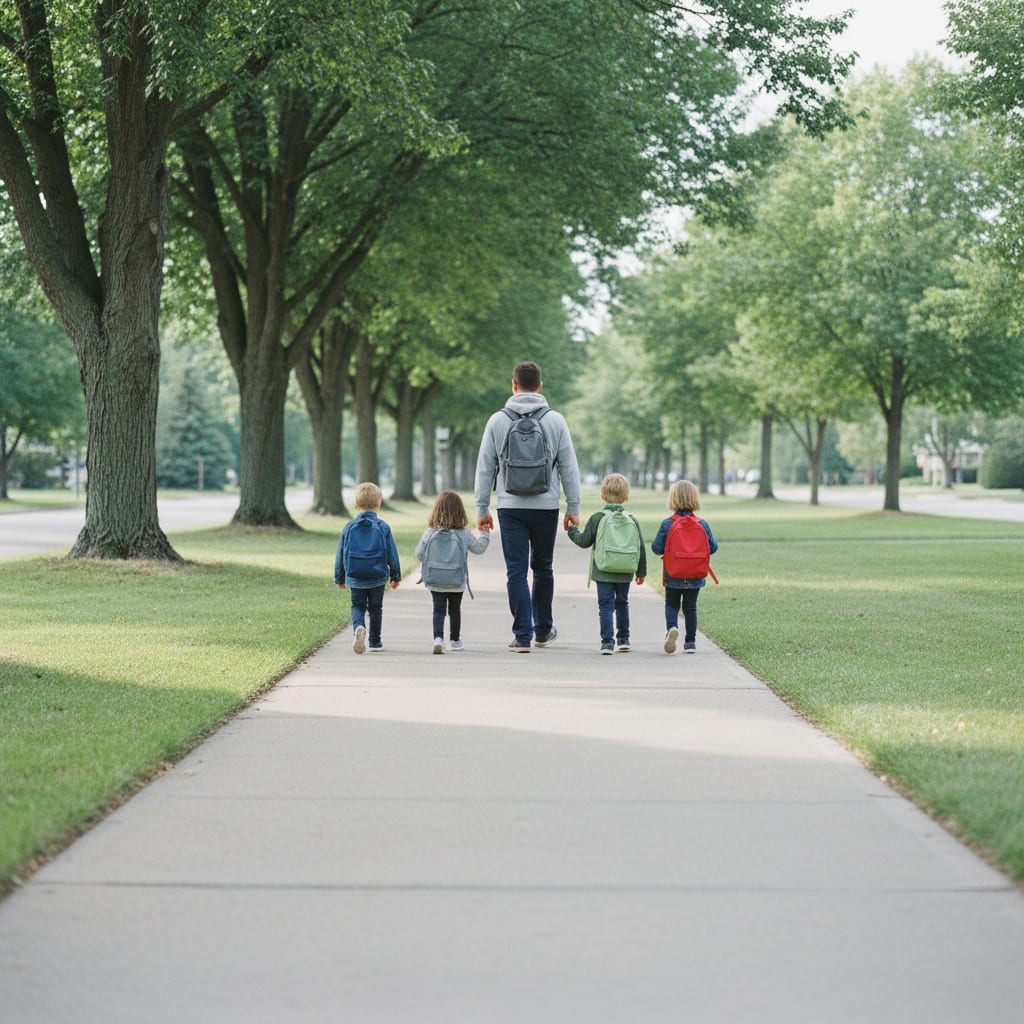
A walking school bus is a group of children walking to school with one or more adults, on a set route, picking kids up at named stops along the way. To start one on your street, you need four families, a route that adults have walked and tested, a list of stops with pickup times, a weekly rota of adult “drivers,” and a plan for rain and no-shows. Check with the school before the first walk, start small, and run it like a bus timetable: same stops, same times, a headcount at every crossing.
Is this worth it for your street?
The American Academy of Pediatrics suggests it directly: in neighborhoods with more traffic, consider organizing a “walking school bus,” in which an adult accompanies a group of neighborhood children walking to school. The same AAP page says children are generally ready to start walking to school without an adult at 9 to 11 years old, so for most elementary families, the choice isn’t walking alone versus being driven. It’s an adult walking one child versus one adult walking six.
The national Safe Routes to School guide describes the range plainly: a walking school bus can be as informal as two families taking turns walking their children to school or as structured as a planned route with meeting points, a timetable and a schedule of trained volunteers. This post is about the street-sized version, which that guide calls “starting simple.”
Step 1: check with the school first
Before anything else, email the school office. Ask whether there’s already a walking school bus or a Safe Routes to School contact, and whether the school or district has requirements for adult walkers. The Safe Routes Partnership’s handout says it plainly: your school, school district and planning team will determine local requirements for route leaders. Some schools will want a form or volunteer clearance, and some won’t care. Find out before you invite anyone, not after.
Step 2: walk the route as adults
The Safe Routes guide’s steps for starting simple are: families in the same neighborhood decide to walk together, adults design and test a route, the group decides how often to walk, and then it starts. The testing is the part people skip.
Walk the route twice at the actual departure time, once on a school day, and look at the things the guide’s route section tells you to check:
- Sidewalks or paths wherever possible, even if the route takes a little longer.
- As few street crossings as possible, avoiding busy, high-speed or multi-lane roads.
- How drivers actually behave: do they yield, and how fast are they going?
- How the route feels: loose dogs, empty lots, poor lighting.
Time the walk at a child’s pace, not yours. That number sets every stop time.
Step 3: write the timetable
This is the part that makes it a bus and not a stroll. Name the stops, put a time on each one, and work backwards from the bell:
| Stop | Where | Time |
|---|---|---|
| 1 | End of the cul-de-sac | 7:52 |
| 2 | Corner of Elm and Birch | 7:57 |
| 3 | The playground gate | 8:03 |
| — | Crossing at the school crosswalk | 8:08 |
| End | School side door | 8:10 |
The bus leaves each stop on time. A child who isn’t at the stop is driven by their own family that day. Agree on that rule at the start, because one bus waiting for one child turns a timetable into a tour.
Step 4: the adult rota
The Safe Routes guide cites the CDC’s recommended adult supervision as one adult for every three children ages 4 to 6, one adult for every six children ages 7 to 9, and fewer adults for children 10 and older. Treat that as the starting point and follow whatever your school says if it’s different.
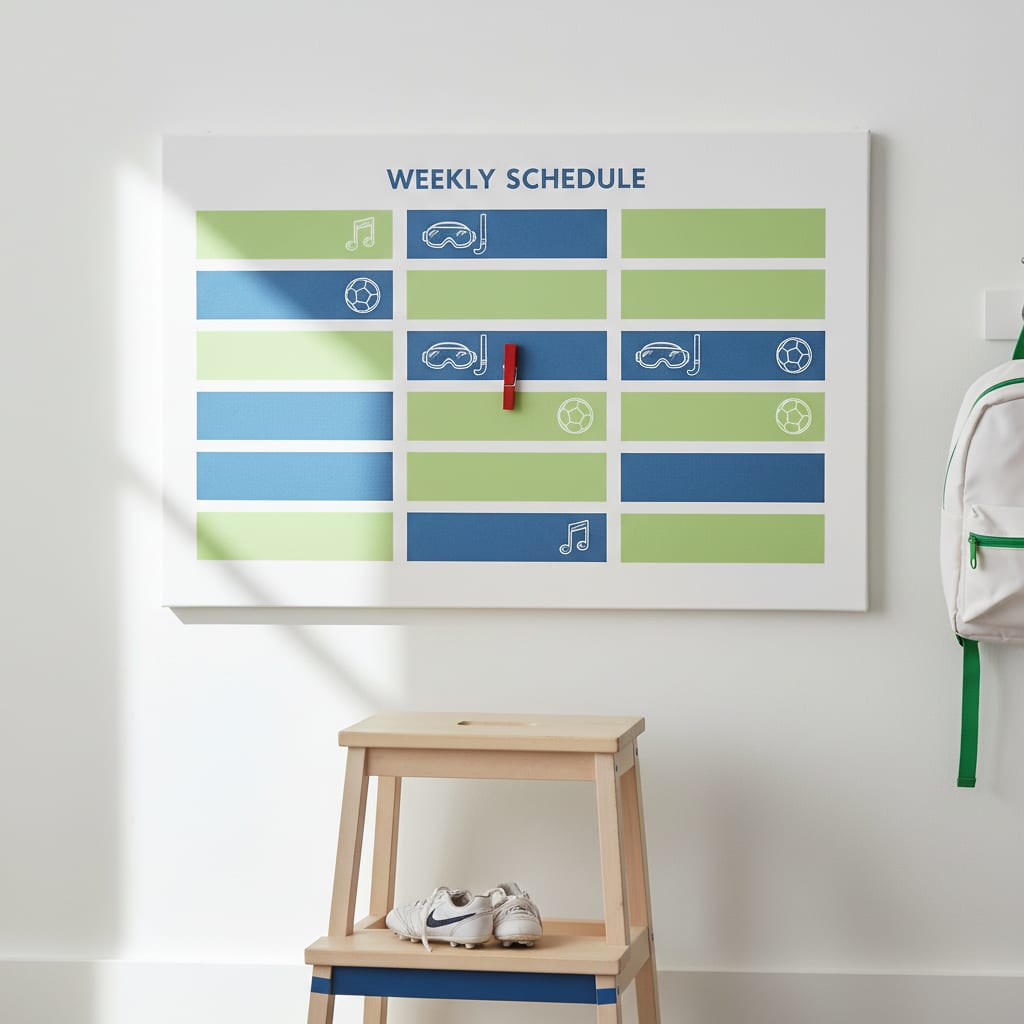
Run the rota like a sign-up sheet: one row per school day, a lead walker and a second adult, filled a month ahead. Each family takes a fair share of mornings. Post it where everyone can see it and keep it current, the same way the carpool grid works.
The guide’s advice on keeping one going is about people, not routes: one person running everything burns out, so name co-leaders, ideally with children of different ages so they don’t all leave the school in the same year.
Step 5: the roster and the rain plan
Every walker needs a contact list for every child: parent name, phone number, and who else may collect them. If your street already has a neighborhood parent roster, the bus roster is a subset of it.
Then decide the two exceptions before they happen:
- No walker that morning. The lead texts the group by 7:00, and each family moves to its own plan. That plan is the same one you use for the carpool: a backup driver bench you’ve lined up in advance.
- Weather. Pick a rule, such as walking in rain but driving in lightning or ice, and agree that the lead walker makes the call by a set time. The bus-stop logistics post has the rain-and-dark protocol, and it applies here too.
Step 6: the headcount
Count at every crossing, not every few minutes. Crossings are where a group spreads out, so it’s the same rule as the trick-or-treat street plan. The lead walker counts out loud, and the kids learn to answer with their numbers.
The Safe Routes guide also lists the pedestrian skills to teach both adults and children: what the walking-person and upraised-hand signals mean, walking facing traffic where there’s no sidewalk, watching for cars turning or pulling out of driveways, and walking, not running, across the street. Go over them on the first walk and again after a break.
For visibility, the AAP suggests brightly colored clothing or a reflective vest or armband. A child’s high-visibility vest like the Salzmann kids’ safety vest can live in the lead walker’s bag for darker winter mornings.
A bike train, briefly
The same idea on bikes is a “bicycle train”: a group of children and adult leaders riding to school together. It needs a route suited to bikes and a check on where the school wants bikes parked, but the timetable, rota and headcount all work the same way. Start with walking and add the bike train once the walking group runs smoothly.
FAQ: walking school buses
What is a walking school bus?
A group of children walking to school with one or more adults, on a set route with stops along the way. It can be two families taking turns or a planned route with a timetable and a rota of volunteers.
How many adults does a walking school bus need?
The Safe Routes to School guide cites the CDC’s recommendation of one adult per three children ages 4 to 6 and one per six children ages 7 to 9, with fewer needed for older children. Your school or district may set its own requirements, so ask.
How long does it take to start one?
A street-sized group can start within a few weeks once the route is walked and the rota is filled. The Safe Routes Partnership says a full school-wide program usually takes at least three months to set up from scratch.
What if a child isn’t at the stop?
The bus leaves on time, and that family drives that day. Agree on this before the first walk, so nobody has to decide it on the morning it happens.