Bus-Stop Logistics: Backup Adults and Rainy Days
Four things need deciding before the first bus of the year, and none of them are about the bus: the walk-out time (not the bus time — the time you leave the house), the named backup adult who can meet the bus when you can’t, the rain, cold and dark protocol, and the missed-bus plan, written down before anybody needs it. Districts publish a pickup time and a set of rules; what they don’t publish is the household system that makes those rules survivable on a February morning when one kid can’t find a shoe. That system is four decisions and about twenty minutes.
Walk-out time, not bus time
The single most common bus-stop mistake is treating the posted pickup time as the time that matters. It isn’t. The time that matters is the one on your kitchen clock when the door closes behind you, and it needs to be a fixed number your family says out loud.
Build it backwards from the district’s time:
| Piece | Typical | Notes |
|---|---|---|
| Posted pickup | 7:22 | The district’s number |
| Arrive at stop | 7:17 | Five minutes early, every day |
| Walk time | 4 minutes | Time it yourself, walking at a kid’s pace, in a coat |
| Walk-out time | 7:13 | The only number the kids need to know |
| Shoes on | 7:10 | The real deadline |
Five minutes of margin is not paranoia — buses run early on light-traffic days, and a driver who sees an empty stop keeps going. Time the walk yourself in September rather than estimating, because a four-minute adult walk is a seven-minute walk with a first-grader, a backpack, and one interesting bug.
Then put the walk-out time — 7:13, not “around 7:15” — at the end of the school-morning run-sheet, and stop announcing bus times entirely. One number, one deadline, no math at 7:04.
The backup adult (name them out loud)
Every family eventually has the morning the car won’t start, or the meeting that runs to 3:40 while a second-grader is released onto a sidewalk at 3:32. The fix isn’t heroics; it’s a person named in advance. Settle four things with one neighbor, ideally at the stop itself in the first week of school:
- Who covers the morning. If you’re stuck, they walk your kid down with theirs.
- Who covers the afternoon. If you’re not at the stop, your kid goes to their house and you get a text. Tell your kid this in plain words: “If I’m not here, you go with Ms. Alvarez.” A kid who knows the fallback doesn’t stand on the curb making decisions.
- What the trigger is. A text, a missed text, or a standing arrangement on Thursdays. Vague coverage is no coverage.
- What you cover in return. Reciprocity is the whole reason this works. Offer first and offer specifically.
Then make it official on the school’s side. Most districts release a child only to an adult listed on file, and standing at the stop is not the same as being authorized — the office needs the name in the system. (Eight years in a school front office taught me that the parent calling in an unlisted pickup was always the one most sincerely certain the rule didn’t apply. It applies.) Names, numbers and authorizations belong on your family info sheet; the numbers come off the street roster if your block keeps one.
Rain, cold and dark: the protocol
Weather isn’t an emergency, it’s a category, and it should have a standing answer:
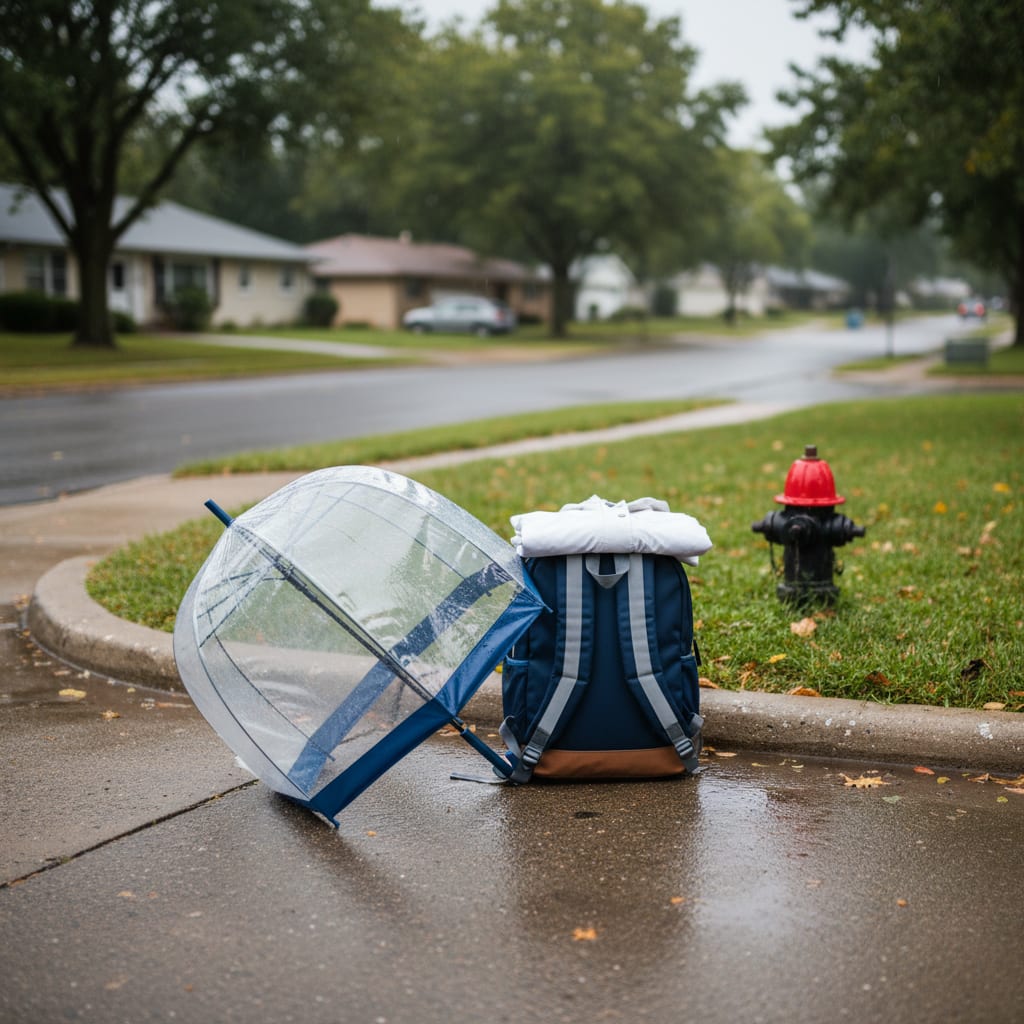
- Rain. Every kid owns a real umbrella they can open alone and gear that keeps a backpack dry. A clear dome umbrella like the totes kids’ bubble umbrella is the version that actually gets used, because a kid can see the curb through it — which matters when the alternative is a small person navigating a wet street under an opaque canopy. Store them at the door with the backpacks, not in the car.
- Cold. The rule that ends the argument is coat in the bag if not on the body. Nobody wins the “I’m not cold” debate at 7:11.
- Dark. Late fall and winter mornings put kids on the roadside before sunrise. Put reflective material on the backpack, not the coat — it’s what a driver sees from behind and it’s the layer that doesn’t come off. A pack of reflective slap bands on the shoulder straps takes ten seconds and survives the season. Wait on the house side of the road and cross only when the driver signals.
- The wait spot. Pick one and use it every day: a driveway apron or the grass, well back from the road, never the street. Kids default to whatever they did last time, so the first week sets the year.
- Extreme weather. Know your district’s cold and heat policy and whether stops get consolidated. On genuinely bad days the answer is usually the car and a slow line, not a stoic wait.
The missed-bus plan
Write this one down, because it’s the scenario where a kid has to act alone.
Morning miss. The plan is: come back to the house, do not chase the bus, and the adult drives. If both adults have already left, the plan is the backup adult’s door. Say it to your kid in the same three sentences every year until they can recite it, and put the school office number and your cell in their backpack pocket on an index card. A kid who’s memorized nothing is still fine if the card exists.
Afternoon miss — the kid stayed at school. Nearly every district’s answer is: the child returns to the office and the office calls you. Confirm the specific policy in writing at the start of the year rather than assuming, because it varies more than you’d think.
Wrong stop. Mostly a first-two-weeks, kindergarten problem. Two things prevent it: the kid knows their stop by a landmark (“the fire hydrant house”) rather than a number, and your name and cell are on a tag inside the backpack, not swinging off the outside where strangers can read it.
Bus is late. Wait ten minutes past the posted time, then call the transportation office rather than the school office — transportation is who can see where the bus is. A late bus is normal in early September while routes settle.
The first two weeks are different
Assume September is chaos: routes shift, times move by a few minutes, drivers change. Walk your kid to the stop for the first week even if you don’t plan to stay all year, and use those mornings to meet the other parents — the stop is where most of the useful street intel actually changes hands.
Re-check the walk-out time in November, because the same route in a coat and boots runs a minute or two longer, and a system built in September quietly fails in the first week of standard time.
FAQ: school bus stop rules for parents
How early should kids be at the bus stop?
Five minutes before the posted pickup time, every day. Buses can run a few minutes early, and a driver who sees an empty stop moves on. Work backwards from that to a fixed walk-out time and use the walk-out time as the household deadline.
What age can a kid wait at the bus stop alone?
There’s no universal age — it depends on your district’s policy, your street, and your kid. Districts commonly require an authorized adult to receive younger elementary children at the afternoon stop, so check your handbook. Whatever you decide, name a backup adult and make sure that adult is listed with the school.
What should we do if my child misses the bus?
Have the plan in place before it happens: the child returns home (or to the named backup adult’s house), never chases the bus, and an adult drives them in and signs them at the office. Keep the school and transportation numbers plus a parent cell on an index card in the backpack.
Do parents have to wait at the bus stop?
In the morning it depends on your child’s age and your comfort. In the afternoon many districts require a listed adult to be present for younger grades, and will keep the child on the bus or return them to school if nobody is there. Confirm your district’s release policy in writing at the start of the year.