The Family Dog's Bedtime Routine and the 5am Bark
A family dog belongs on the evening schedule, not at the edges of it. The routine that works has four fixed parts: a last walk and last water at set clock times, a sleeping spot chosen for sound rather than sentiment, noise masking for whatever the dog reacts to, and a morning release time that doesn’t undercut the household’s. Do those four and the 5am bark usually turns out to be a schedule problem wearing a fur coat. If there’s a baby in the house the pet rules get stricter — covered below, and the short version is that pets and babies are never left alone together and never share a sleep surface.
The dog is on the run-sheet now
Our dog arrived the same summer the middle kid started first grade, and I watched a well-tuned evening fall apart in real time. The fix was embarrassingly ordinary: put him on the school-night run-sheet, with named blocks and clock times. Dinner 5:30, last real walk 7:45 while the big kids shower, water bowl up 8:15, crate 8:45. He didn’t get calmer because we trained harder — he got calmer because his day stopped being improvised.
The most useful line there is last water at a set time, roughly an hour to ninety minutes before the house goes down. Ask your vet what’s appropriate for your dog before restricting water — age, medication, and health conditions change the answer completely, and this is the one item where a rule of thumb can be wrong for an individual animal.
Where the crate goes (a sound decision, not a sentimental one)
Most families put the crate where it looks least intrusive, which is how it ends up in the front hall — acoustically the worst room in the house. A dog by the front door hears every delivery and every 5:12am neighbor leaving for a shift. Place it by three tests instead:
- Away from the front door and street-facing windows — interior walls, back of the house, or a room facing the yard.
- Away from the youngest kid’s door. Whatever noise the dog does make shouldn’t land on the lightest sleeper.
- Not in a child’s bedroom, and specifically not in a nursery — that welds two sleep schedules together, and when one wobbles they both do.
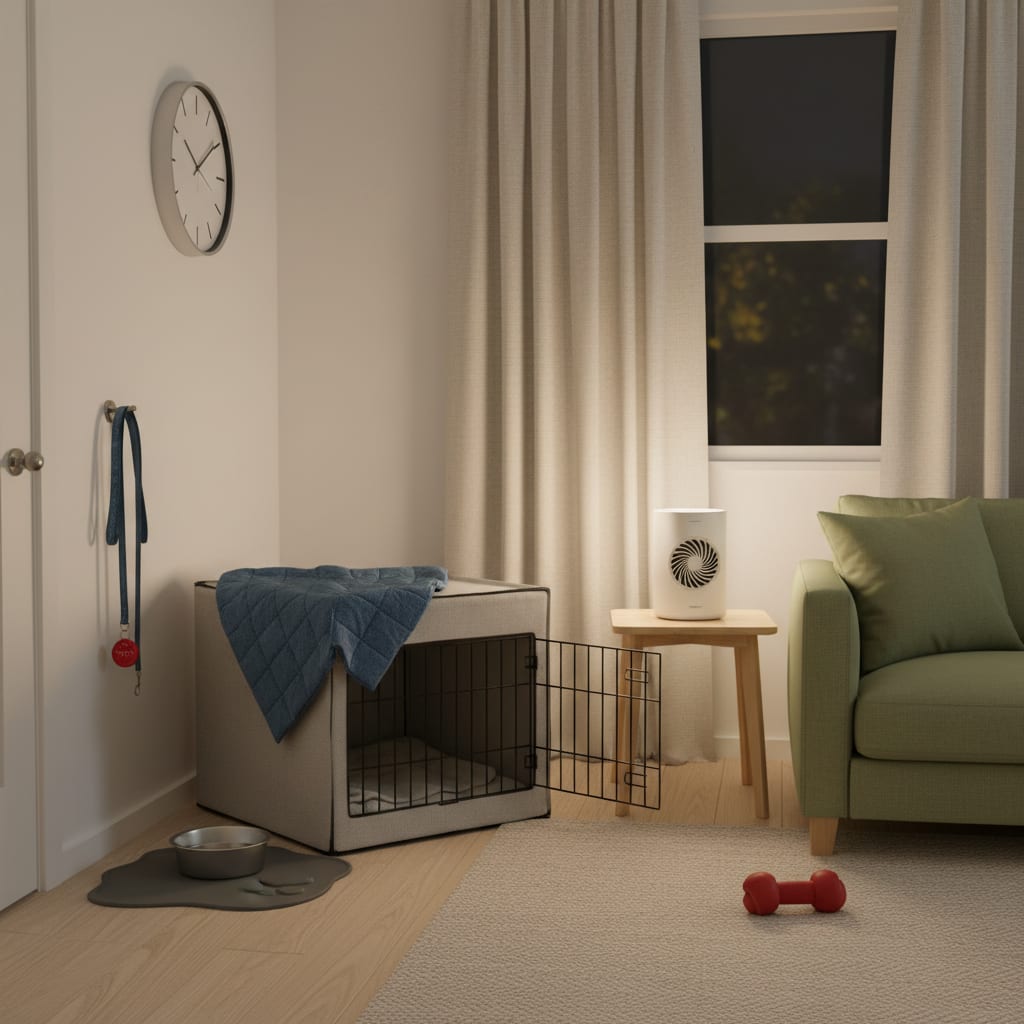
We landed on the family-room corner, an interior wall away from the stairs. Cover the crate on three sides if your dog does better with visual quiet — plenty do, some don’t; try it for a week.
Masking the night noise
The remaining problem is what the dog hears. The suburban 5am soundscape — garbage trucks, sprinklers on a timer, the neighbor’s dog — isn’t something you can remove. You can raise the floor underneath it so nothing registers as an event.
A steady white-noise machine near the crate does most of that work, and doubles for whichever kid sleeps closest. We use the Yogasleep Dohm — fan-based rather than looped, which matters because looped audio has a seam some dogs and kids orient to. Add heavy curtains on the street-facing windows; if your dog reacts to what he sees, the curtain is the whole fix.
If you’re comparing machines for a room that also holds a small child, Betteroo’s rundown of nursery sound machines covers continuous-versus-looped and safe placement distances — guidance that applies just as well to the dog’s corner.
The 5am bark, diagnosed
A dog waking the house before dawn has one of a handful of reasons, and the fix differs by cause:
| What’s happening | Likely cause | What to change |
|---|---|---|
| Barks at a specific outside sound | Trigger noise | Masking, curtains, crate relocation |
| Whines, then settles | Full bladder | Move last water and last walk earlier |
| Barks at the same time daily | Learned release time | Stop rewarding it — see below |
| Restless every night, all night | Possible health issue | Vet appointment, not a schedule change |
| Started suddenly after months of quiet | Change or discomfort | Vet first, then look for what changed |
The learned release time is the most common and most fixable, because we cause it: if the dog barks at 5:15 and somebody comes down at 5:20, barking now produces the morning. Breaking it means the school-morning run-sheet sets the dog’s release time, not the other way round — and expect it to get louder before it gets quieter.
For anything that reads as anxiety, reactivity, or a real behaviour change, a blog post stops being useful: talk to your vet first to rule out pain, then work with a certified trainer or a veterinary behaviourist. Scheduling fixes a scheduling problem, not a distressed animal.
When there’s a baby in the house
New sibling, cousin staying the week, or a friend’s infant napping in your family room — the rules tighten, and they are not negotiable:
- A pet and a baby are never left alone together. Not for a minute, not “he’s great with her.” Supervision means an adult in the room and awake.
- No pet shares a sleep surface with a baby — not a crib, not a bassinet, not a bed, not a couch during a nap. The baby’s sleep space stays empty of everything, animals included.
- Keep the nursery pet-free, structurally rather than aspirationally: a hook-and-eye latch, a tall gate, or a door that stays closed. A latch is more reliable than a rule at 2am.
- No breed is inherently safe or unsafe around an infant. Any dog can be startled, any cat can seek a warm surface, and the plan is the same for every household.
- Cats need their own layer — crib tents aren’t recommended, so the answer is the closed door plus vet advice if your cat is fixated on the room.
- Any behaviour concern — resource guarding, growling, sudden interest in the baby’s room — goes to your vet and a certified trainer immediately. Your paediatrician is the right person for allergies, asthma, or anything health-related.
Two logistics notes on the household side. The dog’s evening slot moves earlier when there’s a baby, so the last walk finishes before the newborn’s evening block instead of colliding with it. And the two rooms have different targets: a crate corner wants dark and quiet, while a baby’s room has a recommended temperature range for safe sleep tighter than most of us guess.

The afternoon half of the problem
An under-exercised dog does not sleep through the night, and the least-walked hour in a school-age household is the one right after the bus. The after-school landing is the natural home for the dog’s real walk — twenty minutes out with whichever kid is on the rotation, which does more for 5am than anything you can buy.
FAQ: dogs, night noise and family sleep
How do I stop my dog barking at 5am?
Identify the cause first: an outside trigger, a bathroom need, a learned release time, or discomfort. Triggers respond to white noise, curtains, and moving the crate away from the front of the house; bathroom needs respond to an earlier last water and walk; a learned time responds to never opening the crate before your household’s real start. Anything sudden warrants a vet visit first.
Where should a dog sleep in a family house?
Somewhere quiet and interior — away from the front door and street-facing windows, and away from the lightest sleeper’s door. Not in a child’s bedroom and never in a nursery.
Can a white noise machine help a dog sleep?
It often helps with noise-triggered waking, because a steady sound floor stops outside noises registering as events. Fan-based machines tend to beat looped recordings. It won’t help with a bathroom need, a learned wake time, or pain — diagnose the cause first.
Is it safe to have a dog around a new baby?
Pets and babies must never be left unsupervised together, and no pet should ever share a sleep surface with a baby. Keep the nursery pet-free with a physical barrier rather than a rule, introduce them gradually under direct adult supervision, and take any behaviour concern straight to your vet and a certified trainer. No breed is a substitute for supervision.