School Morning Routine for Kids: Out the Door by 7:40
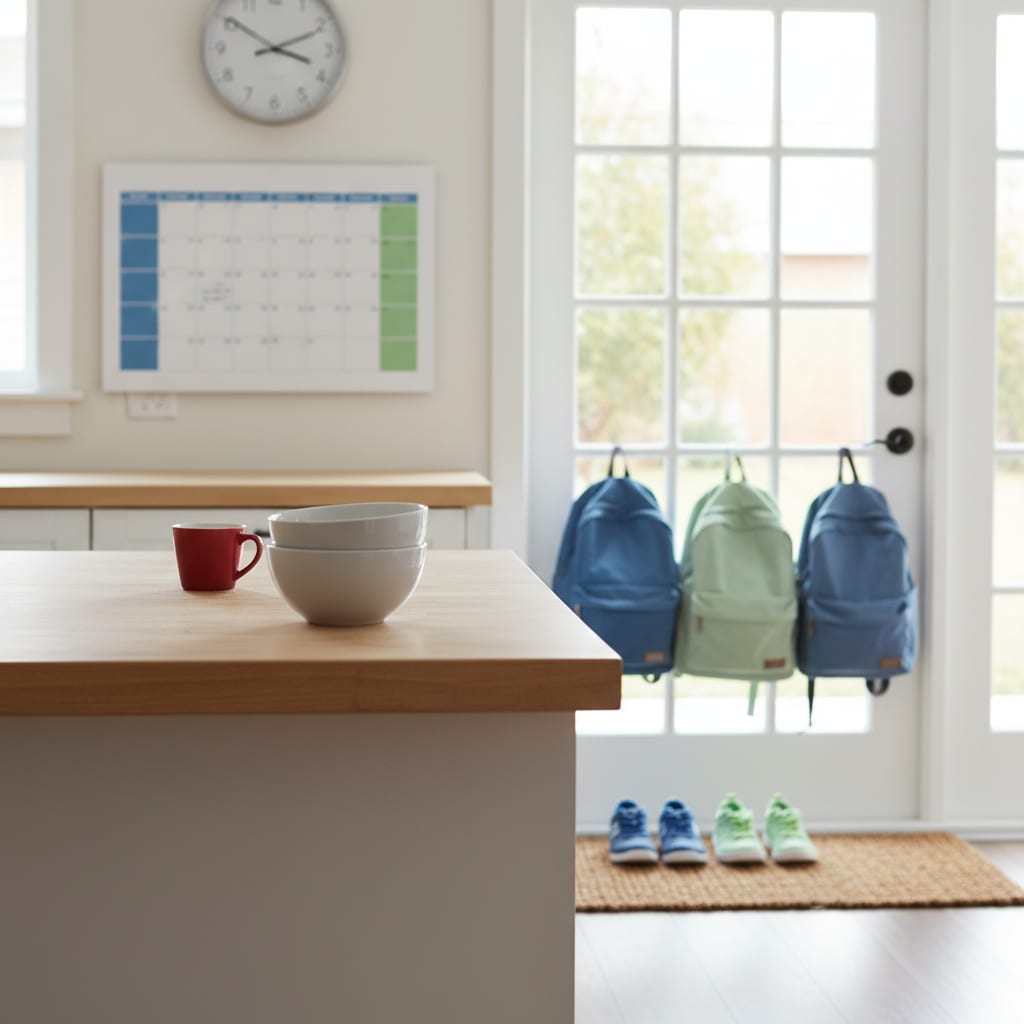
A school morning routine for kids that works is built backwards from the door, not forwards from the alarm. Pick your hard departure time — ours is 7:40 — subtract the four fixed blocks (dress, eat, hygiene, launch), and you get each kid’s wake time. Then move every decision you possibly can to the night before: clothes picked, backpacks staged, shoes at the door. Mornings fail when they contain decisions; they succeed when they’re pure execution. I ran a middle-school front office for eight years, and I promise you the families who glided in at 7:55 weren’t calmer people. They had a run-sheet.
The run-sheet: our actual school morning
Three kids — 10, 7, and 4 — one departure. Times are ours; the shape is the point.
| Time | What’s happening |
|---|---|
| 6:45 | My alarm. Coffee, board check, zero children |
| 7:00 | Big kids up, dressed in last night’s picked clothes |
| 7:05 | Breakfast — everyone at the table, preschooler included |
| 7:20 | Plates in sink, teeth, hair, faces |
| 7:30 | Launch window opens: shoes, backpacks from the station |
| 7:38 | The two-minute warning (see below) |
| 7:40 | Door. Bus is not a suggestion |
Notice what’s missing: finding things. Nothing is found in the morning at our house. It was found last night, or it goes to school un-found, which is a lesson that costs one forgotten library book instead of a family screaming match.
The morning is won the night before
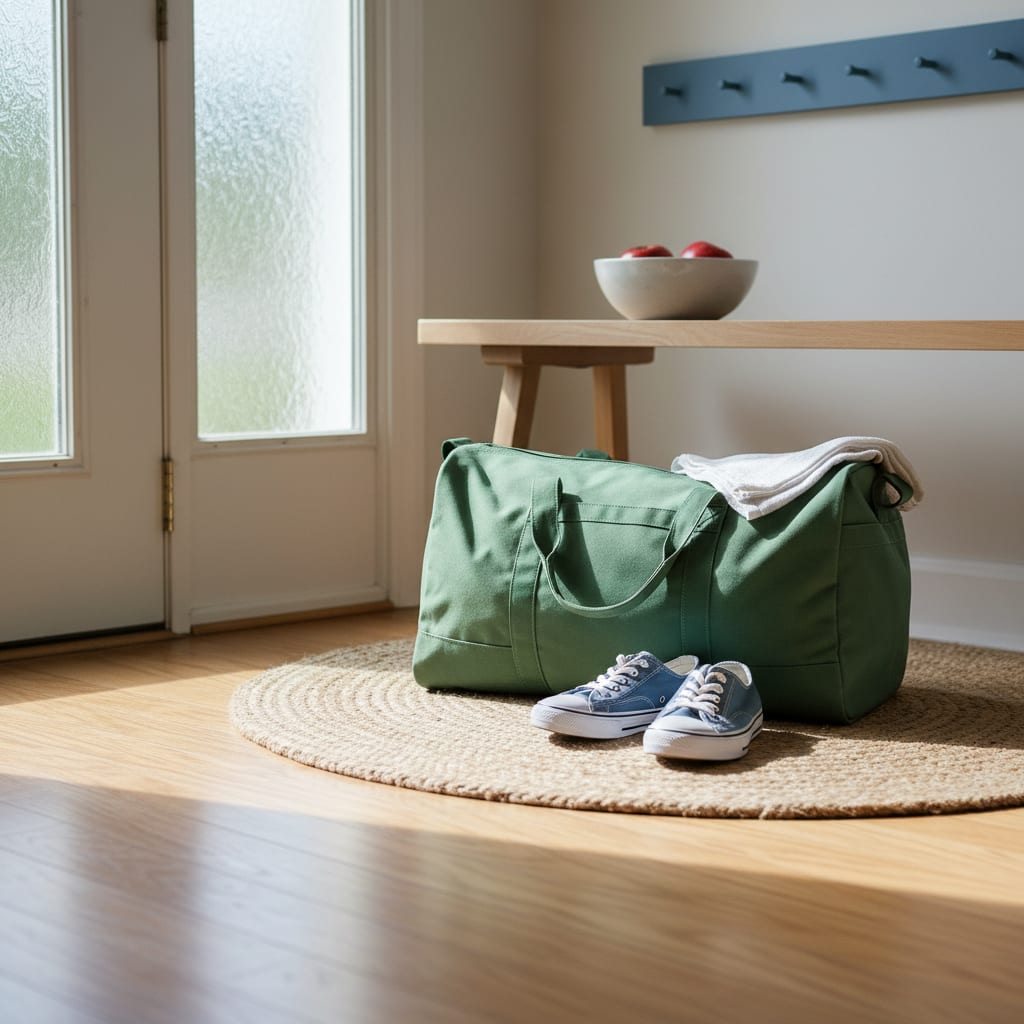
Every smooth 7:40 departure was actually built around 8pm the previous evening. The school-night routine has its own post, but the morning-critical piece is the staging pass: tomorrow’s clothes laid out (including socks — socks are where mornings go to die), backpacks packed and hanging at the backpack station, water bottles filled in the fridge, shoes paired by the door. From November on, add the winter layer to the same pass: coats on hooks, hats and gloves in each kid’s bin, boots beside the shoes. Ten minutes at night buys you thirty in the morning, at an exchange rate no other household chore can match.
Breakfast, for the record, is a time slot on my board, not a menu. What’s in the bowl is a food question, and this is not a food site — if it’s eaten, it’s someone else’s department. My only rule is that breakfast starts by 7:05, because the schedule doesn’t care how nutritious the eggs were if the bus left without you.
Morning routine for kids, by age
The same run-sheet flexes by developmental stage:
- Preschool (our 4-year-old): one job per time block, spoken out loud, every day, forever. “Shoes now.” Not “get ready” — that’s five jobs wearing a trench coat.
- Early elementary (7): a picture-or-checklist morning chart she can read herself, posted at her height. The chart nags so I don’t have to; a laminated card has infinite patience and no tone.
- Upper elementary (10): she owns her whole sequence and a cheap alarm clock like the Peakeep travel alarm. My job shrinks to the 7:38 warning. Handing over the sequence — while keeping the times fixed — is the actual goal of all of this.
Chore charts are a different instrument for a different problem, and mornings are the wrong time to bolt chores on anyway. This chart is routine steps only: the stuff that has to happen for the door to open at 7:40.
The 7:38 rule (also known as: how I stopped yelling)
At 7:38 I say, once, in a bored voice: “Two minutes. The car leaves at 7:40.” That’s the entire intervention. No countdown escalation, no third warning in a higher octave. The consequence of missing the window is natural and boring — you carry your shoes, you finish your hair in the car, you feel mildly silly. Front-office wisdom: the schools that ran calmest weren’t strict, they were predictable. Kids argue with moods; they don’t argue with clocks. It took about two weeks of holding the line before my kids stopped testing whether 7:40 meant 7:46. It has meant 7:40 ever since, and the after-school landing got easier too, because a day that starts on rails tends to stay on them.
When the routine breaks (because it will)
Sick kid, lost cleat, preschooler in full sock rebellion — the run-sheet’s real value is that when one block blows up, the others keep standing. You know exactly which train you missed, so you know what to skip: hair loses first, breakfast compresses to the portable option second, and the departure time loses never. Rebuild that night with a staging pass and you’re back on schedule tomorrow. A routine you can re-enter after a bad day is worth ten routines that only work in perfect conditions.
FAQ: school morning routines
What time should kids wake up for school?
Work backwards: departure time, minus launch (10 min), hygiene (10), breakfast (15), dressing (10), plus your family’s honest friction buffer. For our 7:40 door, that’s a 7:00 wake-up for the big kids. A kid who needs 40 real minutes wakes 40 minutes before the door — not 90, which just breeds dawdling.
How do I get my child to move faster in the morning?
Remove decisions, not minutes. Pre-picked clothes, a packed backpack, one spoken instruction at a time, and a visible chart they can check themselves. Slow mornings are almost never a speed problem; they’re a “nobody knows what’s next” problem.
What’s a realistic before-school routine for a kindergartner?
Wake, dressed (clothes pre-picked), breakfast, teeth, shoes, backpack — six steps, one at a time, same order every day. Give it a full month of repetition before you judge it. Consistency is the feature; enthusiasm is optional and frankly rare.
Should the routine be the same for every kid?
Same clock, different jobs. Everyone eats at 7:05 and launches at 7:30, but each kid’s steps match their age. Shared times keep the house synchronized; individual checklists keep the eight-year-old from being parented like the four-year-old.