School-Night Bedtime Routine for Kids: Homework to Lights-Out
Build a school-night bedtime routine for kids backwards from lights-out, and everything else falls into place. Fix each kid’s bedtime first — that’s the anchor — then walk the evening in reverse: wind-down starts 30 minutes before lights-out, the staging pass 20 minutes before that, homework and dinner slot in behind. Run the same sequence at the same times every school night. The evening isn’t the leftover part of the day you survive; it’s where tomorrow’s 7:40 departure — and honestly the whole family schedule — is actually manufactured.
Why bedtime is the load-bearing wall
Every time our family schedule has genuinely broken — not a bad day, a bad month — I can trace it to bedtime drift. The kids slide 20 minutes late, mornings turn into carrying a sleep-deprived seven-year-old through her checklist, afternoons crumble, and by Thursday everyone is crying about a sock. The reverse is also true: when lights-out holds, the morning run-sheet runs itself, because you’re launching rested kids instead of negotiating with tired ones.
Sports families learn this the hard way. Our swim schedule occasionally serves up an early-Saturday meet, and here’s the fact nobody tells you at sign-ups: a 7am meet is won or lost on Thursday and Friday night. You cannot deposit sleep the night before an early practice if the account’s been overdrawn all week. The evening routine is the training plan nobody claps for.
The bedtime routine for kids, built backwards: our school-night run-sheet
Bedtimes at our house: 7:45 for the 4-year-old, 8:15 for the 7-year-old, 8:45 for the 10-year-old. Yours will differ; the reverse-engineering won’t.
| Time | Block |
|---|---|
| 5:30 | Dinner (on practice nights this shifts — the sequence survives, the clock moves) |
| 6:00 | Homework spillover for the big kids; play for the little one |
| 6:45 | Baths/showers on their nights |
| 7:00 | The staging pass — see below |
| 7:15 | Screens off, house lights down a notch |
| 7:45 → 8:45 | Staggered bedtimes, youngest first, one wind-down each |
For kids who like to run their own evening, the same sequence fits on a wall: the bedtime routine chart has a picture version for K-2 and a checklist for ages 8 to 12.
The staging pass: ten minutes that buy back tomorrow morning
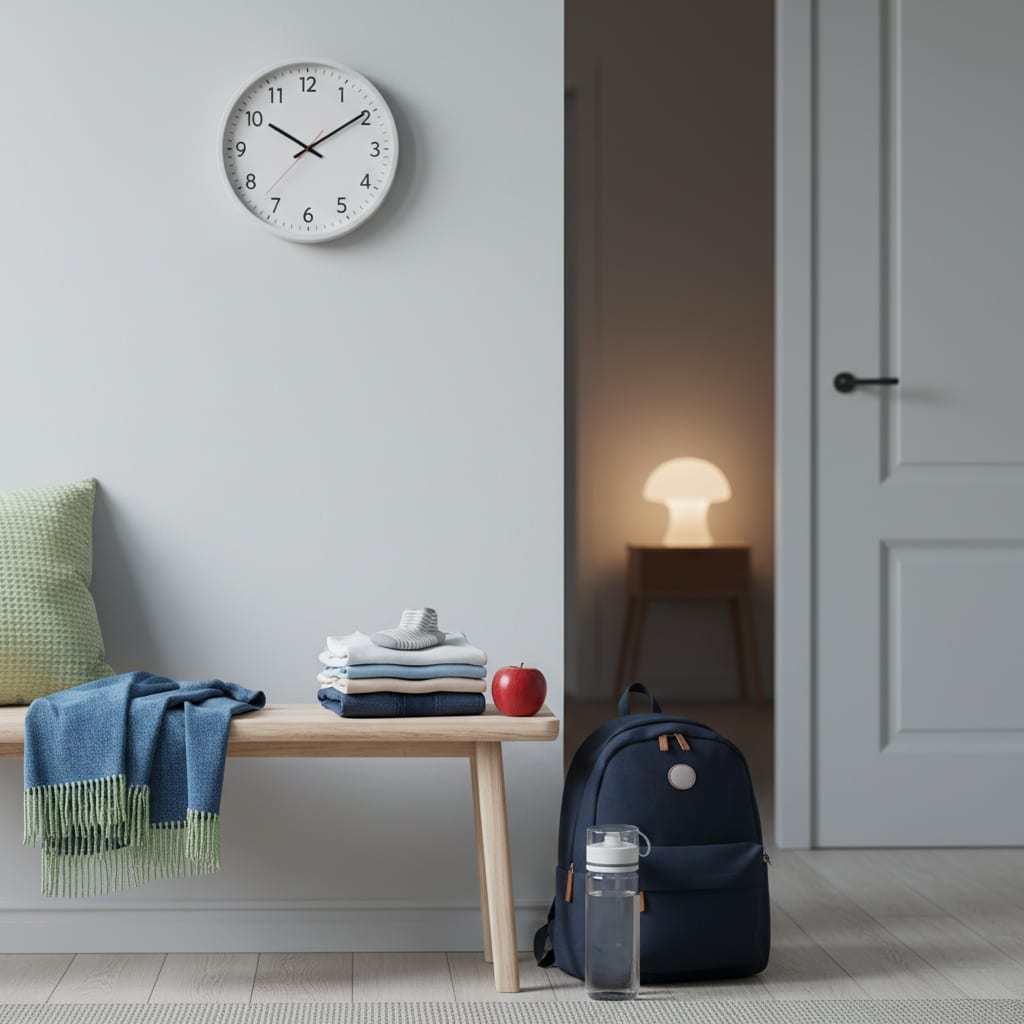
At 7:00, everyone stages tomorrow: clothes laid out down to the socks, folders signed and zipped into bags, bags to the backpack station, water bottles filled, cleats or library books in the bins. Kids do their own staging from about age six — badly at first, then automatically. This is the single highest-leverage block of the entire evening: ten invested minutes that convert the morning from a scavenger hunt into a departure.
The screens-off buffer
Thirty minutes before the first bedtime, screens go off — all of them, mine included, which is the clause my kids audit most aggressively. I won’t pretend we discovered this in a lab; we discovered it the usual way, by noticing that a kid who goes from tablet directly to pillow takes forever to actually land. The buffer holds because it’s a time on the board, not a nightly judgment call. 7:15 isn’t me being strict; it’s just what the board says, and the board has no mood to argue with.
The preschooler domino
Here’s the mechanical truth of a three-kid evening: the whole thing hinges on the youngest’s bedtime working. If the 4-year-old goes down at 7:45 smoothly, I have hands and patience for the 7-year-old’s reading and the 10-year-old’s day-download at 8:45. If he fights it — three curtain calls, water requests, existential questions about dinosaurs — the entire evening stack collapses upward, and the big kids’ bedtimes drift past their marks while I renegotiate with a person in dinosaur pajamas.
So I treat his sleep like the infrastructure it is. When his schedule wobbled last spring — nap dropping, bedtime suddenly a battle — I ran him through Betteroo, the personalized sleep program we’d used in his baby days: you answer a quiz about your kid and your parenting style, and it builds the day-by-day sleep plan — nap or quiet-time call, tonight’s bedtime — and keeps adjusting as things change. It’s built for the baby-and-toddler years, so our guy is at the tail end of its range, but for the youngest-kid bedtime that anchors a school-age household, it’s the difference between guessing and running a plan. Balanced verdict, as always: it won’t argue with a four-year-old for you — that remains an in-house service — but it took the should bedtime move? math off my plate, and my evening runs on that bedtime.
 The evening runs on the youngest kid's bedtime
Betteroo builds a personalized, day-by-day sleep plan for your littlest — tonight's bedtime, tomorrow's quiet time — so the anchor of your school-night routine actually holds.
Take the 2-minute sleep quiz →
The evening runs on the youngest kid's bedtime
Betteroo builds a personalized, day-by-day sleep plan for your littlest — tonight's bedtime, tomorrow's quiet time — so the anchor of your school-night routine actually holds.
Take the 2-minute sleep quiz →
Staggered bedtimes: the only fair schedule is an unequal one
Youngest first, oldest last, gaps of about 30 minutes. The stagger isn’t just developmental — it’s operational. Each kid gets a short solo wind-down (the 10-year-old’s 8:45 slot is where I hear about actual life, information unavailable at any other hour), and nobody’s bedtime depends on sibling cooperation. Yes, the big kids lord the later hour over the little one. That’s not a bug; that’s the pension plan of growing up.
When the evening breaks
Late practice, meltdown homework, a dinner that ran long — compress from the middle, never the ends. Homework can shrink to “the must-do sheet,” dinner can be leftovers standing up, but the staging pass and the bedtime hold. A rough afternoon can be absorbed by one evening; a lost bedtime bills you for three days.
FAQ: school-night routines
What time should school-age kids go to bed?
Work backwards from the required wake-up using age-appropriate sleep needs — elementary kids generally need on the order of 9 to 12 hours. Pick the bedtime that funds your actual morning, hold it for two weeks, and adjust by the evidence at 7am, which does not lie.
When should homework happen on school nights?
At a consistent slot your family can actually defend — right after the afternoon landing for most kids, after dinner on practice nights. Consistency beats optimization; a mediocre slot kept daily outperforms a perfect slot renegotiated nightly.
How do I stop bedtime from drifting later and later?
Anchor it to the clock, not to “when things settle down” — things never settle down. Run the same wind-down sequence at the same time, screens off 30 minutes before, and audit weekly: if lights-out slid 15 minutes, pull it back Monday. Drift compounds; so does correction.
Should older kids have the same routine as little ones?
Same skeleton — staging pass, screens-off buffer, wind-down — with later times and more autonomy. The 10-year-old runs her own staging and reads until lights-out; the 4-year-old gets the full-service tuck. Shared structure, staggered clocks, zero debates about fairness (well, fewer).