Early-Dismissal Days: The Half-Day Playbook
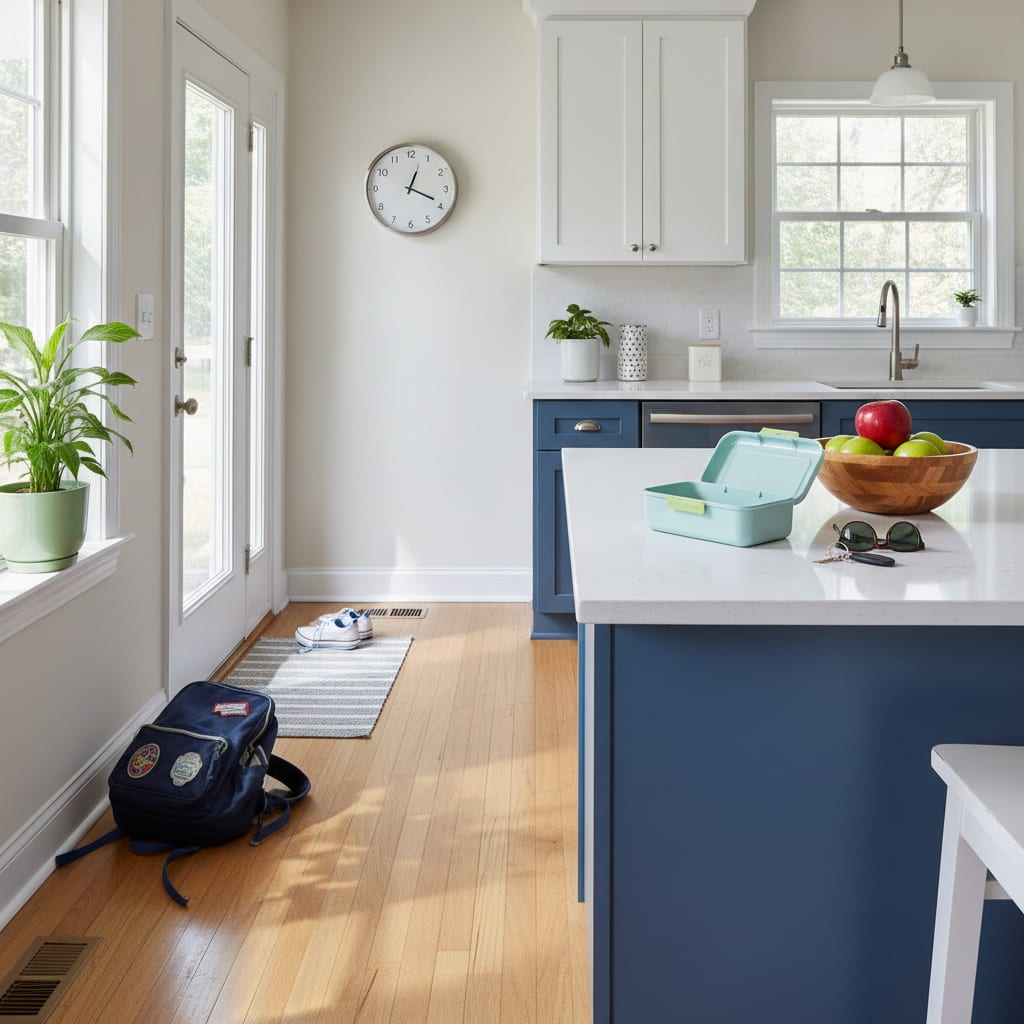
An early-dismissal day is a coverage problem wearing the costume of a short day, and it beats families for one reason: it arrives as a surprise. Three moves fix it permanently. Sweep every half day of the year onto the family calendar in one August sitting, straight off the district calendar. Assign coverage to each date the moment it lands there, not the week of. Then run the same default afternoon every time instead of inventing one at 11:40am. Most districts scatter a handful of them across the year. None should be news.
The August sweep: fifteen minutes, once
Open the district calendar the same week you enter the first and last day of school, and enter every early dismissal, every teacher in-service half day, every conference day, and the half day before each break. Put the actual dismissal time in the entry — 11:45 and 1:15 are very different afternoons — and give them all one color, because what you want in April is to glance at the wall and see that odd color sitting on a Thursday.
That entry has to live on the shared family calendar, not in your phone alone. The half day you personally know about is not covered; the half day the other adult in the house also knows about is. These land often enough to matter and rarely enough to forget, which is exactly the frequency at which “I’ll remember” stops being true.
Add a nudge two weeks out on each one. That’s the moment coverage is cheap — a shift moved, a swap offered, a sitter still free.
Who’s covering: four options, ranked by cost
Fill each date with one of these. Most families end up with a mix, and the mix is the point — nobody should be moving their hours every time.
| Option | Best for | The catch |
|---|---|---|
| A parent moves hours | Conference days you’ll attend anyway | Burns goodwill if it’s every time |
| A swap with another family | Regular in-service days | Requires reciprocating, in writing, on a date |
| School-run half-day care | Districts that offer it | Sells out; often registration-only, weeks ahead |
| A sitter for the afternoon block | Everything else | Costs money; book the recurring ones early |
The swap is the workhorse, and it works best as a standing arrangement rather than a favor: you take both families’ kids on the October and January half days, they take December and March. Agreed in August, it never has to be negotiated again, and neither household spends a year feeling vaguely in debt. The families to ask are already on your street roster or in your carpool group.
One thing to check before assuming a sitter: some districts run enrichment or extended-day programming on in-service half days specifically because they know what they’re doing to working parents. It’s rarely advertised loudly. It’s usually cheap. It usually fills.
The pickup, which is the part that breaks
A carpool built around a 3:20 bell does not survive a 12:15 one. The driver who has your kid on Wednesdays is at work at 12:15. The bus may run, may run on a different loop, or may not run at all. Aftercare may open early or may not open until its contracted hour, which on a half day is the single most expensive gap in the calendar.
So the half-day entry needs three answers attached to it, and they are not the same as the normal-day answers:
- Who is physically at the school at the dismissal time, or which bus, on which loop.
- Where the kid goes next — home, a swap house, the program room.
- Whether your after-school program opens early. Ask this in August, in writing, per program. “We’re open” and “we’re open at 12:15” are different sentences and the second one is the only one that helps.
Run the whole day through the standing carpool system rather than around it: put the half-day driver in the same grid, with the same backup rule and the same no-show rule, so a Tuesday in November doesn’t become a phone tree.
The default afternoon script
Half days go sideways when they’re treated as a treat. A kid who gets home at 12:30 to a fully improvised afternoon has been handed five unstructured hours and no landing pattern, and by 4:00 you have the worst version of both a school day and a weekend.
Ours runs one script, every time, so nobody has to decide anything:
- 12:30 — lunch at the table. Not in the car, not in front of a screen. It re-establishes that this is still a weekday.
- 1:00 — the normal unpack. Backpack emptied, papers into the inbox tray, exactly as on a full day. Half days generate paper — that’s often the reason they exist.
- 1:30 — outside or the standing errand. Half days are the best errand hours of the school year: the pediatrician, the haircut, the shoes that stopped fitting in October. Book the appointment that’s been sliding for a month onto a half day and get an hour of your life back.
- 3:00 — normal after-school hours resume. Homework if there is any, screen window if the day has one.
- Bedtime doesn’t move. Not by fifteen minutes.
That last line is the one that gets skipped, and it’s why some families lose the next morning too. The after-school landing is the same landing; it just starts earlier.
Note the food question is a genuinely different problem — school didn’t feed anyone, so lunch is on you at exactly the hour you’re least prepared. Decide in August that half days are a standing simple-lunch day and never think about it again.
The three half days that aren’t like the others
Conference days. Coverage plus a meeting you’re attending, often at a time that isn’t the dismissal time. Assume you need care for a stretch that doesn’t line up with anything, and book it.
The half day before a break. The bags come home heavy — every unclaimed jacket, every art project from October. Plan for a cleanout, not a normal unpack, and plan for the break itself, since the break week’s coverage grid starts the next morning.
Weather-driven early release. Not on any calendar, and the only one you can’t sweep. What makes it survivable is having the scheduled ones solved, because you already know who your backup adult is, you’ve already asked whether aftercare opens early, and the number you need to call is already in your phone from October.
FAQ: early dismissal and half days
How do working parents handle half days at school?
Get every half day on the shared calendar in August with its exact dismissal time, then assign coverage per date rather than solving them one at a time. Mix the methods — a standing swap with another family for the routine in-service days, school-run half-day care where it exists, a sitter for the rest, and your own flexed hours reserved for conference days.
What time do kids get out on an early dismissal day?
It varies by district and by the reason — teacher in-service days often release near lunchtime, conference days sometimes later in the afternoon. That’s exactly why the dismissal time goes in the calendar entry itself rather than just the word “half day”: an 11:45 release and a 1:15 release need completely different coverage.
Does after-school care run on half days?
Sometimes, and sometimes only from its normal contracted hour, which leaves a gap of two or three hours right where you need it least. Ask each program in writing in August whether it opens at dismissal on early-release days, and treat “we’re open that day” as an incomplete answer until you have a time.
Should bedtime change on a half day?
No. The day ended early; the night didn’t. Keep the bedtime and the wind-down exactly where they are, and let the extra hours land in the afternoon instead. Half days are also the best appointment and errand hours of the school year — the free window is worth more spent there than spent staying up.