The Family Calendar System: One Wall, Zero Surprises
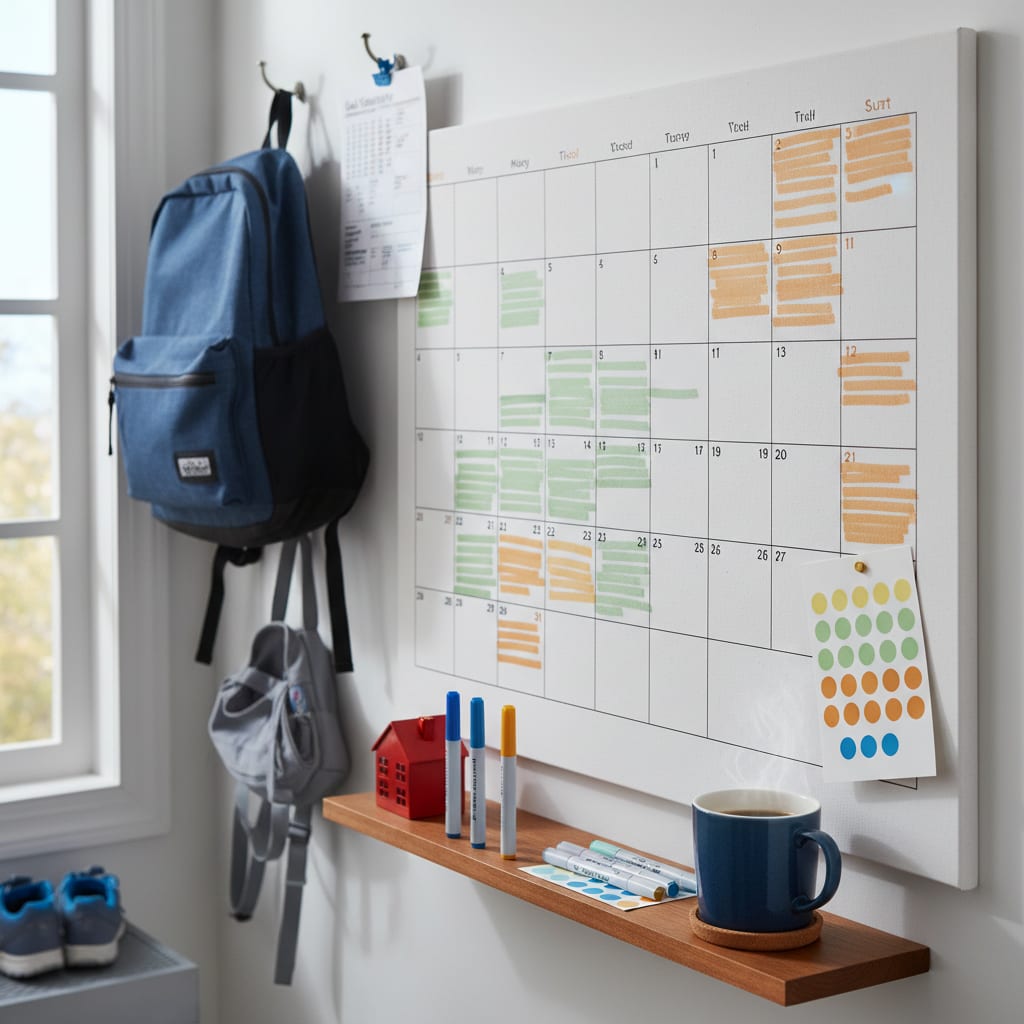
A family calendar system needs exactly four rules: one calendar is the source of truth; every person gets one color; nothing is real until it’s written; and the calendar gets a weekly sync. That’s the whole constitution. The specific products — paper grid, dry-erase, a shared app, a screen on the wall — matter far less than everyone in the house knowing which calendar is the real one. Double-bookings, forgotten picture days, and the 6:55am “I need a poster board TODAY” ambush are not character flaws in your family. They’re symptoms of scheduling data living in four places at once.
Rule 1: one source of truth
Most families run a federation of calendars — school app, team app, work Outlook, a paper one from the fundraiser — and federations have border disputes. Pick one instrument as canonical; everything else is a feed. At our house it’s the big paper month grid on the command center wall: when the soccer schedule drops or the school newsletter lands, events get transcribed onto the wall, and at that moment — not before — they exist.
Why paper for the canon, when I also keep a phone calendar? Because the wall is the only format the whole household can read, including the seven-year-old, including my husband at 6am, including me holding a preschooler and a skillet. Digital-first families can absolutely invert this — phone canon, wall as the feed — and the wall-mounted screen calendars (Skylight and that category) exist precisely to split the difference. Fine instruments, all of them. The system doesn’t care. The system cares that there is exactly one canon and everyone knows which it is.
Rule 2: one color per person
Color-coding gets mocked as a mom aesthetic, so let me defend it as infrastructure: color is the only way a calendar answers questions at a glance, without reading. Red cluster on Thursday — that’s three Maya entries, so Thursday is a Maya-heavy day, so the van is spoken for. My husband is green; if a week shows no green, he’s been scheduled into a mirage and we fix it Sunday.
Implementation notes from three years of doing this: kids pick their own colors (buy-in is cheap, take it), the family-wide color (ours is plain pencil) covers whole-household events, and you stop at one color per person — coding by event type as well is a beautiful theory that dies the day you’re writing “dentist” one-handed. The 10-year-old writes her own entries in her own color now, which is the quiet endgame: the calendar as a skill you hand down, not a service you provide.
Rule 3: nothing is real until it’s written
The intake rule. Verbal scheduling — “I told you about the birthday party in the car!” — is how households end up litigating memory instead of reading a wall. Our protocol: anyone can request anything anywhere, but events become real only in ink, and one dispatcher (me, at this life stage) holds the pen for anything the kids bring home. Papers from school go through the inbox pass and their dates get transcribed same-day. The phrase “is it on the calendar?” has ended more arguments in our house than any parenting book I’ve read; the wall is a neutral third party with no stake in who said what.
Rule 4: the Sunday sync
Ten minutes, Sunday evening, coffee optional but traditional: read next week off the month grid, copy it onto the week board, and hunt conflicts on purpose — two kids across town at the same hour, a practice against a dentist appointment, a Thursday with no adult free to drive it. Finding that on Sunday is a text to the carpool; finding it Thursday at 4:50 is a crisis with cleats. The sync is also when the weekly run-sheet template gets filled in — the kid-readable version of the week that hangs at their eye level, which is what actually stops the “what’s happening tomorrow?” interrogations at bedtime.
Printables, and keeping the system honest
The printable layer — a month grid you like, the weekly sheet, a blank conflict list for the sync — is genuinely useful, and ours ships free to the email list. But hear the front-office warning: printables are the uniform, not the player. I’ve watched gorgeous calendar kits die in three weeks because the family printed the system instead of running it. Install the four rules first with whatever’s taped to the wall today; upgrade the paper when the habits hold. A system this boring shouldn’t work as well as it does — and then again, boring is exactly why it does. If mornings are still chaotic after the calendar’s in charge, that’s usually a staging problem, not a scheduling one.
FAQ: family calendar systems
What’s the best family calendar system for busy families?
The one with a single source of truth your least-techy family member will actually check — for most school-age households that’s a big wall calendar, color-coded by person, synced weekly. Apps and wall screens work equally well as the canon; what fails is running two canons at once.
Paper or digital family calendar?
Paper wins on kid-readability and glanceability; digital wins on reminders and sharing between adults. The stable pattern is canon-plus-feed: one is official, the other mirrors it. Choose based on who needs to read it, not on which feels more modern.
How do I get my husband to use the family calendar?
Make the calendar the answer to questions instead of you: “check the wall” delivered pleasantly and without exception. When the wall becomes where answers live, adults route to it on their own — usually faster than the kids, since adults have more meetings to dodge.
What goes on the family calendar vs. a personal one?
Anything that moves another person or the vehicle goes on the family canon: games, appointments, travel, deadlines that need supplies. Work minutiae stays personal. The filter question: “does anyone else’s Tuesday change because of this?” If yes, ink it.