Weekly Family Schedule Template (Free Printable)
The weekly family schedule template that works is a single page: days across the top, one column per family member, and only the appointments and departures written in — not every hour, not aspirations, just who has to be where, when, and what has to leave the house with them. Fill it anchors-first every Sunday (school times, practices, appointments, carpool duty), hang it at kid eye level, and you’ve built what our house calls the departure board: the sheet that answers “what’s tomorrow?” so you don’t have to, eleven times, at bedtime.
Why a weekly sheet when we already have a calendar?
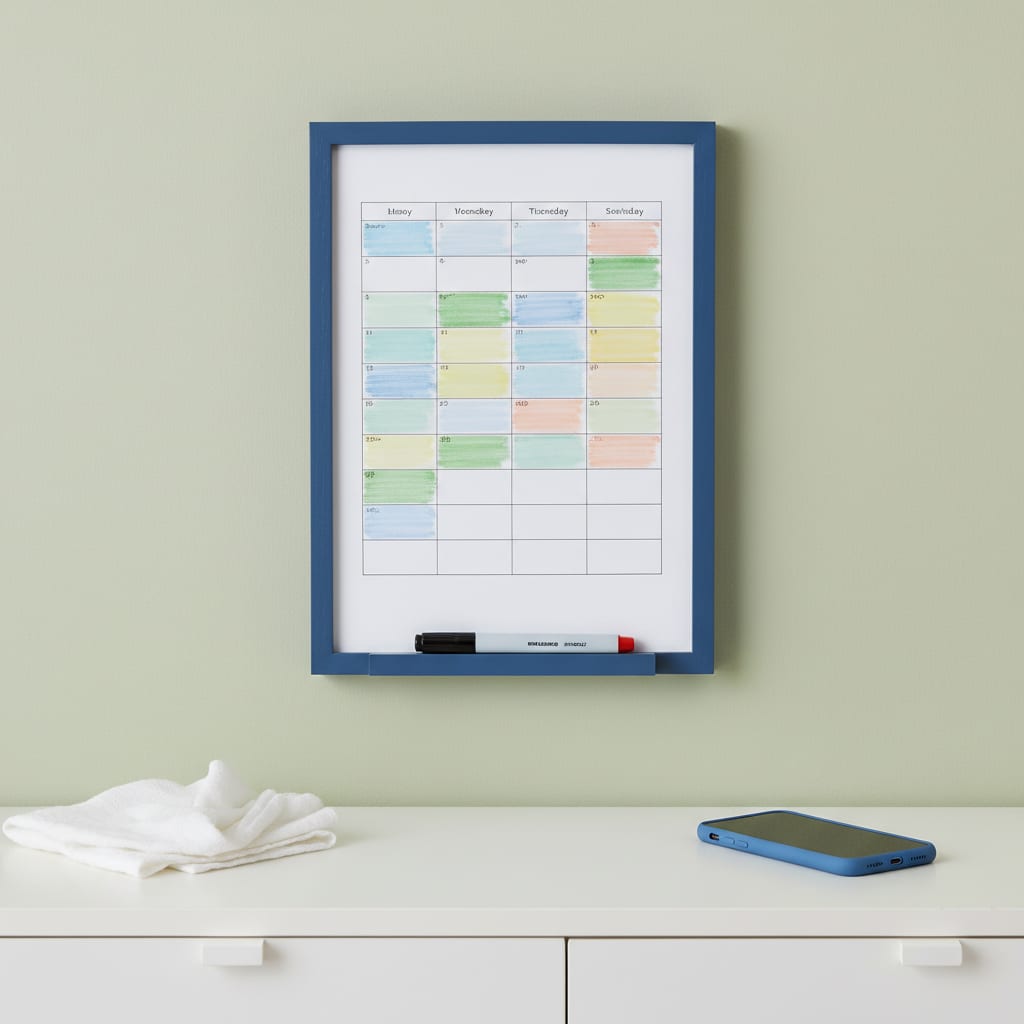
Because a month calendar and a week sheet do different jobs. The month grid is the source of truth — deep, complete, adult-facing. The weekly sheet is the broadcast: shallow, readable in four seconds, posted where short people congregate. Kids don’t parse month grids; honestly, most adults read them badly at 6:50am. The week sheet is the schedule pre-chewed — this week only, big type, one glance. Ours hangs in a cheap frame on the command center wall; we wipe the glass and refill it every Sunday. Same system works taped to the fridge with no frame and no shame.
How to fill it in: anchors first, then freight, then nothing
Pass 1 — anchors. The immovables, copied from the month calendar: school hours (including the early-dismissal Wednesday that ambushes every family in America), practices and games, appointments, work commitments that move the household, carpool days you’re driving.
Pass 2 — freight. Under each anchor, what must physically leave the house for it: cleats Tuesday, library books Thursday, the signed field-trip form, the poster board. Freight lines are the sheet’s secret weapon — they turn the evening staging pass from memory work into reading. Tuesday says cleats; the bin gets cleats; nobody relives the Great Shin Guard Hunt.
Pass 3 — stop. The template’s power is the white space. A filled-solid week sheet is unreadable and, more usefully, it’s diagnostic: if the boxes physically can’t hold your week, the problem isn’t the template. That white space is where the actual living happens — don’t schedule it out of existence.
The layout, and why it’s shaped that way
- Columns by person, not by hour. Hour-grid planners are for one busy adult; families need to see people side by side. The seven-year-old finds her column by color (each kid’s column header matches their calendar color) and reads only that — which is the correct amount of schedule for a seven-year-old to carry.
- A “van” row along the bottom. One line per day for vehicle logistics: who’s driving which run, carpool swaps, the day the van is at the shop and the whole ballet re-choreographs. In a school-age family the vehicle is a family member with the busiest schedule of all; it gets a row.
- Times in the box, always. “Soccer” is a rumor; “Soccer 5:15, leave 4:50” is logistics. Write departure times, not event times, for anything with a drive attached — the sheet should answer the question your 4:40pm self actually has.
- One page, portrait, black-and-white friendly. It photographs cleanly, so Sunday’s last step is snapping it to the family group text — the sheet’s digital echo for the adults, at zero extra system cost.
The Sunday refill: ten minutes, protected
The template is stationery; the refill is the system. Ours happens Sunday evening, right after the week’s calendar sync: copy the anchors, add the freight, hunt the conflicts, hang it, photograph it. Ten minutes when it’s routine, twenty the first few times. Two warnings from a three-rebuild veteran: don’t delegate the refill to “whenever,” because a stale week sheet is worse than none — kids check it, find last week, and stop trusting the instrument. And don’t gold-plate it. The handwriting is allowed to be ugly. This is a run-sheet, not a scrapbook page, and the pretty version that takes 45 minutes is the version that dies in October.
Getting the printable
The template set ships free to the email list: the standard sheet in two-kid through four-kid column versions, plus a blank-header edition for irregular weeks (breaks, tournaments, the week grandma visits and the whole schedule wears perfume). Print a stack, refill on Sundays, recycle without sentiment. The sheet is disposable on purpose — the habit is the heirloom.
FAQ: weekly family schedules
What should a weekly family schedule include?
Anchors (school, activities, appointments, carpool duty), the freight each anchor requires (gear, forms, returns), and vehicle logistics. Leave routine daily rhythm off — the sheet tracks exceptions and departures, and its readability is exactly what makes it get read.
Where should we post the weekly schedule?
At kid eye level on your highest-traffic wall — command center, fridge, the hallway everyone funnels through at breakfast. The test is passive visibility: family members should collide with it daily without meaning to.
How far ahead should a family schedule go?
One week, refilled every Sunday. Further horizons live on the month calendar; the weekly sheet trades range for readability on purpose. A two-week sheet sounds efficient and reads like a spreadsheet nobody opens.
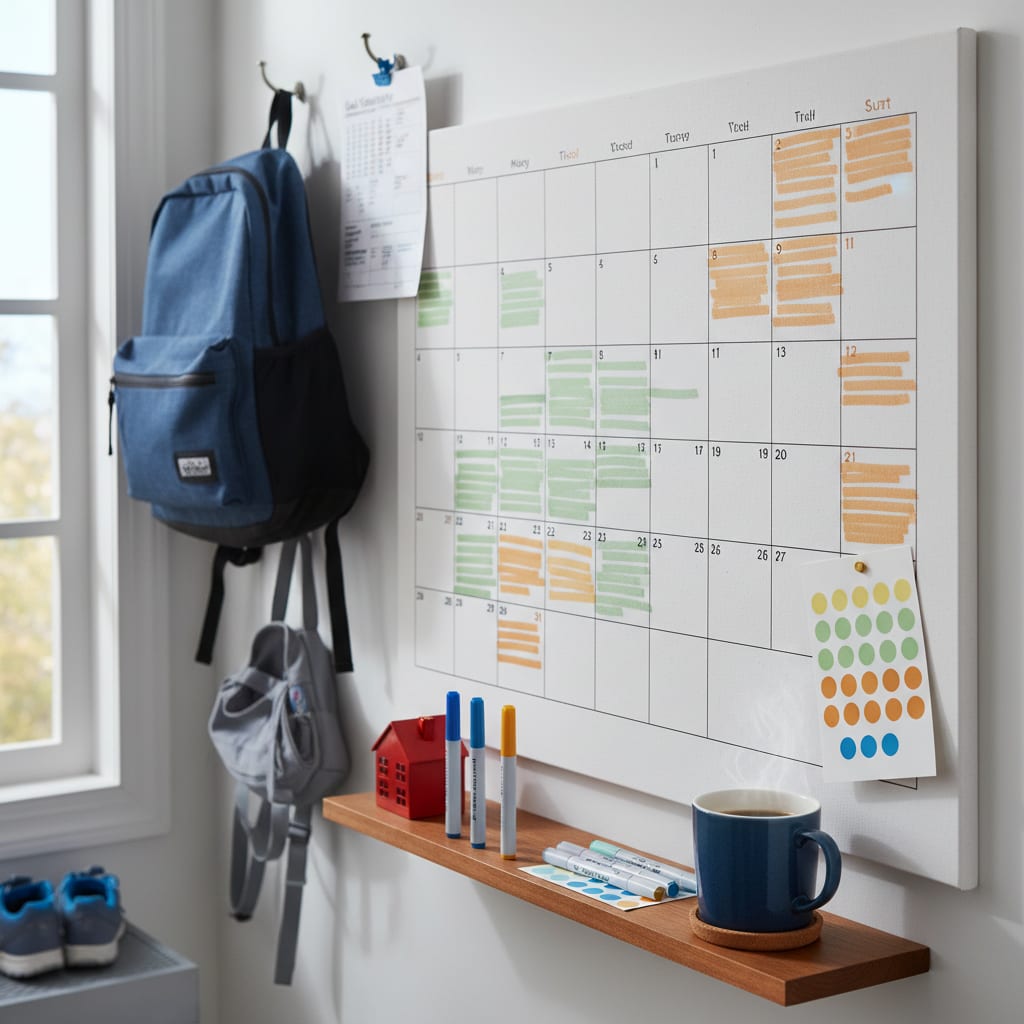
Printable template or dry-erase board?
Same system, different skin. Printable wins if you want the group-text photo and per-kid color columns; dry-erase wins if your week changes mid-flight a lot. We run the printable behind glass and wipe corrections onto the glass — the coward’s dry-erase, highly recommended.