School Papers: The Inbox System (Sign, Return, Done)
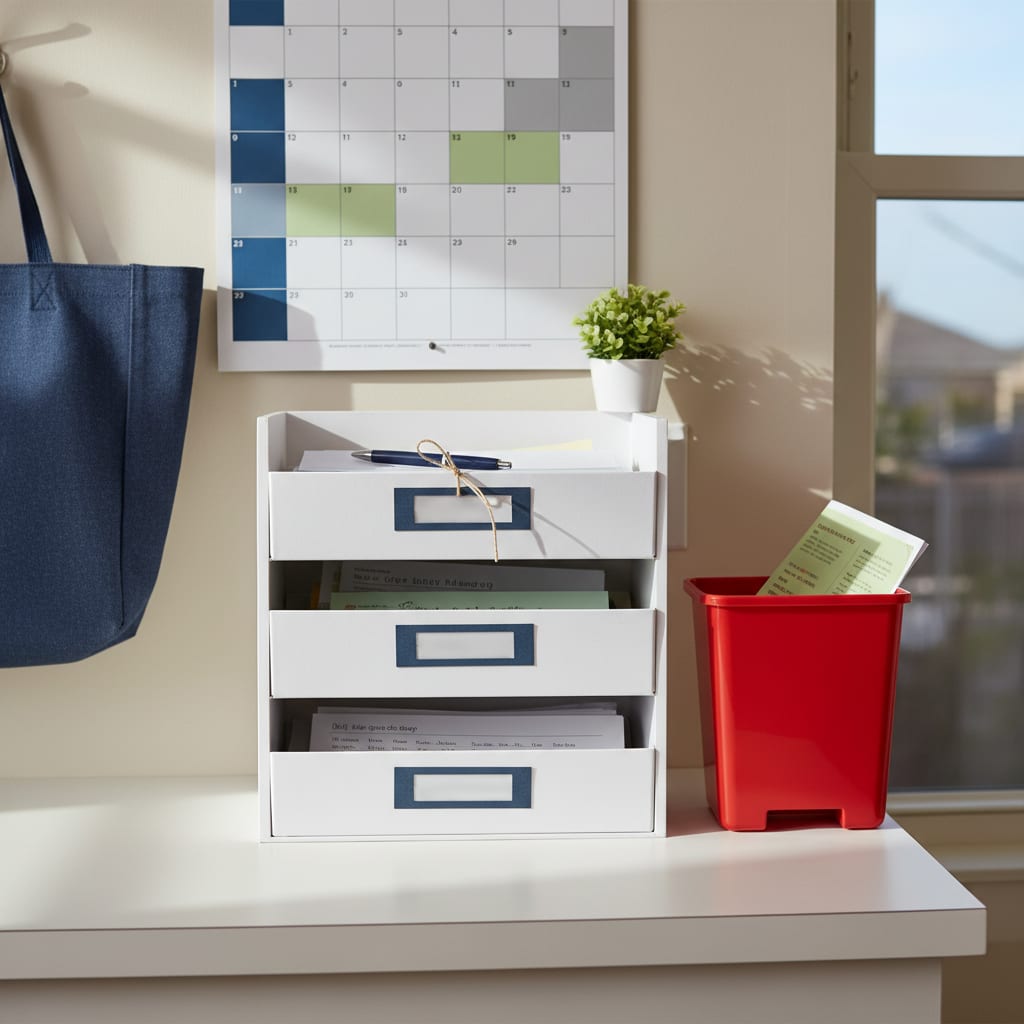
School paper organization for parents comes down to one move: treat the daily flood as an inbox, not an archive. One tray per kid at the command center, papers land there at the afternoon unpack, and a five-minute nightly pass sorts every sheet into exactly one of three exits — sign and return (back in the folder tonight), calendar and toss (the date goes on the wall, the paper goes in the bin), or keep (rare, and someone else’s department). That’s the whole system. The papers that wreck school mornings are never the ones you filed wrong; they’re the ones that never entered a flow at all — the field-trip form discovered at 7:38, fossilized at the bottom of a backpack.
Why the pile happens to good people
Three kids at our house generate a paper stream I can only describe as municipal: permission slips, picture-day envelopes, PTA flyers, spelling lists, fundraiser packets, the art. Each sheet arrives with a different deadline and a different verb — sign this, pay this, memorize this, admire this — and a pile is what you get when papers with different verbs are stored together. The counter pile isn’t a tidiness failure. It’s a routing failure: nothing in a pile has a next action, so the pile’s only function is generating dread. Eight years in a school front office taught me the fix, because the office never piles: every paper that crosses the counter gets routed to its next action the day it arrives. Homes can run the same mail room, five minutes a night.
The hardware: one tray per kid, nothing fancier
At the command center: one labeled tray or wall file per kid — that’s the inbox — plus a pen that lives there on a string (the string is not optional; the pen walks otherwise), the checkbook-and-cash envelope for the endless little payments, and the recycling bin within arm’s reach, because the bin is the system’s most-used exit. That’s the entire build. Resist the 12-slot organizer: more slots means more routing decisions per sheet, and the whole point is fewer. Papers enter the inbox at the afternoon unpack — folder out of backpack, contents into tray, folder back into backpack — which takes a kid about nine seconds once it’s welded to the backpack station landing sequence.
The nightly pass: three exits, five minutes
After dinner, one adult runs the trays. Every sheet gets one of three exits, decided in seconds:
| Exit | The test | Where it goes |
|---|---|---|
| Sign & return | The school wants it back | Signed now, into the kid’s folder, folder zipped into the bag tonight |
| Calendar & toss | Only the date matters | Date onto the wall calendar, sheet into recycling, no guilt |
| Keep | You’d genuinely miss it | Out of the flow entirely — see below |
Two rules make the pass work. Never leave a sign-and-return unsigned in the tray — a form touched twice is a form that gets lost once; sign it the moment it’s read and send it straight back to the bag. And the calendar is the archive for dates: once picture day is on the wall, the flyer has no further job, and keeping it anyway is how trays silt up into piles with better branding. Fundraiser packets and Scholastic flyers get a house policy decided once per year, not a fresh deliberation per packet — ours is one book order per season, everything else exits through recycling without a hearing.
The “keep” exit is not my department
Maybe one paper in thirty survives both exits: the report card, the drawing with actual soul in it. Those leave the inbox flow entirely and go to a keepsake routing — a memory box, a portfolio, whatever your house runs. Building that system — the keep-toss-treasure decisions, the storage — is genuinely its own project, and it’s the natural lane of the home-organization folks like Retro Modern Mom, who live where stuff-in-space problems live. My lane ends where the paper stops moving. The inbox’s job is that by 8pm, every tray is empty and every returning form is already zipped in a bag — which is also why this system quietly feeds the morning run-sheet: a 7:40 departure has never once been derailed by a form that went back the night before.
The audit loop
Once a week, at the Sunday calendar meeting, the trays get a thirty-second audit: anything that survived the week in an inbox is either a decision someone’s avoiding (make it now) or evidence a kid’s unpack step slipped (reinstall it Monday). And each June, the whole flow gets a teardown week — end-of-year papers arrive in a surge, the keep pile earns a real sort, and the trays go to summer duty holding camp forms. The system restarts cold every August, which is exactly when you want an empty inbox waiting.
FAQ: school paper flow
How do I organize the papers my kids bring home from school?
Run them as a daily inbox, not a filing project: one tray per kid, papers land at the afternoon unpack, and a five-minute nightly pass gives every sheet one of three exits — sign and return tonight, put the date on the calendar and recycle, or (rarely) keep. Empty trays by 8pm is the goal.
What do I do with forms that need to go back to school?
Sign them the moment you read them and put them straight into the kid’s folder and backpack that night — never back into the tray. A returning form should be touched exactly twice: once entering the inbox, once leaving it signed. Morning-of discoveries come from forms that waited.
Should I keep school flyers and newsletters?
Almost never. If only the date matters, transfer it to the family calendar and recycle the paper immediately — the calendar is the archive. Keep the sheet only when you’ll need its details later (packing lists, spirit-week schedules), and even then it lives clipped at the command center, not in a pile.
How do I get my kids to hand over papers instead of leaving them in backpacks?
Attach it to a routine that already happens: folder out, contents into your tray, folder back — one welded step at the backpack unpack, same time every afternoon. Kids from about first grade can run it themselves; the weekly tray audit tells you quickly if the step has slipped.