Family Meeting Agenda: The 15-Minute Sunday Calendar Meeting
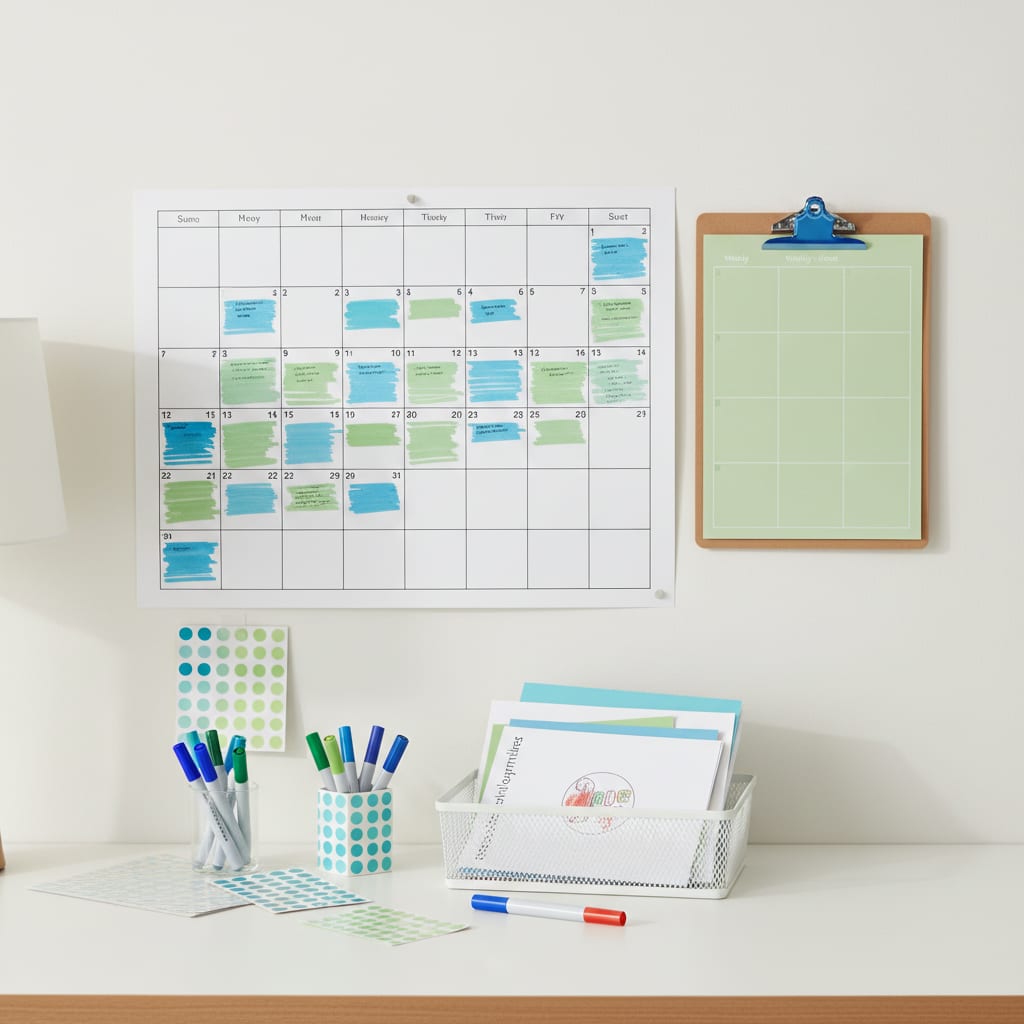
The family meeting agenda that keeps a school-year week on the rails is the Sunday calendar meeting: fifteen minutes, same time every week, adults required and kids welcome, with a fixed five-part agenda: read the week aloud, flag the collisions, solve them out loud, assign every drive a driver, and write the final version where the whole house can see it. That’s the entire institution. It is a planning meeting, not a family summit and not a chore session — no feelings on the agenda, no cleaning during the meeting — and it works because Monday-morning surprises are almost never surprises; they’re Sunday facts nobody said out loud.
Why fifteen minutes on Sunday beats five scrambles a week
Every logistics failure I’ve ever run down — the double-booked Thursday, the kid at practice with no ride home, the permission slip discovered Sunday at 9:40pm — was knowable by Sunday afternoon. The information existed; it just lived in four places: the school newsletter, the team app, two adult heads. The meeting is simply the moment all four sources report to the same table. Fifteen minutes is the honest budget, and honesty matters: call it a fifteen-minute meeting and hold the line, because the first time it becomes forty-five, you’ve lost your co-chair. We run ours Sunday at 7:00pm, after dinner, before anyone’s melted into the couch. Attendance is the only rule I enforce like a bell schedule.
The family meeting agenda, minute by minute
Minutes 1–5 — read the week aloud. One person walks the family wall calendar day by day, out loud, while everyone else checks it against their sources — school newsletter, team apps, work calendars, the field-trip form in the folder. Out loud is the technology here. Eyes skim; ears catch. “Wednesday: dentist 3:40, soccer 5:15” gets three seconds of silence, then someone says wait — and that wait is the whole return on investment.
Minutes 6–10 — flag and solve the collisions. Every wait gets solved now, at the table, while options still exist: shift the dentist, arrange the carpool backup, decide which parent bends. Sunday-you has choices; Wednesday-3:15-you has a phone and rising blood pressure.
Minutes 11–13 — assign the drives. Every trip on the week gets a named driver, including the return legs — orphaned pickups are how a child ends up doing an unscheduled hour of enrichment in a parking lot. Names go on the calendar, not in the air.
Minutes 14–15 — publish. The reconciled week gets written onto the weekly run-sheet and posted on the command center. The meeting isn’t over when the talking stops; it’s over when the wall is current. An unpublished plan is a rumor.
Kids at the meeting: yes, with jobs
School-age kids attend, and each has a role sized to the kid: my 10-year-old reads her own activities off the week (and has caught two conflicts the adults missed, which she will mention forever), the 7-year-old confirms her swim days and puts the magnet on Wednesday, and the 4-year-old attends in the sense that he is present and occasionally under the table. The point isn’t labor — it’s that kids who hear the week on Sunday stop being surprised by Tuesday, and a kid who knows the plan argues with it noticeably less.
What this meeting is not (a boundary rule)
The calendar meeting plans people-in-time. It is not the moment to reset the house — no tidying, no bin-sorting, no laundry summits inside my fifteen minutes, or the meeting bloats and dies. The stuff-in-space side of Sunday is its own discipline with its own excellent playbook — that’s the retro-modern folks’ Sunday reset, and the two rituals pair beautifully as neighbors: reset the house, then plan the week, or the other way around. Just don’t merge them. Merged meetings produce clean counters and a Thursday collision nobody caught.
FAQ: family calendar meetings
How long should a family calendar meeting be?
Fifteen minutes, protected on both ends. Long enough to read seven days aloud and solve the conflicts; short enough that everyone shows up again next Sunday. If it routinely runs long, the calendar’s too scattered coming in — fix the sources, not the meeting length.
What should be on the family meeting agenda?
Five items: read the week aloud, flag conflicts, solve them, assign every drive a named driver, publish the final week to the wall. Keep feelings, chores, and long-range dreaming off this agenda — worthy topics, different meetings.
Should kids be part of the weekly planning meeting?
Yes, from about age 5, each with a small job: reading their own activities, moving their magnet, confirming their days. Kids who hear the week in advance resist it less, and older kids become genuinely useful conflict-spotters.
What’s the best day and time for a family calendar meeting?
Sunday, after dinner, before the week’s information goes stale — late enough that team apps and school newsletters have landed, early enough to still fix what they reveal. The specific hour matters less than its total predictability.