Home Management Binder: The Portable Command Center

A home management binder holds the parts of running a house that don’t change every week, in one place that someone else could pick up and use: the year’s dates, every contact, school and activity details, the house itself, and the money calendar. Set it up with eight tabs, keep it next to the family command center (or on a shelf nearby), and give it one test. Could another adult run this house next week using only this binder? If they could, it’s finished. If they’d have to text you, add whatever they’d be texting you about.
The wall and the binder do different jobs
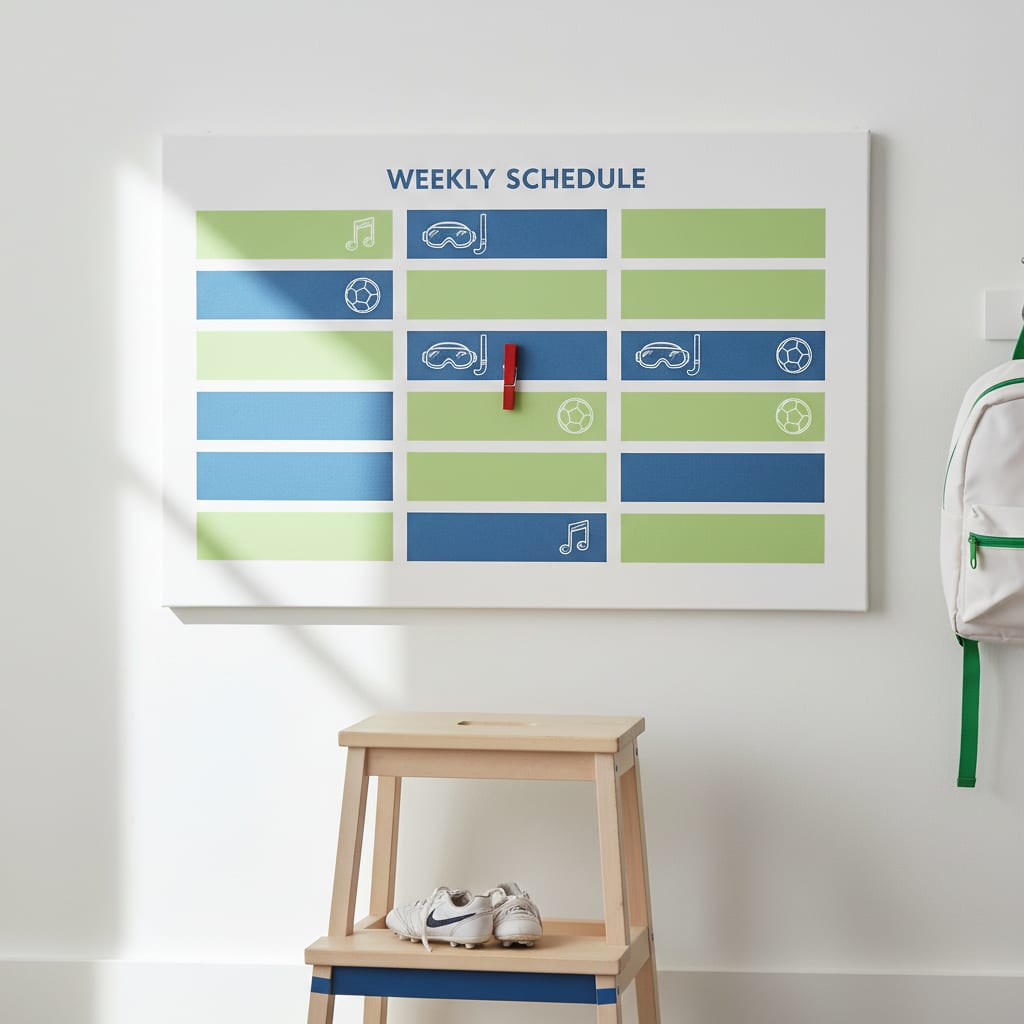
The command center wall is for this week: who’s where at 5:15, which form goes back tomorrow. It changes daily, which is why it’s on a wall where everyone walks past it.
The binder is for everything that changes once a term or once a year: the pediatrician’s after-hours number, the swim registration window, the furnace filter size, the date the car registration renews. You look these up a few times a year, usually in a hurry, and usually when the person who knows is out of town. Put them on the wall and the wall turns into wallpaper. Put them in a binder and they can travel to the kitchen table, the car, or the house of whoever is covering for you.
Eight years in a school front office taught me this split. The front desk had a whiteboard for today and a fat binder for everything else, and the binder is what got a substitute secretary through a Tuesday.
The eight tabs
| Tab | What goes in it | Updated |
|---|---|---|
| 1. The year | School calendar, no-school days, activity seasons | August, January |
| 2. Contacts | Doctors, school office, coaches, sitters, neighbors, repair people | Each term |
| 3. The info sheet | The one-page household sheet for anyone covering | Each term |
| 4. School | Teachers, schedules, bell times, pickup rules, login locations (never passwords) | Each term |
| 5. Activities | Teams, practice nights, registration windows, uniform sizes | Each season |
| 6. The house | Appliance models, filter sizes, shutoff locations, service dates | When something changes |
| 7. The car(s) | Registration and inspection dates, service intervals, insurance contact | When something changes |
| 8. Money calendar | When bills are due and which account pays them | Once a year |
The first five are the reason this binder belongs on a family-logistics site, so they get the most detail below. The last three are short on purpose.
Tab 1: the year
This is the school-year calendar on paper: the district calendar printed and marked up, every closed day flagged with who is covering it, plus each activity’s season dates. If you’ve done the school-year calendar sweep, this tab is just the printed result. If you haven’t, do the sweep first, because a binder full of unsorted calendars is just a nicer-looking pile.
Tabs 2 and 3: contacts and the info sheet
The contacts tab is a full list, one line per person: name, role, number, and when to call them (“after-hours nurse line, use before urgent care”). The “when” column is what makes the list useful to someone who isn’t you.
Put the family info sheet right behind it. That’s the one page a sitter or grandparent actually reads, and that post covers what goes on it and what never does. The binder holds the master copy; the fridge holds a copy.
Tab 4: school
One page per child: teacher and how they prefer to be contacted, the bell schedule, the pickup and dismissal rules, the bus number or car-line spot, and where each school login lives, such as which app, which email, which password manager entry. Never write the passwords themselves in a binder that sits on a kitchen shelf.
Behind each child’s page, keep a clear sleeve for the papers that need to be found again: the supply list, the conference confirmation, the field trip details. Daily papers don’t go here. They go through the inbox flow on the wall and then either back to school or into the recycling.
Tab 5: activities
One page per activity: the coach and team-parent contacts, practice nights and locations, the season dates, the uniform and equipment sizes from last season, and when registration for next season opens. That last line is the one most people miss, and missing it is how a family ends up on a wait list. The youth sports registration calendar post explains how to find those windows, and this tab is where they’re written down.
Tabs 6 to 8: short on purpose
The house: model numbers for the furnace, water heater and big appliances, the filter size, where the water shutoff and breaker panel are, and the last service date for each. Someone covering for you doesn’t need a cleaning rota; they need to know where the water shutoff is.
The car: registration and inspection months, the service interval, the insurer’s number. That’s all.
Money calendar: which bill is due when and which account pays it. Dates only, no balances and no account numbers. Budgeting is a whole subject, and this tab isn’t trying to cover it.
What stays out of the binder
A binder that tries to hold everything ends up holding nothing useful. These go somewhere else:
- Meal plans. They change weekly, which makes them wall material. For the planning itself, heymomblog’s week of meal prep on a budget is the one to follow.
- Cleaning schedules. Retromodernmom’s weekly cleaning schedule covers the house side.
- Chore charts. Those belong to the kids, on the wall, and bigfamilyplaybook’s chore chart by age is the place to start.
- Passwords and account numbers. Use a password manager, and write down only where things are kept.
The binder itself
A 2-inch D-ring or slant-ring binder holds eight tabs plus sleeves without the rings straining. Something like the Avery Durable View binder has a clear cover pocket, so the front page can be the contacts summary. Use insertable tab dividers like Avery Big Tab 8-tab, because you’ll rename a tab at least once, and a tab you can’t rename becomes a tab nobody uses.
Keep it in one place, the same shelf every time, and tell every adult in the house where that is. The binder isn’t much use if the person covering for you can’t find it.
The quarterly update
Four times a year, at the end of summer, after winter break, at spring break and at the start of summer, spend 20 minutes on it. Swap in the new calendar, update the team and teacher pages, throw out last season’s sleeves, and re-read the contacts list for anyone who has moved or changed jobs. Add it to the Sunday calendar meeting the week it’s due, and it gets done.
FAQ: home management binders
What should be in a home management binder?
The things that change once a term or once a year: the school calendar, every contact, a household info sheet, school and activity details, house and car service information, and a bill-date calendar. Anything that changes weekly belongs on the wall.
Is a home management binder the same as a family command center?
No, they work as a pair. The command center is the wall that runs this week. The binder is the reference that runs the year and can be carried to whoever is covering for you.
Should I keep passwords in a household binder?
No. Write down where each login lives, such as which app or which password manager entry, but never the password itself.
Digital or paper?
Whichever the person covering for you can use without asking you. Many families keep a paper binder because a grandparent or sitter can open it without a login.