A Weekly Schedule Kids Can Read (Free Printable)
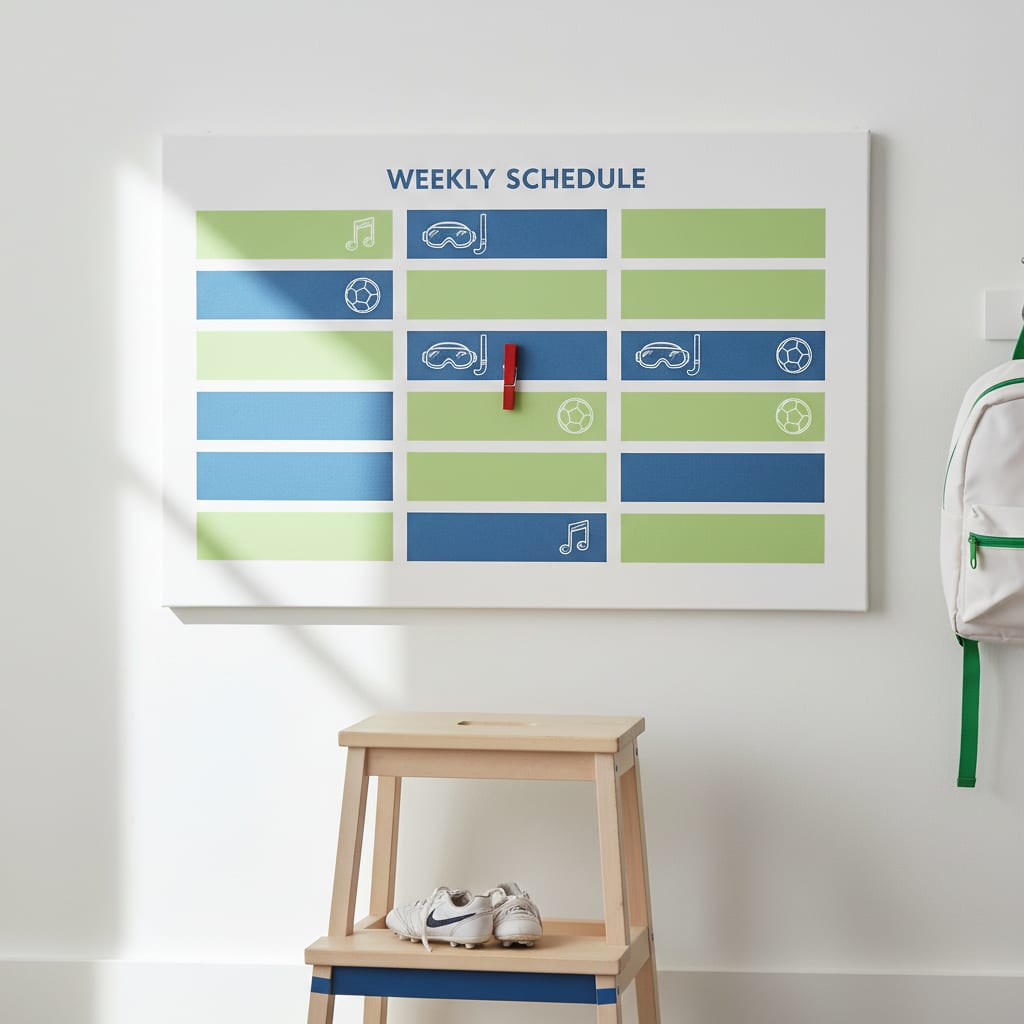
A weekly schedule kids can read has four rules: one row per day (never a time-grid), icons before words, one color per kid, and only the events that change a kid’s day — school specials, practices, the babysitter, the dentist. Print it, hang it at kid height on the command center, and update it Sunday. The goal is a specific, glorious transaction: a child walks to the wall, answers “is tomorrow a swim day?” for herself, and does not ask you. Every design choice below serves that transaction.
Why kids can’t read your calendar
The family calendar is a database: month view, five people, appointment times, small handwriting. Adults query databases fine. A 7-year-old standing in front of one is a tourist reading a train-station departure board in a language she started learning in September — the information is technically present and functionally gone. Kids don’t need the family’s whole schedule anyway; they need their week, rendered at their reading level. That’s a different document, and pretending the wall calendar can be both is how you become the household’s search engine, fielding “do I have practice today?” as a service request eleven times a week.
The four design rules
One row per day. Monday through Sunday stacked vertically, each day one horizontal strip. Adult planners use time-grids; kids think in day-sequence — “today, then tomorrow, then swim day.” A grid asks them to cross-reference two axes; a row asks them to read left to right, which they were literally just taught.
Icons before words. Every recurring event gets a symbol: goggles for swim, a ball for soccer, a music note, a star for library day. Words ride underneath for the readers. My 4-year-old reads goggles fluently; my 10-year-old reads the words and finds the icons babyish and consults them anyway.
One color per kid. Same color they carry on the family calendar — green kid is green everywhere, forever. Color is what lets a pre-reader find her row of the week without arbitration.
Only the exceptions. School happens daily; it doesn’t make the chart. What makes the chart is what varies: PE day (sneakers), library day (the book), practice, the sitter, grandma pickup. A kid chart listing everything is wallpaper by Wednesday; a chart of exceptions stays news.
Where it hangs, and when it updates
Kid height, on or beside the command center — the family information district — but low, at the eye level of your shortest reader. Ours hangs directly below the adult layers, which gives the wall a nice municipal structure: city records up top, public notices at street level. It updates once a week, at the end of the Sunday calendar meeting, copied off the master in about ninety seconds, ideally by a kid old enough to hold the marker. A kid schedule that’s ever wrong is worse than none at all — one stale swim day and your credibility as a wall is finished; they’ll go back to asking you, and honestly they’ll be right to.
By age: the same sheet, three ways
Ages 4–6 get icons and colors only, plus a clothespin or magnet they move down the rows each morning — “today” as a physical object is half the comprehension at this age. Ages 7–9 get icons plus words and start reading ahead; this is peak chart age, when “is tomorrow library day?” permanently stops being your job. Ages 10+ mostly graduate to reading the adult wall, but keep them a row anyway: my 10-year-old claims she’s above the kid chart and checks it every morning, a contradiction I’ve decided not to raise. The chart pairs naturally with the morning routine chart — one answers what’s happening today, the other what do I do next — and together they retire the two questions that otherwise fund your entire 7am hour.
FAQ: kids’ weekly schedules
What should a kid’s weekly schedule include?
Only the things that change their day: practices, school specials like PE and library day, sitters, appointments, and pickup changes. Leave out the daily constants — school itself, meals, bedtime. A short chart of exceptions gets read; a complete chart gets ignored.
How do I make a schedule a pre-reader can follow?
Icons and color, no reliance on words: one symbol per activity, one color per kid, one row per day, plus a moveable marker for “today.” A 4-year-old can’t read Tuesday, but she can find her green row and the goggles on it.
Where should a kids’ schedule be posted?
At your shortest reader’s eye level, in the spot the family already checks — on or beside the command center, near the door or the kitchen. Height is the detail that decides usage: a chart hung at adult level is, functionally, an adults’ chart.
How often should the kids’ schedule be updated?
Weekly, at a fixed moment — right after the Sunday calendar meeting is ideal, copying from the master calendar. Accuracy is the whole product: a chart that’s occasionally wrong teaches kids to skip the chart and resume asking you.