Free Printable Morning Routine Chart for Kids
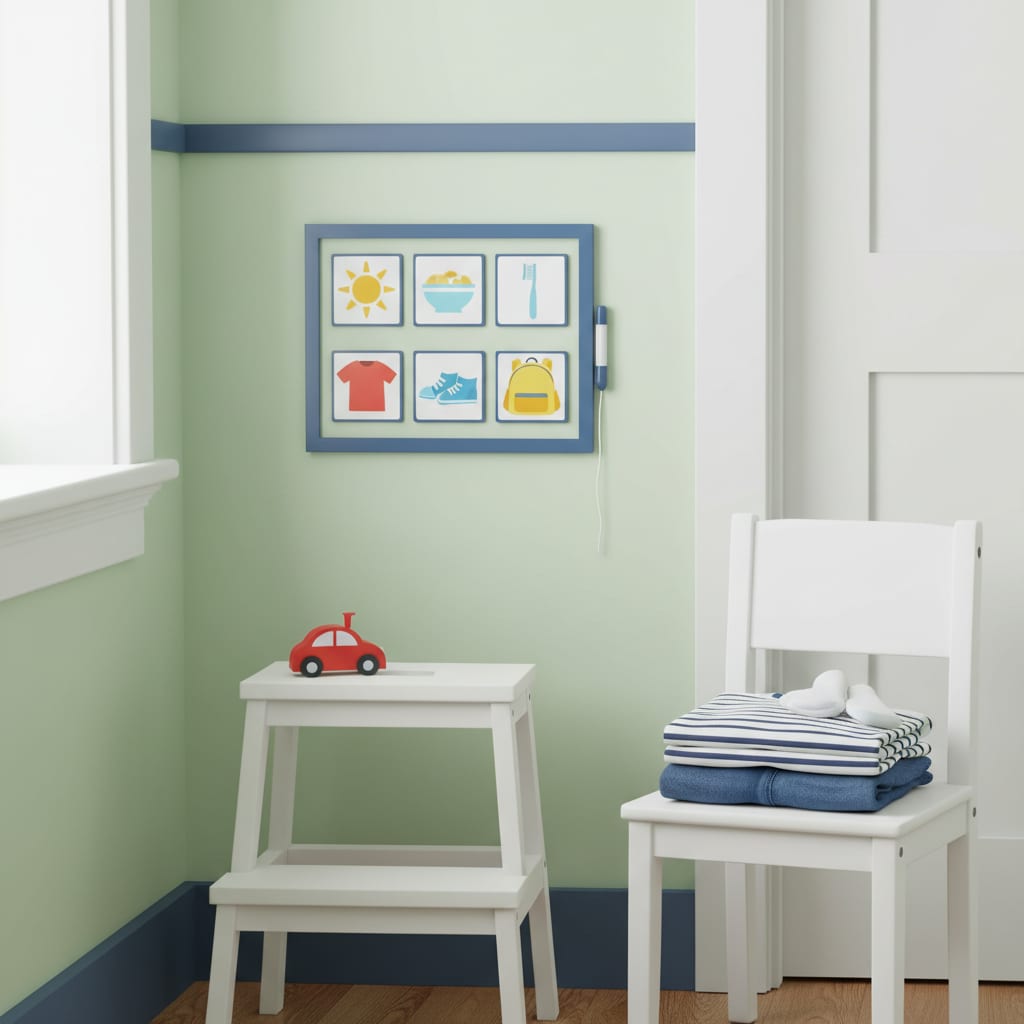
The morning routine chart that actually works has three properties: it shows only the steps that must happen before the door opens, it matches your kid’s reading level (pictures for pre-readers, a checklist for readers), and it hangs where the routine happens — not on the fridge as decor. Our printable set below covers both versions. Print it, laminate it or slide it in a page protector like Avery’s heavyweight sheet protectors, add a dry-erase check per step, and then do the part everyone skips: run it with your kid for two straight weeks before expecting it to run itself.
Why a chart beats a nagging parent
A chart externalizes the sequence. Instead of you being the sequence — “teeth! shoes! backpack! TEETH!” — the wall is, and your voice drops back to one question: “check your chart.” That single shift is why charts work: the argument stops being between you and the kid and starts being between the kid and a laminated card, and the card always wins because the card doesn’t negotiate. In our house it also survived the transition to the full school morning run-sheet, because the chart is just one kid’s lane of that bigger board.
One boundary before we start: this is a routine chart, not a chore chart. Feeding the dog, emptying the dishwasher, allowance tracking — different tool, different post, different corner of the internet. Morning charts carry only the steps standing between your kid and the door. Mixing chores in is the fastest way to make the whole chart feel like homework and die by Friday.
Version 1: the picture chart (pre-readers, roughly ages 3–5)
Six tiles, one image per step, in fixed order:
- Get dressed (clothes were picked last night — the chart assumes a staged morning)
- Eat breakfast
- Brush teeth
- Brush hair
- Shoes on
- Backpack on — grabbed from the backpack station, already packed
Our four-year-old “reads” this chart the way he reads every book he’s memorized: with total confidence and occasional improvisation. That’s fine. The win is that he walks to the chart when he’s lost, instead of standing in the hallway announcing he doesn’t know what to do — a sentence that, before the chart, was said in our house roughly per minute.
Print one per kid even if steps are identical. Ownership matters at this age; a shared chart is nobody’s chart.
Version 2: the checklist chart (readers, roughly ages 6–10)
Same steps, written out, with two upgrades: a time budget next to each step (“Dressed — by 7:10”) and a final line that says “At the door — 7:40” in letters bigger than everything else. Readers don’t need pictures; they need the connection between steps and the clock. My seven-year-old checks boxes with a dry-erase marker; my ten-year-old graduated off the chart entirely last year, which is the point — the chart is scaffolding, not furniture. When a kid runs the sequence unprompted for a month, retire their chart with some ceremony and let the clock take over.
How to introduce the chart (the two-week rule)
- Week zero: build it together. Kids follow charts they helped make with roughly double the goodwill — let them pick the spot it hangs and check the first box.
- Weeks one and two: you are the chart’s hype team. Walk to it together, point, narrate. Do not test whether it “works on its own” yet; it doesn’t, nothing does in week one.
- Week three onward: retreat to “check your chart,” said once. Resist re-narrating. The silence is where the independence grows.
- Any week it collapses: don’t add rewards, add staging. Nine times out of ten a failed chart step is a missing input — no clean socks, unpacked backpack, cereal decision at 7:12. Fix the night-before routine and the chart starts working again on its own.
Do sticker rewards help?
Short honest answer: they help for about two weeks, which makes them a decent launch booster and a lousy engine. Stickers get the chart noticed; the routine itself has to be what keeps it running, because no eight-year-old on earth is motivated by sticker #41. If you use them, use them loudly in week one and let them quietly disappear. The chart’s real reward is structural: mornings where nobody yells, and a kid who gets to feel like the competent operator of their own launch sequence.
Getting the printable
The chart set — picture version, checklist version, and a blank grid for families whose steps differ — goes out to the email list, along with the weekly run-sheet the rest of the house runs on. It’s free, it prints on a home printer in black-and-white just fine, and laminating it is optional but deeply satisfying.
FAQ: morning routine charts
What should a morning routine chart include?
Only the must-happen steps between wake-up and the door: dressed, breakfast, teeth, hair, shoes, backpack. Six or fewer for little kids. Every extra item dilutes the chart’s authority — if it’s not launch-critical, it doesn’t make the board.
At what age do routine charts work?
Picture charts click somewhere around age three, when kids can follow a two-step instruction. The checklist version carries kids until they internalize the sequence — often around 9 or 10 — after which the chart retires and the clock takes over.
Where should we hang the chart?
Where the traffic jam happens. Bedroom door if dressing is the bottleneck, bathroom mirror if it’s teeth, at the backpack station if it’s the launch. The fridge is only correct if your kids actually get ready in the kitchen.
My kid ignores the chart. Now what?
Check the inputs first — most “ignored” charts are actually blocked by a missing sock or an unpacked bag, which is a staging problem, not a motivation problem. Then shrink it: three steps, huge type, two weeks of doing it together again. Charts recover; nagging doesn’t.