Snow Day Activities for Kids: The Plan Made Before 6am
The best snow day for school-age kids runs on a plan made the night before the district calls it, not at the window at 5:45. Three decisions do the work: who covers the adult hours, which three times hold (wake, lunch, bedtime), and a short menu of snow day activities sorted into two outdoor blocks with indoor warm-ups between them. Everything else is weather. Do the fifteen-minute version whenever a winter storm watch is up for the next morning, and the morning call stops being a crisis and turns into a choice between plans you have already written.
The four versions of tomorrow
“Snow day” is one phrase covering four different schedules, and they break different things. Which ones your district actually uses lives in its handbook or its winter-weather notice. Read it once, in November, before you need it.
| Version | What changes | What holds | The trap |
|---|---|---|---|
| Closed | The whole building’s hours land on you | Wake, lunch, bedtime | Treating it as a holiday and losing the clock |
| Delayed opening | Bus, drop-off and before-care all move | Everything after the bell | Before-care may open late or not at all |
| Remote learning day | Kids are home but school hours belong to school | The school-day timetable | One device, two kids, one 9:00 login |
| Early dismissal | The afternoon collapses into midday | The morning | Every carpool and after-care plan breaks at once |
The early-dismissal row is the same problem as a scheduled half day with no warning, and the half-day playbook covers it. The rest of this post is about the closed day, which is the one people mean.
The night-before trigger: a watch, not a rumor
The National Weather Service’s winter alert definitions are the cleanest trigger I know. A Winter Storm Watch is issued “when conditions are favorable for a significant winter storm event”, filed under “Be Prepared”. Warnings are “Take Action!” The NWS also notes that each local office uses local criteria, so the snowfall that triggers a warning in the Northern Plains is typically much higher than in the Southeast.
So the rule in our house: a watch for tomorrow morning means the maybe-plan gets made tonight. Not the group chat’s rumor. The maybe-plan takes fifteen minutes:
- Confirm the alert channel. District texts, the app, or email. One adult owns reading it in the morning, so two people are not refreshing two phones.
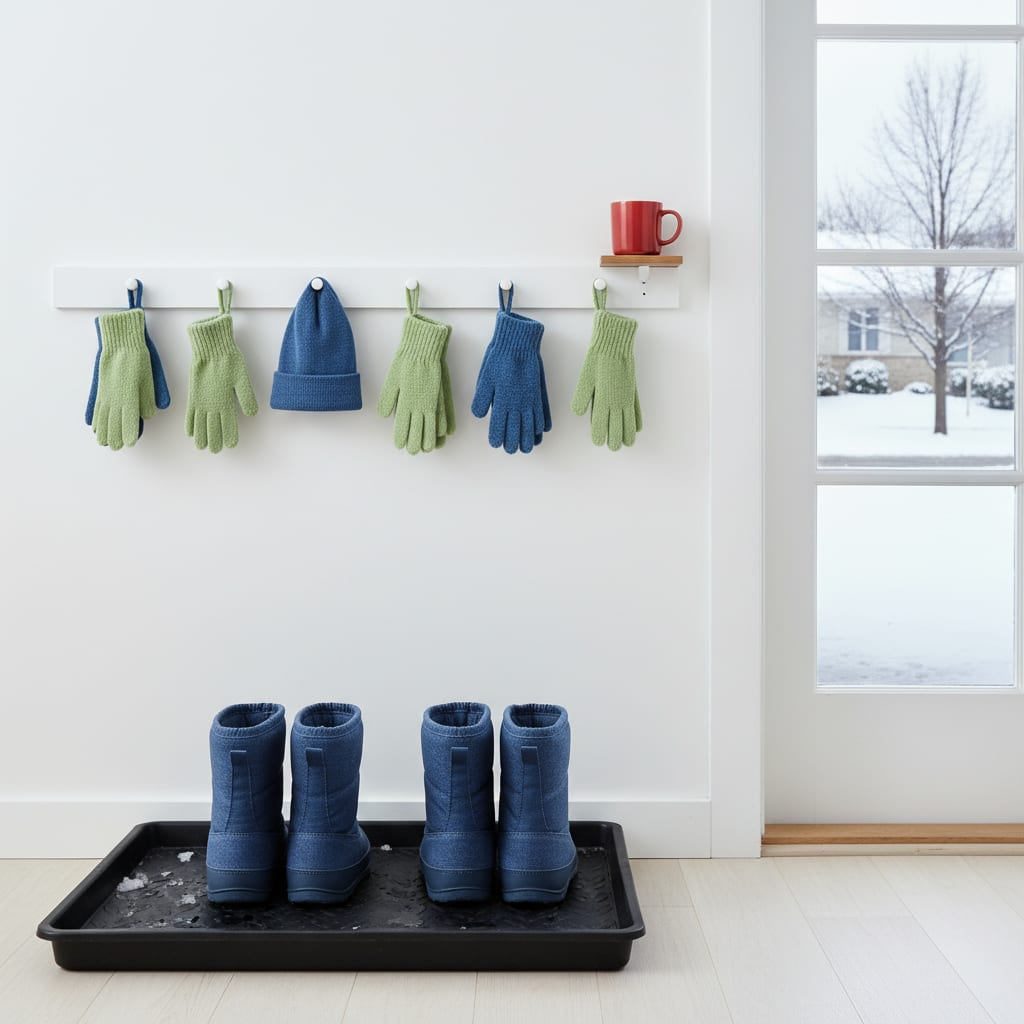
- Stage the gear by the door. Snow pants, boots, mittens and hats, one pile per child, the same way the backpack station stages school mornings. Five minutes at 8pm saves a twenty-minute search at 9am.
- Charge the devices, in case it turns into a remote day.
- Decide coverage (next section), so the 5:45 call needs no conversation at all.
Decide coverage before you go to bed
A snow day uses the same bench as the sick-day plan, with one important difference. A sick day hits one family. A snow day hits the whole street at once, so the neighbor who is your tier-three backup is home with her own kids and needs a backup too.
That is also the opportunity. Two families split the day: one takes all the kids from 8:30 to 12:30, the other from 12:30 to 4:30, and each adult gets a protected half day of work. It is the break-week swap from the school-break plan set up in an evening. Set it up by text the night of the watch, while everyone is still awake. The street roster is where the numbers live.
Then send the work message the night before, conditionally: “If the district closes tomorrow, I’m offline 8:30 to 12:30 and on from one.” If school opens, you send nothing and nobody noticed.
The snow-day shape: three anchors, two blocks
The hold-the-clock rule from break weeks applies harder here, because a snow day can end with school the next morning. Wake time can slide half an hour. Lunch and bedtime do not move.
| Time | Block | Why it’s here |
|---|---|---|
| 7:30 | Wake, breakfast | Half an hour of grace, no more |
| 9:00 | Outside block one | Fresh snow, full energy, best light |
| 10:15 | Inside: warm up, dry out | Wet layers off right away |
| 12:00 | Lunch | The day’s fixed point |
| 1:00 | Quiet hour | Everyone, including adults on calls |
| 2:15 | Outside block two | Before the light goes flat |
| 3:30 | Gear dried and restaged | Tomorrow might be a school day |
| Usual time | Bedtime | Non-negotiable; see why below |
The 3:30 restage is the line that pays off. If the district opens the next morning, the boots are dry and by the door. If it closes again, you run the same day twice.
Snow day activities for kids, sorted by block
Keep the menu short and sorted by where it happens, so nobody has to invent the day at 10:15.
Outside (blocks one and two):
- Sledding, on the rules below.
- A snow fort or wall, built with an opening and with an adult in sight.
- Shoveling the walk, ours or an older neighbor’s, with child-size shovels. It is a real job with a visible finish.
- A snow measuring stick pushed into three spots, checked at each block.
Inside (warm-ups and the quiet hour):
- A board game that ends inside 30 minutes, so it fits a warm-up.
- A blanket fort and a stack of library books for the quiet hour.
- One baking or cooking job, if you want one. The recipe is not this site’s department.
- A one-hour screen block, scheduled rather than negotiated.
Cold-weather rules that go on the wall
The AAP’s winter play guidance on HealthyChildren is short enough to post by the door. The parts that matter for a closed school day:
- Check the wind chill. “In general, playing outside in temperatures or wind chills below -15° Fahrenheit should be avoided.” The AAP also notes that children lose heat faster than adults and “may be less likely to come inside when they’re getting too cold”. That is why the blocks have end times.
- Dress in several thin layers, with insulated boots, mittens or gloves and a hat, and change out of wet clothes right away.
- Take regular indoor breaks. The page does not set a number of minutes. The warm-up blocks are how we build the breaks in.
- Sledding: children under 12 supervised; feet first or sitting up rather than head-first; steerable sleds rather than disks or inner tubes; away from cars and trees; a helmet worth considering.
- Snow forts: supervised, with an opening to exit, because a collapse is a suffocation risk.
Frostbite and hypothermia are medical questions, and the same AAP page covers what to do. I run a schedule, I am not a clinician.
The gear loop: wet at 10:15, dry by 2:15
Two outdoor blocks only work if the gear dries between them. A raised-edge Stalwart boot tray by the door keeps the melt off the floor. A PEET boot dryer turns one pair of boots into two rounds outside. Mittens dry in a row on a peg rail, not in a pile.
The day after
Snow days are rarely free. Many districts build make-up days or remote days into the calendar, and they move whatever was scheduled around them. Check the district calendar the evening after a closure, and re-enter anything that slid: the test, the field trip, the early dismissal.
FAQ
What do you do with kids on a snow day? Run two outdoor blocks, one in the morning and one in early afternoon, with warm-up and quiet time between them. Keep lunch and bedtime at their usual times. A short menu sorted by block beats a long list of ideas.
How long can kids play outside in the cold? The AAP’s HealthyChildren page gives no fixed number of minutes. It says to avoid playing outside below -15°F wind chill, to set reasonable limits and to make sure kids take regular indoor breaks.
Should kids sleep in on a snow day? A little. Let the wake time slide about half an hour and hold bedtime, because the next morning may be a school day.
What is the difference between a winter storm watch and a warning? Per the National Weather Service, a watch means conditions are favorable for a significant winter storm (“Be Prepared”); a warning is issued for a significant winter weather event (“Take Action!”). A watch is the night to make the plan.