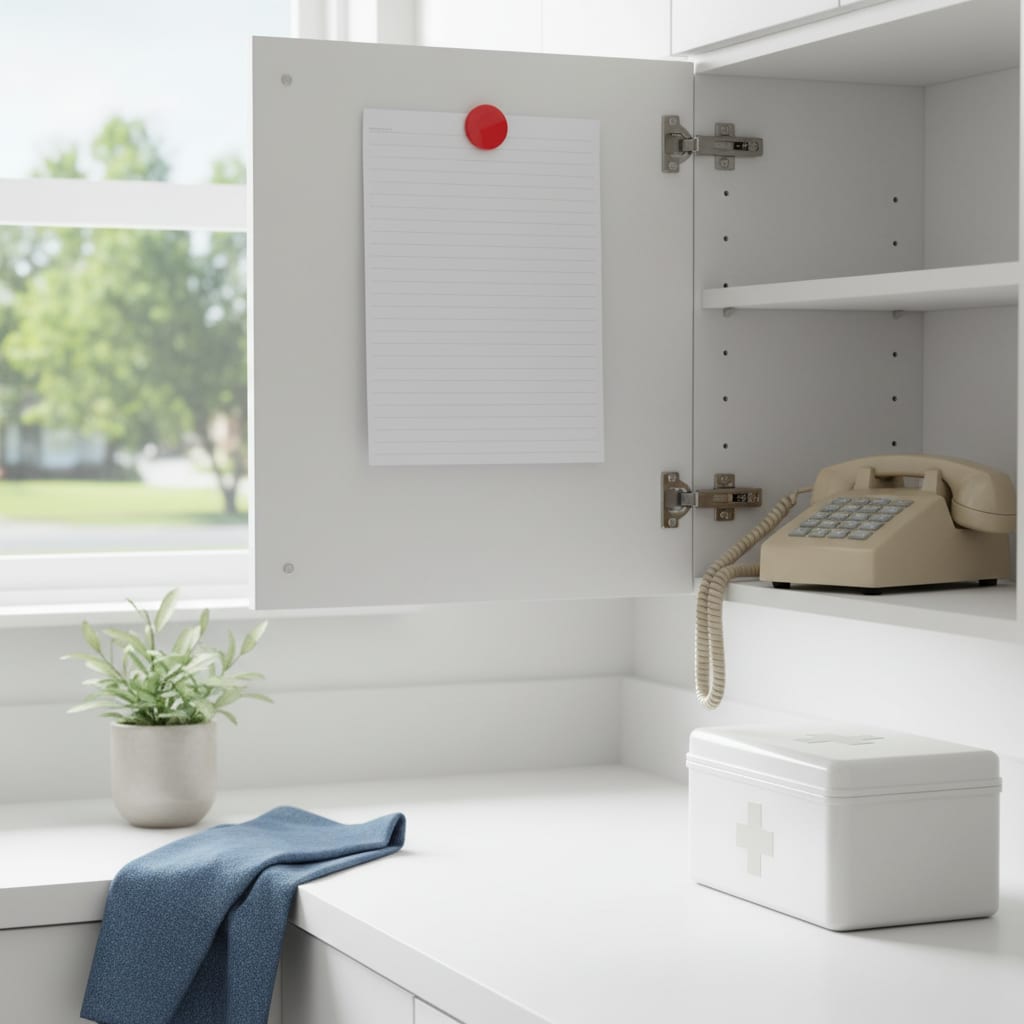
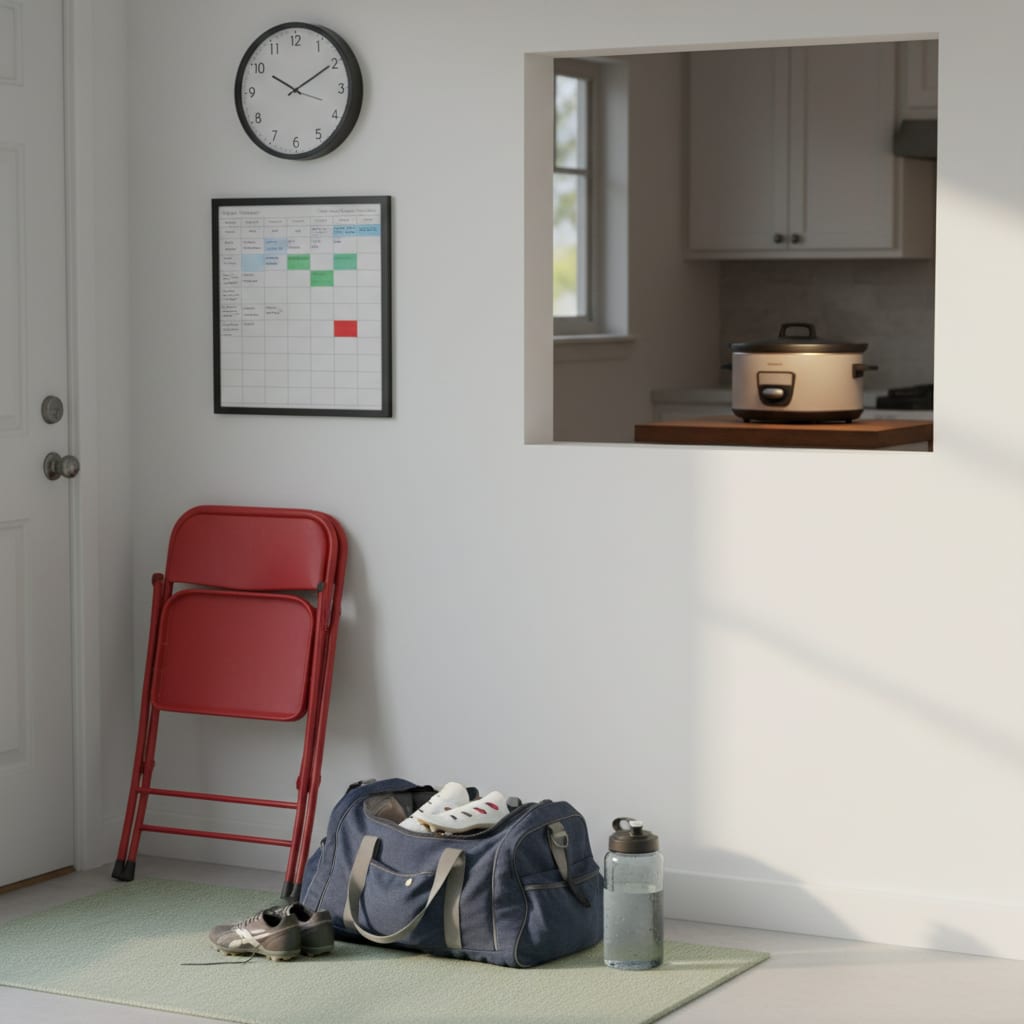
The Family Command Center That Actually Gets Used
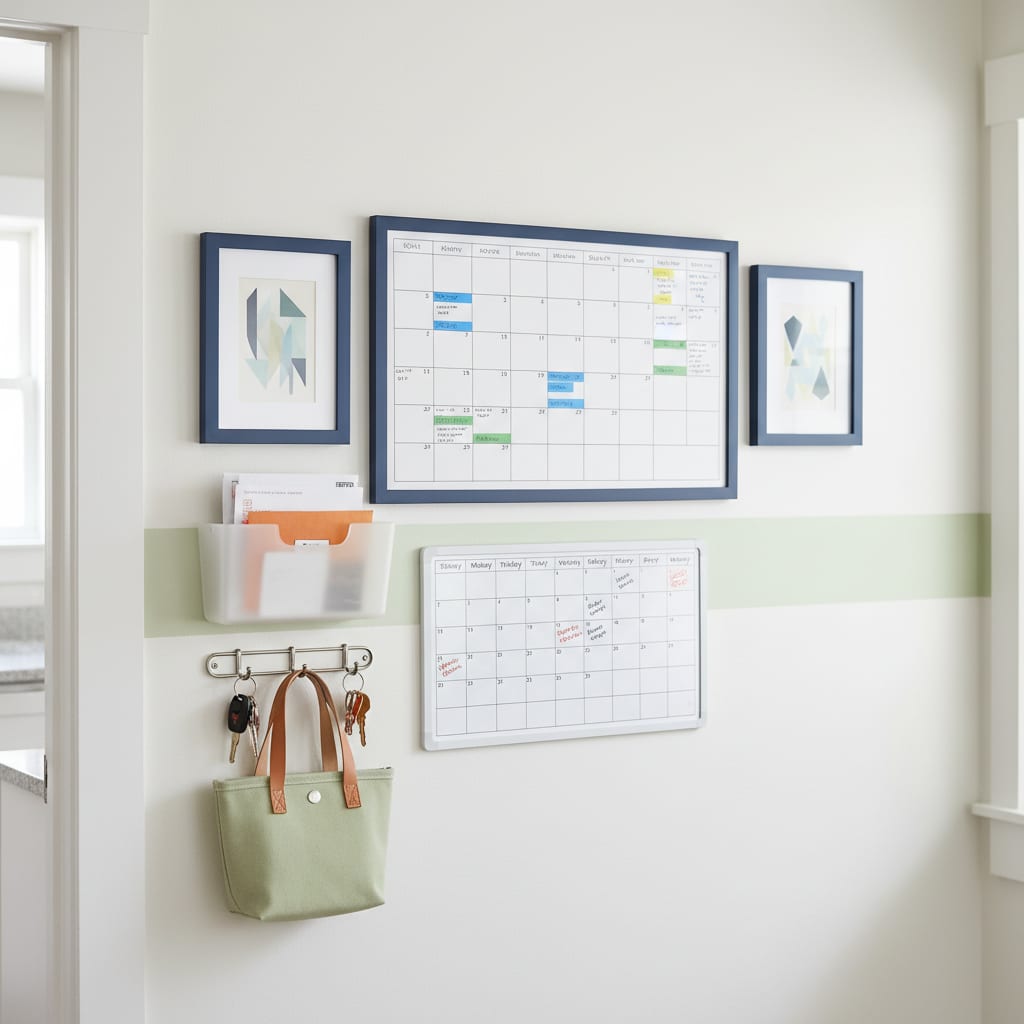
A family command center that actually gets used is a scheduling machine with four working parts: a month calendar everyone can see, a this-week board, a paper inbox with an outflow, and a launch zone for stuff that leaves the house. That’s the entire machine. Most command centers fail because they’re built as decor — a gallery wall with a clipboard cameo — and decor doesn’t get updated on a Tuesday. Build it where the household actually walks, wire each part to a daily habit, and it stops being a wall and starts being how your family knows where it’s supposed to be.
I’ve rebuilt ours three times. Version one was beautiful and dead in a month. Version three has run for two years, because I finally accepted the front-office truth: a command center is a schedule you can stand in front of, not a craft project.
The four working parts
1. The month calendar — the source of truth. One calendar, paper, big, where everything lands: games, dentist, picture day, the in-laws’ visit. One color per person. The family rule that makes it work: if it isn’t on the wall, it isn’t happening. The full color-code method gets its own post — the family calendar system — because it’s the engine of the whole wall.
2. The week board — the zoom lens. A dry-erase board — something like the Quartet 17x23 magnetic whiteboard — showing only this week, rewritten every Sunday from the month calendar: who goes where, which days are early dismissal, whose cleats need to be in the van. Kids don’t read month calendars; they read this week, at their eye level. Ours is a printable weekly run-sheet in a frame we wipe and refill.
3. The paper inbox — with an outflow. One tray where every school paper lands during the afternoon unload. Here’s the critical distinction: the command center handles paper flow — sign it, calendar it, return it, recycle it, ideally within a day. Paper storage — the keepsake art, the records worth filing — is a different discipline; the wall is a river, and the retro-modern folks run the reservoir. An inbox that only takes deposits is a pile with ambition, and it will eat your permission slips.
4. The launch zone. Whatever leaves the house tomorrow stages here tonight — the signed forms, the library books, the borrowed casserole dish. Ours merges into the backpack station three feet away, which is the correct move if your geography allows it: return-flow and launch-flow share a runway.
Family command center ideas that survive week three
- Put it in the traffic, not in the office. The wall by the kitchen or the exit route wins; a command center you must visit is a command center you’ll skip. Ours lives beside the garage door, which is not where I’d stage a photo shoot, which is why it works.
- Go analog for anything kids must read. Shared phone calendars are wonderful for the adults; a wall is the only interface a seven-year-old checks voluntarily. (The screen-calendar gadgets some families mount — Skylight and its cousins — aim at the same job; whether a screen or paper runs your wall matters less than the habits below.)
- Eye levels are load-bearing. Month calendar at adult height, week board and any charts at kid height. A command center only adults can use is a mom center with better branding.
- One writer, many readers. Everyone can read the wall; appointments get added through one dispatcher (me), or the calendar forks into contradictory realities. Requests shout from anywhere; ink happens at the wall.
- Skip the mail sorter with six labeled slots. Six categories is five decisions too many at 3:45pm. In, acted on, gone.
The habits that power the wall
Hardware is Saturday’s job; the habits are forever. Three keep ours alive: the daily inbox pass (with the after-school unload — sign, calendar, return), the Sunday rewrite (ten minutes: next week from the month calendar onto the week board, conflicts caught while they’re still theoretical), and the glance rule — everyone checks the week board at breakfast, which took two weeks of pointing at it before it became involuntary. Notice none of these is “keep it pretty.” Version one of our wall died of pretty.
What a command center is not
It’s not storage (no bins of stuff), not a chore system (different tool, and the multi-kid crowd has charts covered), not a decor moment, and not a mail archive. Every one of those jobs will apply to colonize your wall, and every one of them, accepted, makes the schedule harder to see. The wall does one thing: it tells the household who is where, when, and what has to leave the house. Guard that job and the wall earns its real estate; dilute it and you’ve built a very organized-looking place to lose field-trip forms.
FAQ: family command centers
What should a family command center include?
Four parts: a month calendar (the source of truth), a this-week board at kid eye level, a paper inbox with a daily outflow, and a launch zone for tomorrow’s outbound stuff. Anything beyond that — menus, mail, chores — is optional cargo, and cargo sinks walls.
Where is the best place to put a command center?
On the household’s busiest walking route — usually kitchen-adjacent or beside the everyday exit door. The test: could every family member check it without changing course? If reaching it requires a detour, it will lose to entropy by October.
How do I get my family to actually use it?
Wire each part to an existing daily moment: papers processed at the after-school unload, the week board checked at breakfast, the rewrite every Sunday. Two weeks of you narrating the habits, then the wall takes over. Walls don’t nag, which is precisely why kids will take orders from one.
Do I need to buy a command center kit?
No — a paper month calendar, any dry-erase board, one tray, and a hook zone run the identical system. Spend on the big calendar (visibility is the feature) and skip the boutique matching-frame sets; the wall’s power is the flow, not the font.