Tournament-Day Checklist: Pack Once, Sit Happy
A tournament packing list only works if it’s sorted by pile, not by object: the player bag, the sideline kit, the food-and-water block, and the between-games kit. Four piles, packed the night before, loaded once. A tournament day is not a long practice — it’s three to five hours of sitting between short bursts of sport, usually in a field complex with one bathroom and a concession stand that runs out of ice by ten. Pack for the sitting and the sport takes care of itself. Below is the four-pile list we run, plus the timing plan that keeps a nine-hour Saturday from ending in a parking-lot meltdown.
Pile 1: the player bag
This is the smallest pile and the one people over-pack. It holds only what the athlete needs to play, and the athlete carries it:
- Uniform, including the second jersey if the tournament uses home/away colors — check the rules email, not your memory
- Cleats plus one pair of slides or sandals for between games (feet need out of cleats or the afternoon gets ugly)
- Shin guards, two pairs of game socks, spare hair ties
- Their water bottle, filled
- One small towel
Two spares belong here and nowhere else: a second pair of game socks and spare shin guards a size down. Both live in the gear staging bin year-round and transfer into the bag the night before. That “night before” isn’t a nicety — a tournament load-out done at 6am is a load-out done wrong, and I have the family photo of a kid in mismatched socks to prove it.
If your kid is old enough to own the bag, they pack it against the door list and you spot-check. A vented cleat pocket makes that five seconds instead of an excavation; ours is a plain youth soccer bag with a separate cleat compartment, and that pocket is why the ride home is survivable.
Pile 2: the sideline kit (this is where the day is won)
You’ll be at that complex far longer than your kid is on the field, and sideline comfort is the difference between a fun Saturday and an endurance event:
- Chairs. One per adult, one per sibling. A chair with a real armrest and a cup holder like the Kijaro Dual Lock is the upgrade you feel by hour four; the flimsy ones sag by the second game.
- Shade. A pop-up canopy if the complex allows them, a large umbrella if it doesn’t — plenty of fields ban canopies near the touchline.
- Blanket. For the sibling zone, and for the 8am games in October when the ground is wet.
- Sun and bug. Sunscreen (reapply at the between-games break, not just at 8am), bug spray for evening games, lip balm.
- Weather hedges. A rain shell per person and a fleece per person, in the same bag, always — a tournament day covers two seasons.
- Power. A charged battery bank — your phone is the schedule, the map, the group chat, and the camera.
- Cash. For parking, gate fees, and the concession stand — plenty of small tournaments are still cash-only.
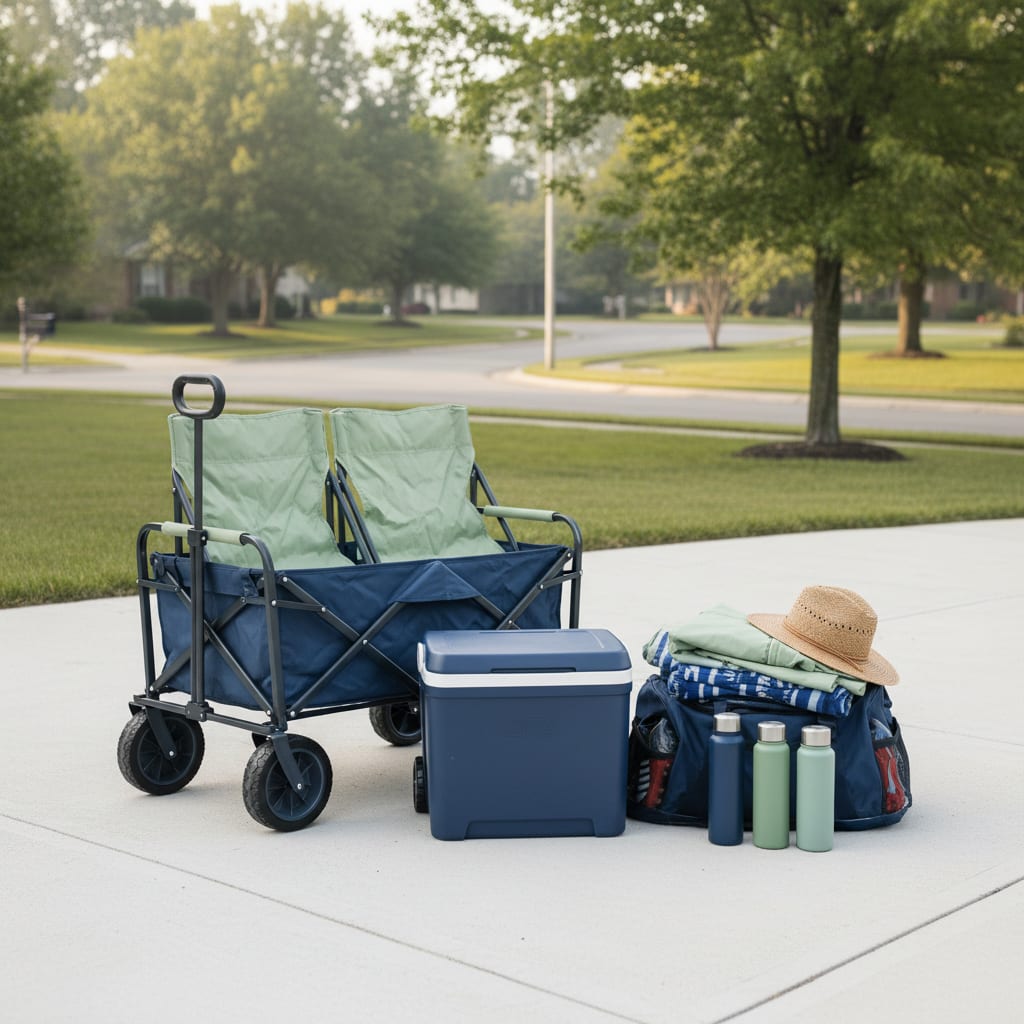
Hauling all that from a distant lot is the actual physical labor of tournament day, which is why a folding wagon earns its storage space faster than any other purchase in youth sports. A Mac Sports folding wagon collapses into the same trunk block that carries everything else in the van setup, and it turns three trips into one.
Pile 3: food and water
Water first, because it’s the one thing that ends days: bring far more than you think, in a hard cooler you refill from, not in individual bottles you ration. A wheeled cooler like the Coleman 62-quart Xtreme holds a full family’s day plus ice into the evening and rolls behind the wagon.
On the food itself, I’ll be honest about my lane: I plan the slot, not the menu. The plan is structural — a real breakfast before you leave, a light snack ninety minutes before each game, the actual meal in the long gap after game one, something with protein waiting in the car for the drive home. What goes in each slot is a question for people who cook better than I schedule; the after-school snack lineup at Hey Mom Blog travels almost unchanged to a cooler.
Two notes worth more than any snack idea. Don’t feed a kid a full meal inside ninety minutes of a whistle — you’ll get a sluggish half and possibly worse. And if you’re the team parent handling group food or the shared cooler, that’s a duty with a real checklist attached; it belongs in the team-mom binder, not in your head on a Friday night.
Pile 4: the between-games kit (the siblings’ day)
The kid who isn’t playing is at that complex for the same nine hours with none of the purpose, and “they’ll be fine” is a plan that expires around 11:15am. Give them a kit that appears only at tournaments — scarcity is the entire magic — with a card game, a sketchpad, a ball of their own, and one screen with downloaded content for the midday gap. Add a sibling spot on the blanket that isn’t the touchline, because a four-year-old on the touchline is a four-year-old you’re watching instead of the game.
Also plan the gap, because tournaments have one long dead stretch and it’s the hinge of the day. In order of preference: leave the complex entirely (real food, real bathroom, air conditioning), find shade and go quiet, or — the emergency option — walk. Four straight hours in a folding chair is how tired becomes cranky becomes a fight in the parking lot at 6pm.
The day plan, in times
| Time | Block |
|---|---|
| Night before | Four piles packed, car loaded, uniform laid out, phones charging |
| Departure minus 45 | Real breakfast, water bottles filled, one last door-list check |
| Arrive minus 60 | Park, wagon loaded, find the field, chairs up before warm-ups |
| Between games | Leave the complex if the gap is over 90 minutes; eat, reset, reapply sunscreen |
| Last whistle | Cleats off, water in hand, cooler ice-check before the drive |
| Home | Gear out of the bag, uniform to the wash, cooler emptied — tonight, not tomorrow |
That last line is the one people skip. A bag left packed on Sunday morning is a science experiment by Tuesday and a missing shin guard by Wednesday. Unload at the same standard as any other night — the season-long sports system only holds if the biggest days follow the same rules as the small ones.
If the tournament involves a hotel or more than one night, you’ve crossed into travel planning, which has different packing math — the road-trip-with-kids playbook is the right starting point. Everything above assumes you sleep in your own house.
FAQ: tournament day
What do you bring to a youth sports tournament?
Four piles: the player bag (uniforms including the alternate, cleats, slides, shin guards, spare socks, filled bottle), the sideline kit (chairs, shade, blanket, sunscreen, rain and warm layers, battery bank, cash), food and water in a hard cooler, and a between-games kit for siblings. Pack all four the night before and load once.
How early should you arrive at a tournament?
About an hour before the first whistle. That covers parking at a distant lot, hauling gear in, finding the right field among six, and getting the athlete to warm-ups unhurried. Later arrivals mean a rushed warm-up and no shade left on the good side of the field.
What do you do between games at a tournament?
If the gap is over ninety minutes, leave the complex — real food, a real bathroom, and air conditioning reset everyone far better than another hour in a camp chair. For shorter gaps, get out of the sun, get cleats off, rehydrate, and keep the eating light until after the last game.
How do you keep siblings happy at all-day tournaments?
A tournament-only activity kit that never appears at home, a shaded spot off the touchline that’s theirs, a planned walk or playground break during the long gap, and one screen with content downloaded in advance for the dead midday hour. Treat the sibling’s day as a schedule to plan, not a stretch of time to survive.