Gear Staging: Never Drive Back for the Cleats Again
Sports equipment organization has exactly one job: making sure the gear is where the departure happens at the moment the departure happens. Everything else — the labels, the bins, the color coding — is decoration on top of that. The system that works is four parts: one bin per kid per sport, staged by the exit you actually leave through; a door list naming what’s in it; an unload rule that puts gear back on arrival, not “later”; and a car kit that catches the misses. Set it up in week zero of the season and the 4:45 launch turns into grab-bin-and-go. Skip it and you will, I promise, drive back for the cleats.
Stage at the exit you actually use
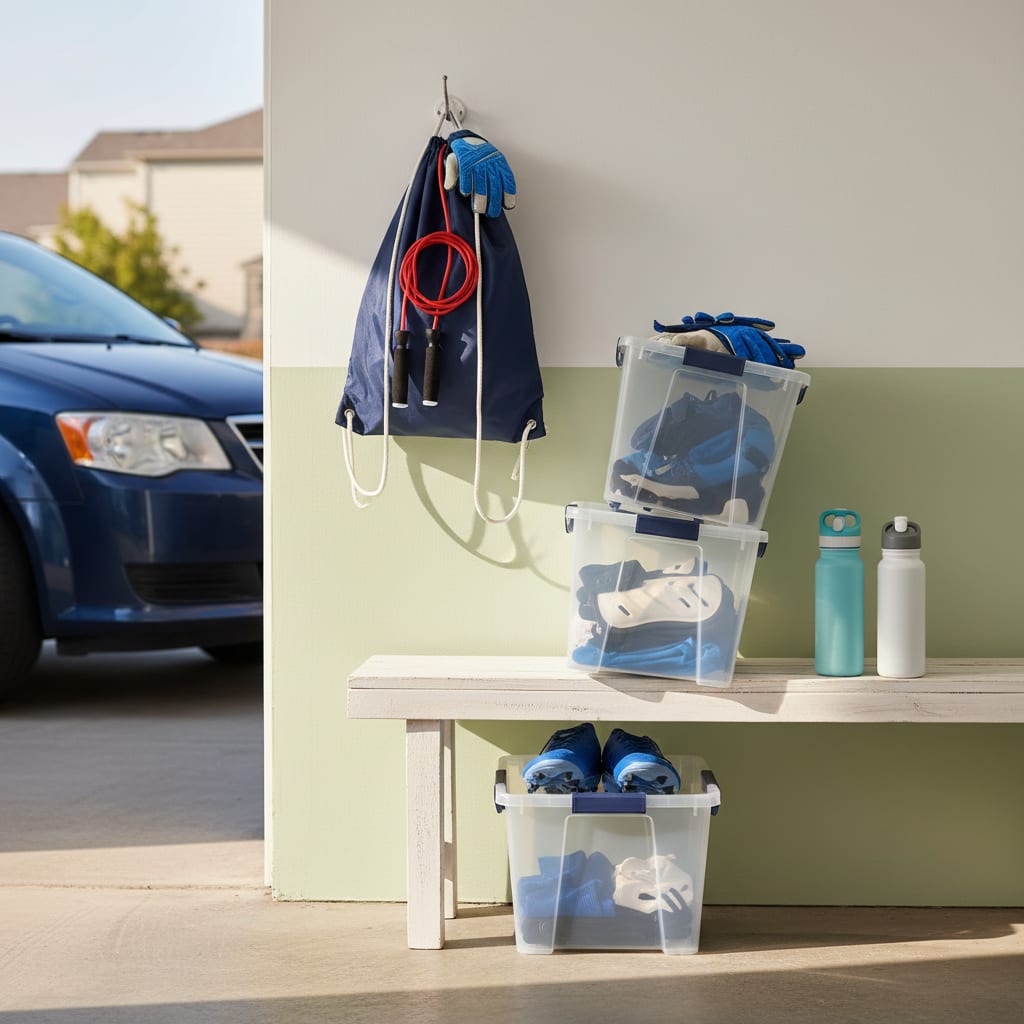
Most gear systems fail because they’re built somewhere sensible instead of somewhere true. Ours lived in the upstairs closet for exactly one season — beautifully organized, wrong floor, wrong door, useless at 4:45 with a car running. Gear staging belongs at the exit you actually leave through on a practice night, which in most suburban houses is the garage door, because the minivan is the departure point and the last ten feet before it are where things get forgotten.
So walk the path once: kitchen, hallway, garage step, van. Whatever surface sits within arm’s reach of that step is your staging zone — a shelf, a bench, a stretch of wall. It doesn’t need to be pretty; it needs to be on the way, because a station one room off the path is a station your kids walk past for fourteen weeks. Same principle as the backpack station on the school-morning side of the house.
One bin per kid per sport
The unit of gear staging is not “the sports bin.” It’s one bin per kid per sport, because the second a household holds two sports, a shared bin becomes an archaeology dig at 4:40. Soccer bin holds cleats, shin guards, the game socks, ball, and water bottle. Swim bin holds cap, goggles, two towels, and the bag that lives permanently damp. Each kid’s bins stack in their own column.
Clear latching totes beat open crates for one reason: you can see the contents without unstacking, and the latched lid means the pile doesn’t reorganize itself when a bin gets carried sideways. A six-pack of Sterilite’s 66-quart ClearView latch boxes covers a two-sport, three-kid house with spares, and they stack square. Size matters more than brand — 60-ish quarts swallows a full soccer kit with the ball; smaller and the ball rides loose in the van forever.
For the kid old enough to own the process, swap the bin for a bag with a separate ventilated cleat compartment — something like the Athletico youth soccer bag — and the bin becomes the bag’s parking spot. My ten-year-old’s bag goes bin → shoulder → van without ever being unpacked, and that’s the endgame: the kid carries one object.
Two things must not go in the bin: anything that needs charging, and anything that needs washing. Uniforms return only once they clear the laundry — a jersey put back dirty is a jersey discovered dirty at 4:50 Saturday. Hang the sport-adjacent stuff you can’t stack — jump ropes, goalie gloves, the swim bag that must drip — on hooks above the bins; a strip of Command large utility hooks does that without a drill.
The door list (the part everyone skips)
A bin only works if somebody can check it in fifteen seconds. So the wall above the bins carries a door list — one short line of gear per sport, written once, laminated, hung at kid height:
| Sport | Door list |
|---|---|
| Soccer | Cleats · shin guards · game socks · ball · full water bottle |
| Swim | Cap · goggles · 2 towels · flip-flops · dry clothes bag |
| Basketball | Court shoes · reversible · ball · full bottle |
Five items, no adjectives. The kid reads it, touches each item in the bin, and calls “checked.” That verbal call isn’t a cute family ritual — it’s the audit that catches the missing shin guard while we’re still in the garage instead of on the sideline. The load-out block on a practice-night time map is ten minutes long and the door list is the whole content of it.
Water bottles get their own line on every list, because they’re the most-forgotten object in youth sports. Give every kid one bottle that lives in the bin between uses — a straw-lid insulated bottle like the 12-ounce Hydro Flask kids’ survives a season of field gravel and is identifiable at a distance from twenty near-identical ones in a pile.
The unload rule
Here is the sentence that saves more evenings than any bin: gear returns to the bin on arrival, not later. The unload happens in the garage, before anyone goes inside, while everyone is still in car-mode. Bags out, cleats knocked together over the grass, wet things hung, bottle to the sink, bin restocked. It takes ninety seconds when it happens then and twenty-five minutes when it happens Saturday morning.
The enforcement mechanism, since eight-year-olds are not naturally compliant with logistics doctrine: nobody’s screen unlocks until their bin is restocked. Cleats live in the bin by 8:05pm or they live in the lost-and-found — both places teach the lesson, one costs a replacement pair.
Uniforms are the exception that needs a rule of its own. Practice clothes go straight to the laundry; game uniforms go into a mesh bag hung on the hook, wash on a named day (ours is Thursday, because Saturday games), and return to the bin folded. A uniform without a named wash day is a uniform you will be hand-drying at 7am.
The car kit: your backup goalie
Even a perfect station misses sometimes, so the van carries a small gear kit that turns a drive-home into a shrug: spare shin guards a size down, a spare pair of game socks, a hair-tie card, sunscreen, a folded emergency towel, and a ziplock of band-aids. It lives in a fixed spot — for us, the seat-back pocket behind the passenger seat, which is part of the larger minivan setup and never gets repurposed for snacks. Restock it at the season’s midpoint and forget it otherwise.
What the car kit is not is a second gear system. The moment it holds a whole backup kit you’ve built a bin in your trunk, and trunk bins get raided — so the day you need the spare shin guards, they’re on the garage floor. The season-wide picture lives in the sports-mom system; gear staging is the piece that keeps the physical objects honest.
FAQ: sports equipment organization
Where should sports gear be stored at home?
At the exit your family actually leaves through — usually the garage or mudroom door, within arm’s reach of the path to the car. A gear station in a bedroom or upstairs closet loses to convenience every single practice night. If the only usable spot is small, go vertical: one narrow shelf column of bins plus a hook strip beats a beautiful setup in the wrong room.
How do you organize sports gear for multiple kids?
One bin per kid per sport, stacked in per-kid columns, each with its own five-item door list. Never share a bin between kids or between sports — shared bins force a search at exactly the moment nobody has time to search. Label the front face of each bin so the column reads correctly while stacked.
How do you stop kids from losing sports equipment?
Make the return trip as scripted as the departure: gear goes back to the bin on arrival, before anyone enters the house, with a consequence attached to skipping it. Add one identifiable water bottle per kid, write initials inside cleats and goggles, and do a door-list touch-check out loud before you pull out of the driveway.
What should I keep in the car for practice?
A small fixed kit: spare shin guards one size down, spare game socks, hair ties, sunscreen, a folded towel, and band-aids. Keep it in one permanent spot and restock it midseason. Resist expanding it into a full backup gear set — a duplicate system in the trunk gets raided and stops being reliable.