The Sports Mom System: A Season Without Dropped Balls
Being a sports mom is a logistics job, and the families who look effortless on the sideline are running four systems: a schedule merge the day the season calendar drops, gear staging so equipment lives ready instead of lost, a carpool web with named backups, and a practice-night time map that decides dinner before 3pm. None of it requires a spreadsheet personality — it requires doing four setup tasks once, in week zero, instead of improvising all fourteen weeks. Two soccer teams and a swim schedule that changes weekly taught me this the expensive way; this is the version I wish someone had handed me at the first sign-up table.
System 1: the schedule merge (do it the day the calendar drops)
The team schedule arrives — PDF, app, or a coach’s text with strong ransom-note energy — and the temptation is to “deal with it as it comes.” Don’t. That evening, merge every game, practice, and tournament onto the family calendar in that kid’s color, with departure times, not start times (“leave 4:50,” because 5:15 is the coach’s problem and 4:50 is mine). Then immediately hunt conflicts: overlapping practices, a game against the dentist, the Saturday with two kids on two fields in two towns. Week-zero conflicts are solved with a text; game-day conflicts are solved with tears in a parking lot. Fifteen minutes, once — the highest-leverage evening of the season. From then on, each week’s games flow onto the weekly run-sheet with the rest of the family freight.
System 2: gear staging (the cleats live in the bin now)
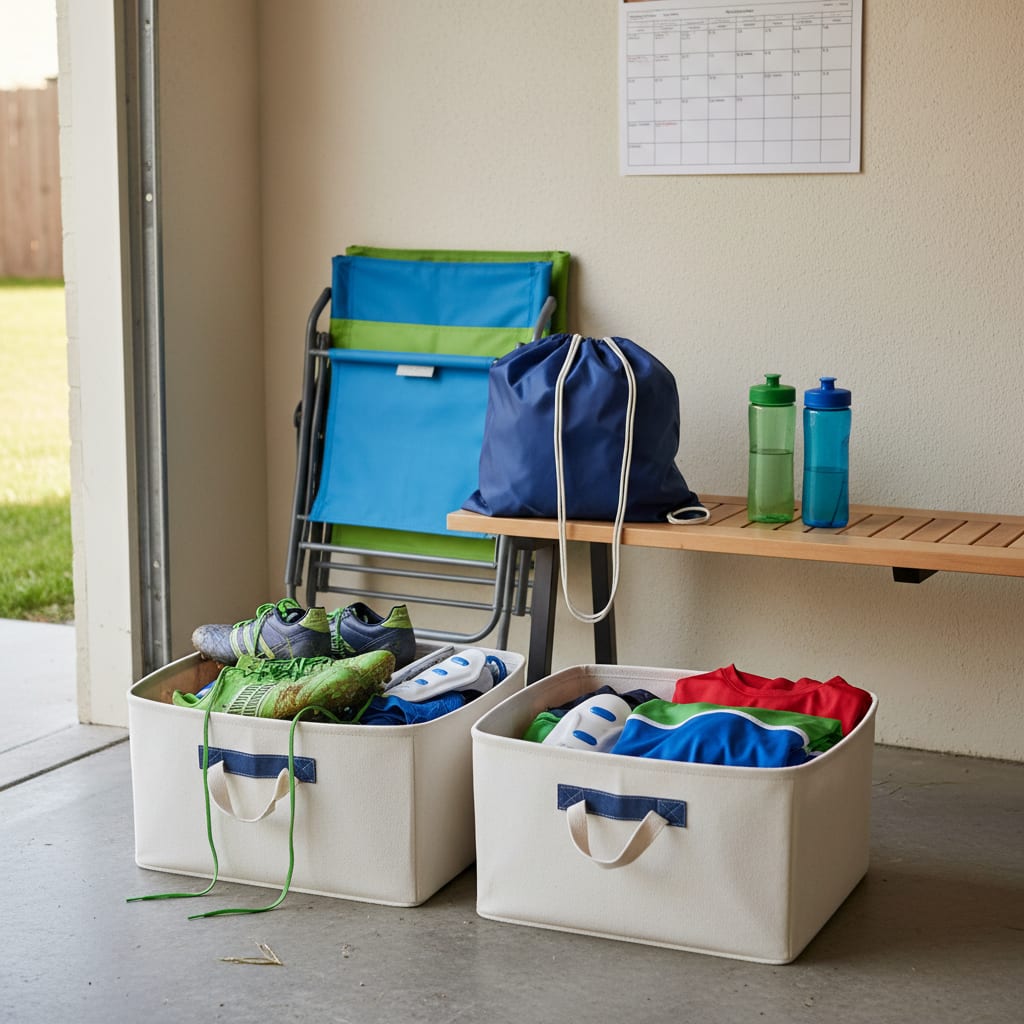
Sports gear has exactly one failure mode — not being where the departure happens — so give every kid-sport a staged home: one bin per kid per sport near the exit, holding cleats, shin guards, water bottle, and the uniform the moment it clears the laundry. The rule that makes it work is the same one that runs our backpack station: gear returns to the bin on arrival, not “later.” Unload happens in the garage, bin gets restocked at the evening staging pass, and the 4:45 launch becomes grab-bin-and-go. My kids’ cleats live in the bin by 8:05pm or they live in the lost-and-found; both locations teach, one of them cheaper.
Two clarifications about scope, because this is a logistics site with lane discipline: what your kid eats before practice and whose week it is to bring team snacks are food questions — the sign-up sheet is my department, the menu belongs with the food folks. And what you wear on the sideline is a style question that other bloggers cover beautifully. I bring a chair, a water bottle the size of a toddler, and no opinions.
System 3: the carpool web (with named backups)
A carpool isn’t a favor economy; it’s infrastructure, and infrastructure needs specs. Ours: a fixed weekly pattern (I drive Tuesdays, the Patels drive Thursdays), written down and shared, with a named backup for every leg — because the question isn’t whether someone gets stuck at work, it’s when. Add the boring-but-critical layer: every driver has every parent’s number, every kid’s seat situation is known, and changes get texted to the group, not to whoever you saw at pickup. The no-show protocol is agreed in advance: fifteen quiet minutes of margin in the schedule, group text at five, backup rolls at ten. One awkward conversation in August prevents six frantic ones by October.
System 4: the practice-night time map
Practice at 5:15 doesn’t cost you 90 minutes; unmanaged, it costs the whole evening — which is why practice nights get mapped like a flight plan. Ours, for a 5:15–6:30: homework compresses to the must-do sheet at 4:15, launch at 4:50, and dinner is decided by 3pm because a crockpot going on at three is what saves the 6:45 re-entry. (What’s in the crockpot is a food question — the time map just guarantees the slot.) The map’s real job is protecting the back end: home by 6:45 means the bedtime anchor still holds, and a season of practices doesn’t quietly become a season of 9:30 lights-out and Thursday meltdowns. Sleep is the budget the whole sports schedule spends from; the time map is how you keep the account solvent.
The sideline is the payoff
Here’s the part the “sports mom era” memes get right: this life is genuinely fun when the logistics are boring. The chaos version — screaming into the junk drawer for a missing shin guard at 4:52 — and the systems version watch the exact same game; only one of them enjoys it. Set up the four systems in week zero, expect them to wobble for two weeks, and then spend the season being the parent in the camp chair who looks suspiciously calm. You’ll know the truth: you’re not calm, you’re staged. Same result from the bleachers.
FAQ: sports-mom logistics
How do working parents manage kids’ sports schedules?
Merge the season calendar into the family system with departure times the day it drops, then pre-solve coverage with a written carpool pattern plus named backups. The families that survive multi-sport seasons don’t have more time — they have fewer game-day decisions.
How do you handle two kids with overlapping practices?
Divide-and-conquer with the carpool web: you take one leg, a partner or carpool family takes the other, decided at the weekly sync rather than day-of. For chronic overlaps, ask the coach about the sibling-practice-slot swap — clubs handle this constantly and almost nobody asks.
What should a sports mom keep in the car?
A season kit that lives there: camp chairs (a sturdy one like the Kijaro Dual Lock), a blanket, sunscreen and bug spray, a towel, a small first-aid kit like the Band-Aid Travel Ready kit, water, and a phone charger. The bin system extends to the vehicle — restock it at the Sunday sync, not at the field.
How early should we leave for practice?
Write the departure time on the calendar, not the start time: count backwards from cleats-on-the-field, including parking and the walk. For most local practices that’s 20–25 minutes of true margin. Chronic lateness is almost never a driving problem; it’s a “we scheduled the start time” problem.