Hosting a Sleepover With a Baby in the House

You can host an older child’s sleepover with a baby in the house if you plan the evening around the baby’s clock rather than the party’s. Put the guests in the room farthest from the baby. Set arrival for after the afternoon nap. Split the night into a loud phase that ends at the baby’s bedtime and a quiet phase after it, and tell the guests’ parents about both at drop-off. Give one adult the baby’s bedtime and the other the guests. Then plan the morning, because the baby will be up hours before anyone in sleeping bags.
Four things move: the date, the rooms, the noise and the morning. The baby’s schedule is the fixed point.
Pick the night on the baby’s calendar, not just the big kid’s
The older child picks the friend. The family calendar picks the night. Check three things before the invitation goes out:
- No early start the next morning. A Saturday-morning game or an early family plan on the day after a sleepover means a short-slept crowd and a baby who was also woken early.
- The baby’s week is ordinary. If the baby is getting over a cold, in the middle of dropping a nap, or just back from a trip, move the sleepover a week. It’s an easy change when nobody has been invited yet.
- Both adults are home. One adult can run a sleepover, and one adult can do a baby’s bedtime. Doing both at once, at 7:15 with four ten-year-olds in the kitchen, is where these nights go wrong.
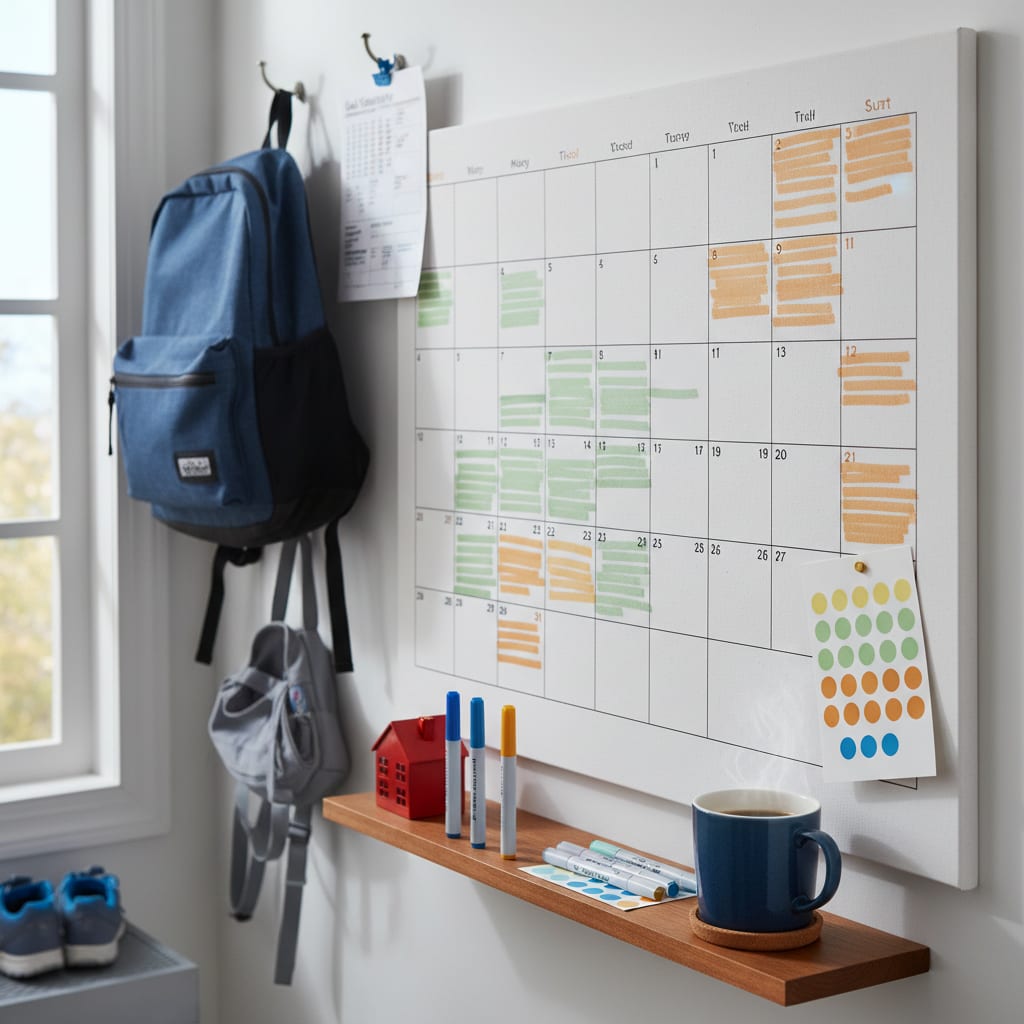
Put it on the family calendar with a lead-time reminder the Monday before, so the room shuffle and the grocery run don’t land on Friday afternoon.
Room placement: put distance between the two rooms
Walk the house and find the room farthest from where the baby sleeps. That’s the sleepover room, even if it isn’t the birthday child’s bedroom. A family room at the other end of the house, or a finished basement, beats the bedroom next to the nursery every time. It also helps to have a door you can close, and a floor below or a hallway between.
Then walk the route the guests will take at night: sleepover room to bathroom, bathroom back. If it goes past the baby’s door, pick a different bathroom and tell them which one. A small warm night-light in the hallway stops a sleepy guest opening the wrong door.
Should the baby sleep somewhere else for the night? Sometimes the simplest move is the baby’s crib staying put and the baby spending one night in the parents’ room, if that room is farther from the guests. If you do that, the rules for where the baby sleeps don’t change for one night. Betteroo’s checklist for a safe sleep setup sets out the basics: the baby sleeps on their own “firm, flat, approved sleep surface with only a fitted sheet”, which means a play yard or bassinet and not the parents’ bed, with the same bare setup wherever it is.
The noise curfew: two phases, one time
The mistake is trying to keep a sleepover quiet all evening. It won’t be, and nobody enjoys it. Split the night into two phases with a time between them:
| Phase | When | What happens |
|---|---|---|
| Loud phase | Arrival to the baby’s bedtime | Dinner, games, running around, the loud movie. Nobody shushes anybody. |
| Quiet phase | The baby’s bedtime onward | Guests move to the far room. Quiet movie, card games, snacks, talking. |
| Lights-out | A time you set and announce | Lights off, voices down. The time is on the drop-off message, not decided on the night. |
Tell the kids about the switch at the start: “At 7:30 the baby goes to bed, and that’s when we move to the family room. Loud stuff happens before then.” A rule announced in advance feels like part of the plan. The same rule announced at 7:40 feels like a telling-off.
The quiet phase is also where steady sound in the baby’s room does its job. A plain fan-style white-noise machine like the Yogasleep Dohm evens out the thumps and bursts of laughter coming down the hall. Betteroo’s guide to running a sound machine at a safe volume gives the two numbers: at or below about 50 decibels, and at least seven feet from the crib. It also says to run it through the whole sleep rather than on a timer, because the sudden silence when a timer clicks off can wake a baby too. On a sleepover night that matters, because the loudest laugh of the evening can come at any point after lights-out.
This is the same sound-and-light split as homework running past a younger sibling’s bedtime, just with more children.
The baby’s day: protect the nap and the bedtime
The sleepover’s timing should fit around the baby’s day. Two rules:
- Arrival after the afternoon nap. If the baby naps until 3:30, guests arrive at 4:00 or later. A doorbell and six feet running across the hallway at 2:45 ends the nap early, and a short nap means a harder bedtime on the busiest night of the month.
- Bedtime doesn’t move. Don’t push the baby’s bedtime later so they can “join the party”. An overtired baby on a noisy night is usually harder to settle, and the whole evening pays for it.
Split the adults by job. One adult runs the baby’s bath and bedtime at the normal time, in the normal order. The other runs the switch to the quiet phase and moves everyone to the far room. Then swap if you like. The job to avoid is being the person doing both.

The morning after: two households on different clocks
The baby will be up at their usual time. The guests went to sleep late and will wake up later, or all at once and early. Plan for both:
- The baby’s morning happens away from the guests. Take them straight to the kitchen or out for a walk, at the far end of the house from the sleeping bags.
- Breakfast has a time. Say 8:30. Anybody still asleep at 8:30 is woken gently, so pickup doesn’t happen before breakfast is over.
- Pickup has a time too, and it’s on the invitation. A pickup time of 10:00 means the morning has an end, and the baby’s morning nap isn’t happening in a house full of kids who don’t know when they’re leaving.
If the night went badly for the baby, with a wake-up in the quiet phase or a short night, the next day’s nap often has to come earlier. Plan a quiet afternoon rather than a busy one.
What to tell the guests’ parents
Put it all in the invitation message, so it’s agreed before anyone arrives. The playdate etiquette of drop-off, pickup and allergies still applies, with three additions:
“Drop-off 4:00 — our baby naps until then. We move to the family room at 7:30 when the baby goes to bed, lights-out at 10. Pickup 10:00 tomorrow. If anyone gets homesick, we’ll call you, whatever the time.”
That last line matters. A homesick guest going home at 10:30 is a normal part of sleepovers. Agreeing on it in advance means it’s a phone call, not a crisis.
FAQ: sleepovers with a baby in the house
Is it rude to set a noise curfew for guests? No. Kids will go along with a rule they were told at the start. Present it as “at 7:30 we move to the family room,” not “you have to be quiet because of the baby,” and it’s just part of the plan.
What if the baby wakes up during the sleepover? The adult on baby duty handles it exactly as on any other night. Don’t bring the baby out to the guests. That turns one wake-up into a much longer one.
Can the older child’s sleepover be in the room they share with the baby? Not on the same night. Move the sleepover to another room, or the baby to the parents’ room on a safe separate surface, for that one night.