Homework Past a Younger Sibling's Bedtime: What Moves
The homework can’t move much and the four-year-old’s bedtime shouldn’t move at all, so the things that actually move are where the homework happens and which part of it happens when. Sort a week of assignments by three questions — does it make noise, does it need a lit surface, does it need an adult sitting there — then put the loud, adult-shaped half before the little one’s lights-out and leave only the quiet half for eight o’clock. That is the whole fix, and it costs nothing but one evening of rearranging.
Homework is not the variable you think it is
Most evening advice assumes the late thing is optional. Homework isn’t. It arrives at a size somebody else chose, on a night you didn’t pick, and “just do it earlier” runs into a ten-year-old who got home at 5:40 and has already spent the earlier. So the negotiable inputs are not whether, and not really when — they are which surface, which light, which adult.
One thing to check first: most districts publish a target homework time by grade in the handbook. If your child routinely runs double it, that is a conversation with the teacher, and no amount of clever evening design fixes it.
Triage the homework before you triage the evening
Spend ten minutes with a week’s worth of assignments and sort them. Almost everything falls into one of five shapes:
| Homework type | Noise | Needs light | Needs an adult | Where it goes |
|---|---|---|---|---|
| Reading aloud, spelling, times tables | Loud | Some | Yes | Before 7:30, always |
| A long project or poster | Loud + spread out | Lots | Yes | Weekend or straight after school |
| Worksheets, math practice | Quiet | Yes | On call | Either side |
| Silent reading | Silent | A little | No | The perfect after-bedtime task |
| Studying from a device | Quiet | Its own | No | After, with the door shut |
The point of the table is the bottom two rows. There is nearly always something that can be done quietly, alone, under a small light — and if your eight o’clock slot holds only those, the collision disappears without anybody renegotiating a bedtime. What wrecks an evening is reading aloud at 8:10, three feet from a shut door.
The light is the part nobody names
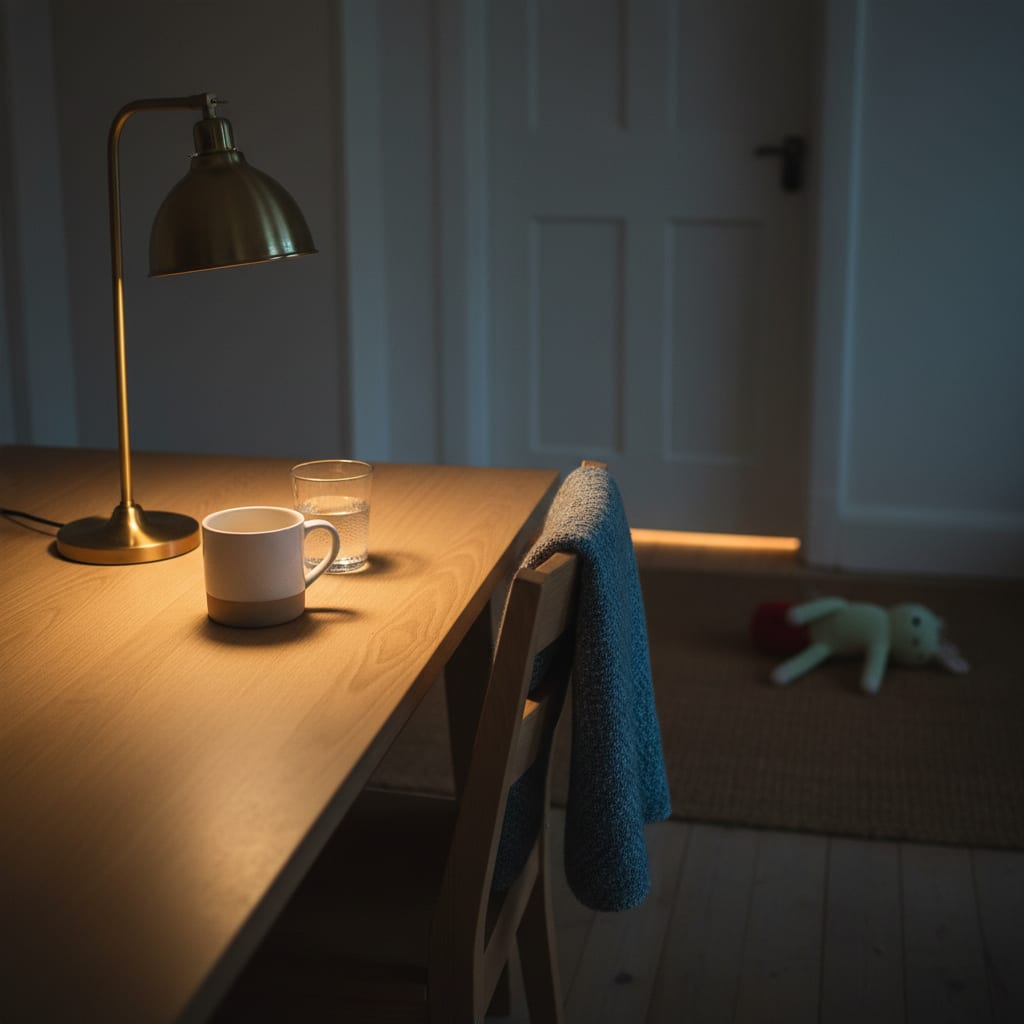
Everyone plans the noise and nobody plans the light, and in our house light is what wakes the youngest. A desk lamp at 8pm throws a wedge down a hallway and under a door, and a four-year-old thirty seconds from asleep reads that as the day is still happening. Three things to look at, in order:
- The hallway sightline. Stand in the little one’s doorway, door ajar, and look at where the homework light will be. If you can see the lit surface, so can they.
- The gap under the door. A closed door with a lit hall outside still puts a bright strip on the floor. A rolled blanket is a free experiment; if it works, buy something that does the job properly.
- The window. If a street lamp is already doing half the work, the window is the bigger lever — Betteroo has a non-breathless read on what actually works there and what doesn’t, and the expensive option is not automatically the effective one.
Then give the older child warm, low, aimed-down task light instead of the ceiling fixture. A ceiling light fills a hallway; a task lamp lights a page. Cheapest change on the list, and usually the one that ends it.
Move the desk, not the bedtime
One sentence: the lit working surface should not share a wall, a door or a hallway sightline with the youngest child’s room. In an ordinary suburban floor plan that ranks about like this:
- The dining table — far from bedrooms, own light, big enough for a project. Costs you the room for an hour.
- The kitchen island — an adult is already there, solving the adult problem for free. Noisier.
- The far end of the family room — fine for silent work, bad for anything spoken.
- The older child’s own desk — right only if their room isn’t on the little one’s wall. If it is, this is the worst option in the house, not the best.
Choosing and equipping the surface itself is the homework station post; the difference tonight is that you are picking the location against a sleeping constraint rather than a concentration one, and those two answers are often different rooms.
Sequence the adult, not the children
The real bottleneck: at 7:15 one adult cannot sit through long division and run a bath, and no amount of furniture fixes that.
- Two adults home: split it out loud at the start of the evening, and swap nights so the same person isn’t always doing bedtime. The unspoken version of this arrangement is where resentment lives.
- One adult home: the adult-needed homework has to finish before the bedtime sequence starts — so it happens in the 6:00–6:45 block, not after dinner, and the 8pm slot is silent-work-only by design. Same backwards build as the school-night run-sheet, applied to the adult instead of the clock.
- Practice nights: on a 5:15 practice the adult-needed half doesn’t fit. Move it to the morning, or let Tuesday’s be the quiet kind — the after-school landing is where you find out whether you have the hour you think you have.
The sound half is smaller than you expect
Light is the wake-up; sound is mostly the stay-awake. Pull the little one’s bed off the shared wall if it’s on one, put a rug down, and run something steady so the gap between silence and a scraping chair stops being an event. We use a Yogasleep Dohm in the room nearest the working surface — a fan-style machine makes a continuous sound rather than a short loop, and a loop is what a child learns to listen for. The other transmission fixes are the ones that work when the noise comes through a wall entirely.
Don’t let the little one’s wind-down absorb the squeeze
The failure mode isn’t bedtime moving later — that’s visible and somebody argues about it. It’s the sequence silently compressing: bath skipped, two books become one, lights out at the usual time but after four minutes of winding down instead of twenty. Then settling takes longer, and the evening you were protecting gets spent anyway. So protect the length of the run-in, not just its end time. Betteroo’s write-up on how long that stretch actually needs to be is a fair read on what the sequence is for — and if it can’t fit tonight, the honest move is to start it earlier, not to shorten it.
The stop rule, and the note
Some nights it will not finish, and the most useful thing I brought out of eight years at a school front desk is this: teachers would far rather have an unfinished assignment with a one-line note than a family that stayed up until nine fighting about it.
Pick a stop time — ours is 8:15 — and stop at it. One line in the folder: “Stopped at 8:15, got through questions 1–6.” Signed, back in the bag, done. If that note goes in three weeks running, it is also your evidence for the workload conversation, which is far better to have with dates in hand.
FAQ
Should I move the younger one’s bedtime later so homework can finish? The most tempting fix and the one that costs most: a later bedtime usually buys a harder settle and an earlier wake, so you pay for the hour twice. Move the surface and the light first. The bedtime is the last thing to touch.
My kids share a room. Now what? Then the homework leaves the room — the one case where there is no choice to make. Give the older child a lit surface elsewhere for the school year, and put only silent reading back in the bedroom, before lights-out rather than after.
What if the older child says they can only concentrate in their bedroom? Test it rather than argue it. Two weeks at the dining table with a proper task lamp, their own supplies and an adult in the next room is a fair trial — in our house the attachment was to the quiet, not the room.
Is a nightlight better than darkness if there’s hall light anyway? Often yes: a small constant source removes the contrast that makes a hallway strip an event. Dim, warm and fixed — nothing that changes or plays.