Bedtime Head-Banging and Rocking: Normal or a Problem?
That rhythmic thump against the wall at 8:40 — a small person rocking on hands and knees, or knocking the back of their head into the mattress on the way to sleep — is usually self-soothing, not distress. It’s common in babies and toddlers, it happens at sleep onset, and most children stop on their own by around five. The household fixes are hardware and clock: get the bed off the wall, and stop letting practice nights push the wind-down late. But five signs make this a pediatrician’s question rather than a scheduling one, and they’re listed below, ahead of any of the fixes.
What the thumping actually is
It shows up in a few shapes: rocking forward and back on hands and knees, rolling the head side to side on the pillow, or banging the head backward into the mattress or headboard. It’s metronomic — a steady beat, usually a couple a second — and it almost always happens as the child is falling asleep, or heading back to sleep after a waking.
The tell is the child’s face. They’re calm. Often they’re humming. It’s the same mechanism that puts a kid out cold four minutes into a carpool run: rhythm is soporific, and some children generate their own instead of borrowing yours. Betteroo’s rundown of why babies bang their heads in the crib is the closest thing to a full picture of the behavior itself, and it’s the reading I’d do before you spend a single evening worrying.
It is not a night terror, and the two get confused constantly. Night terrors land ninety minutes to a few hours after lights-out, with screaming and a child who can’t be consoled or woken properly; rhythmic rocking happens at the edges of sleep and the child stays calm. If what you’re hearing is the sitting-bolt-upright version, night terrors in toddlers is the thing you’re actually reading about, and it’s handled differently.
Where this stops being my department
I run a calendar. I am not a clinician, and this is the one topic on this site where the difference matters, so here is the honest line. Book a pediatrician visit — not a routine tweak — if any of these are true:
- There’s injury. Bruising, scrapes, a bald or worn patch on the scalp, anything bleeding.
- It happens in the daytime too, outside of sleep and its edges — or it’s showing up alongside developmental worries, or skills your child had and seems to have lost.
- The nights are loud in a different way. Snoring, gasping, mouth-breathing, long pauses — plus a kid who is wrecked in the morning no matter how early lights-out was.
- It’s fragmenting sleep. Repeated wakings through the night, daytime irritability, a child who can’t hold attention.
- It’s still going strong past about five, or it started suddenly in an older child who never did it.
Also call if it arrives with a fever, ear-pulling or a rash — sometimes a kid is rocking because something hurts, and no bed placement fixes an ear infection. And don’t buy a helmet or a restraint on your own initiative: if protective gear is ever the answer, it’s the answer a doctor gives you.
Fix the room before you try to fix the child
Assuming none of that list applies, most of what makes this feel like a crisis is transmission, not movement. The child is fine; the house is what’s rattling. Five moves, in the order I’d do them:
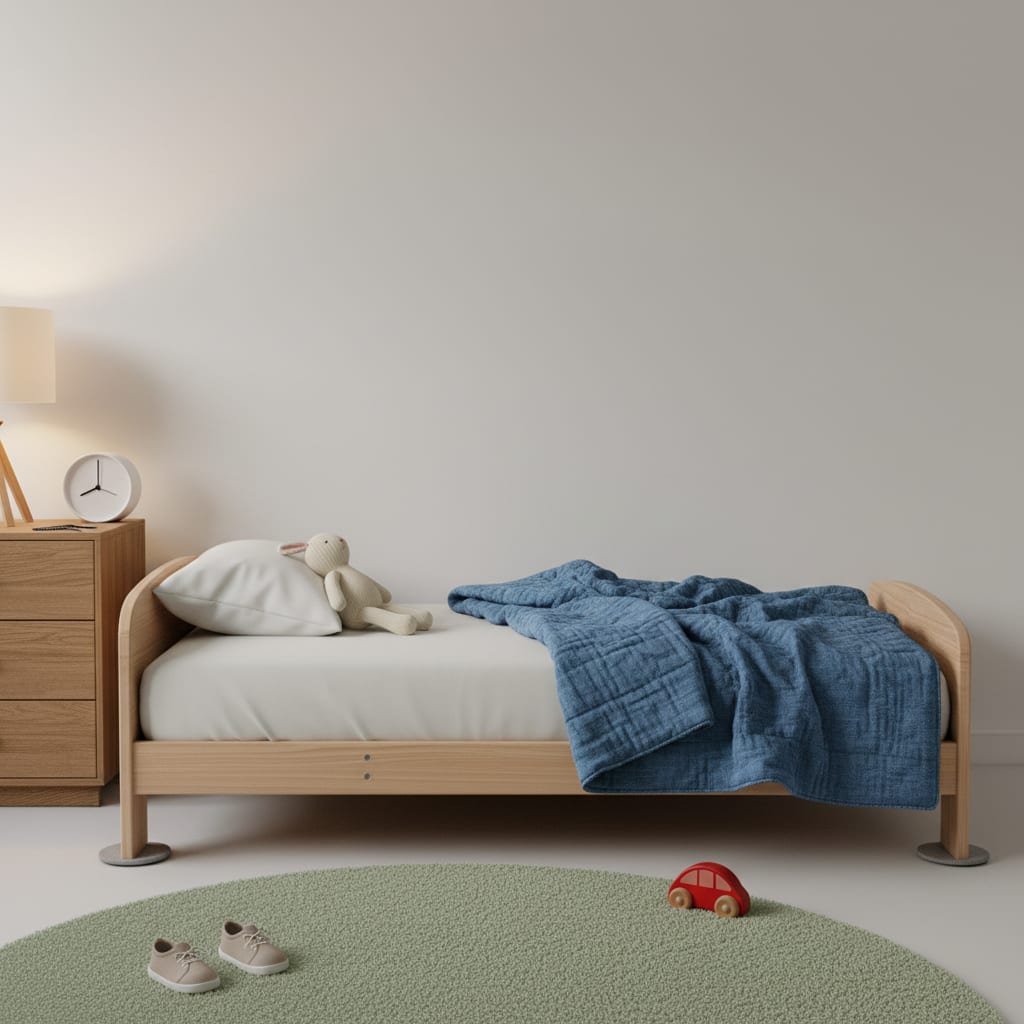
- Pull the bed three or four inches off the wall. Highest-return change on the list, and it takes ninety seconds. Contact with the wall is what turns a rocking kid into a drumline for the whole floor.
- Tighten every bolt on the frame. A loose slat or a wobbly joint is the difference between a soft rhythmic sound and what genuinely sounds like demolition. Put it on the same quarterly pass as the smoke-detector batteries.
- Decouple it from the floor. A rug under the bed, or felt pads under the legs, stops the beat travelling through the joists into the room below.
- Do not pad a crib with bumpers. Safe-sleep guidance is clear about bumpers and loose bedding, and trading a suffocation risk for a bruise risk isn’t a trade. Distance from hard surfaces does the same job for free.
- Mask it for everyone else. Sound in the siblings’ rooms is the real fix for the 10-year-old at the desk. A fan-based machine like the Dohm Classic puts a broad, boring floor of noise under the hallway, which is what you want at 8:40 on a Tuesday.
The schedule variable nobody mentions
Here’s the part I actually know something about. Rhythmic rocking tends to run longer and louder when a child hits the mattress overtired — and in a school-year household, “overtired” is not a mood, it’s a route.
Ours goes like this. Practice at 5:15, home at 6:50, dinner at 7:10, and the youngest — whose actual lights-out is 8:00 — is in bed at 8:35. Thirty-five minutes is nothing on a 10-year-old and enormous on a four-year-old, and the practice-night rocking sessions here are audibly longer than the Sunday ones. Same kid, same bed, different arrival time.
So the youngest’s lights-out is the fixed point in the school-night routine, and everything else moves around it. In practice that means the youngest eats before we leave for practice rather than after we get back, and the wind-down gets shortened rather than skipped on the two nights we can’t win. It also means the after-school landing matters more for the little one than the big kids — a four-year-old who never decompressed at 3:30 is still carrying it at 8:00.
What not to do at 8:45
- Don’t go in and stop it. Interrupting a self-soothing rhythm usually restarts the process and buys you a longer session, not a shorter one.
- Don’t hold them still. Same outcome, plus a fight.
- Don’t make it a conversation. Attention is a reward, and this is a habit, not a negotiation.
- Don’t push bedtime later hoping they’ll be too tired for it. That runs backwards, for the reason above.
- Do check once, silently, from the doorway — early on, so you know exactly what sound you’re listening to.
The sibling problem is a floor-plan problem
At 8:40 there’s a fourth-grader at a desk and a second-grader with a book on the other side of that wall, and the thumping is the household’s problem more than the child’s.
Treat it as layout. Put the youngest’s bed against the wall that backs onto a closet, a bathroom or the stairs — never the one that backs onto homework. Same reasoning as where the family dog’s crate goes: the noise isn’t going away, so you decide in advance which room absorbs it. Do that once and you stop relitigating it nightly.

FAQ: head-banging and rocking at bedtime
Is head-banging at bedtime normal?
Rhythmic rocking, head-rolling and head-banging at sleep onset are common in babies and toddlers, and most children grow out of them by around age five. The usual picture is a calm, metronomic habit at the edge of sleep, not distress. It stops being routine if there’s injury, if it happens in the daytime, or if it’s wrecking the night — see a pediatrician for any of those.
Should I wake my child or stop the rocking?
No. Interrupting a self-soothing rhythm generally restarts it and lengthens the session, and holding a child still tends to add a fight to the evening. Check once from the doorway so you know what you’re hearing, then leave it alone and put your effort into the bed placement and the arrival time instead.
When should I call the pediatrician about head-banging?
Call if there’s any injury, if it happens outside sleep, if it comes with snoring or gasping or a child who’s exhausted every morning, if it’s fragmenting sleep night after night, or if it’s still going strong past about five. Also call if it arrives with fever, ear-pulling or a rash. Never add a helmet or restraint on your own.
Will padding the crib or the headboard help?
Don’t pad a crib — bumpers and loose bedding cut against safe-sleep guidance, and you’d be trading a bruise risk for a suffocation risk. For a bed, distance does the work: move it a few inches off the wall, tighten the frame, put a rug underneath. That handles the noise, which is usually the real complaint.