A Homework Station That Ends the Kitchen-Table War
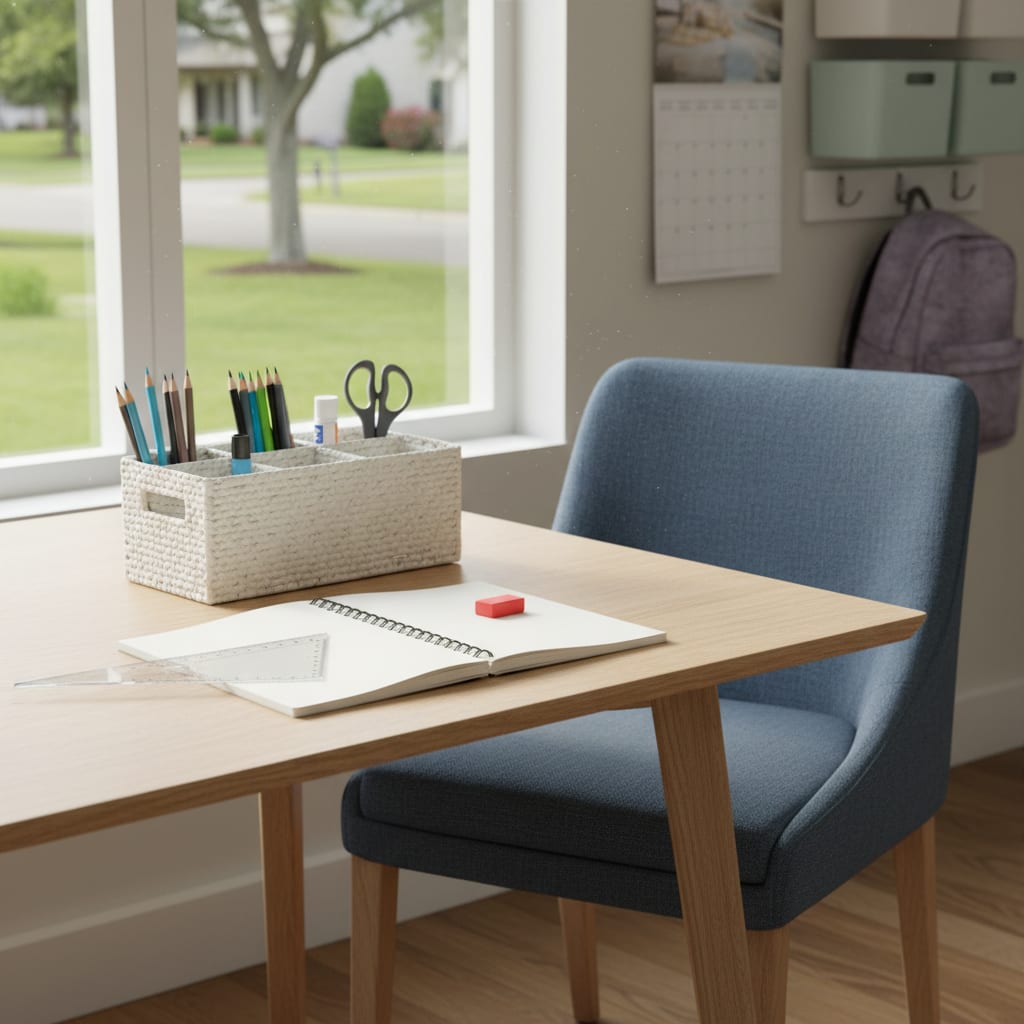
A homework station is three decisions, not a furniture purchase: a fixed place per kid (matched to how that kid actually works), a stocked supply caddy so no one ever leaves the seat hunting a pencil, and a fixed start time wired into the afternoon. That’s it. You almost certainly own everything required already. The kitchen-table war isn’t caused by the kitchen table — it’s caused by homework having no address and no appointment, so every afternoon renegotiates both from scratch, at 4:30, with tired people.
Location: match the kid, not the catalog
The catalog version of a homework station is a darling little desk nook. The working version is wherever this particular kid does focused work, which you already know if you watch one week of homework honestly.
The proximity kid works at the kitchen table or counter — needs an adult in sensory range or the wheels stop. My 7-year-old is this kid; moved to her lovely desk, she produces one worksheet per geologic era. Table it is, and the station comes to the table (that’s what the caddy is for).
The door-closed kid needs quiet and separation — desk in the bedroom or a corner far from the 4-year-old’s afternoon opera. My 10-year-old graduated to this around fourth grade, roughly when multiplication stopped surviving background noise.
The satellite kid does homework in odd windows — bleacher time before swim, the 20 minutes between school and practice-night departure. This kid’s station is a zippered pouch that lives in the backpack: pencils, sharpener, the folder. Sports seasons turn most kids into part-time satellite kids, so build the pouch even if you also have a desk.
Mixed households run mixed stations. Ours has all three going at once, which sounds chaotic and is actually the peace treaty.
The caddy: end the pencil hunt forever
Whatever the location, supplies live in one carryable caddy — a shower tote, honestly, is the ideal vehicle. Stock it kit-style: pencils (sharpened, plural, because pencils evaporate), sharpener, erasers, glue stick, scissors, crayons or colored pencils, a ruler, index cards, and one highlighter. Nothing in the caddy is anyone’s personal property and nothing leaves the caddy’s orbit; it docks on a shelf when homework ends. The pencil hunt is the single biggest line item in homework overhead — a seated kid who gets up to find an eraser is a kid who reboots from zero, eleven minutes later, having discovered the dog. Keep the kit boring and stocked; restock it during Sunday’s sweep, same rhythm as feeding the backpack station.
The appointment: a start time, not a nag
The station’s third leg is temporal: homework starts at a clock time, the same one daily, sitting inside the afternoon sequence — for us, 4:15, after the snack-and-reset landing and before free time, exactly where the after-school routine slots it. A fixed start time does the arguing for you. “Homework at 4:15” is a calendar fact, like the bus; “do your homework” issued at random moments is an opening bid. Practice nights get their own version — the satellite pouch plus an earlier or split slot — decided Sunday when we see the week’s grid, not improvised in the driveway. Homework that ends the evening instead lives in the school-night routine, and that post explains why we guard against it drifting there.
The adult’s station: nearby, occupied, unavailable-ish
One more piece nobody puts on the supply list: where you are. For proximity kids especially, homework goes best when the adult is nearby doing adjacent quiet work — dinner prep, the mail, your own list — visibly not hovering. Sit down next to a 7-year-old and you become the tool she reaches for before her own brain. Stay in range, answer real questions, decline to become a co-author. Front-office posture: present, busy, interruptible for actual emergencies only.
What a homework station is not
It’s not a monitored study hall (we’re out of the discipline business by design), not a Pinterest build, and not a gear question — the supply list above is a kit you assemble from the junk drawer, not a shopping guide, and I have no desk to sell you. If the system’s in place and homework is still a nightly siege, that’s a conversation with the teacher, not a caddy deficiency.
FAQ: homework stations
Where is the best place for a homework station?
Wherever your specific kid focuses: kitchen table for kids who need an adult in range, a bedroom desk for kids who need quiet, a backpack pouch for kids doing homework around practices. Watch a week of homework and the answer announces itself.
What supplies should a homework station have?
One carryable caddy: several sharpened pencils, sharpener, erasers, glue stick, scissors, colored pencils, ruler, index cards, a highlighter. The goal is that nobody leaves the seat mid-task. Restock weekly; caddy supplies are communal and never migrate.
What time should kids start homework?
A fixed clock time that fits your afternoon — right after the snack-and-reset landing works for most families, before free time rather than after. The specific hour matters less than its sameness: a standing appointment removes the daily negotiation.
Do kids need a desk to do homework?
No. Plenty of kids do their best work at the kitchen table, and forcing a proximity kid to a desk in the name of Real Study Habits usually costs you the homework. A desk is one possible address; the station is the place-plus-caddy-plus-time system.