Minivan Organization: The Rolling Locker Room
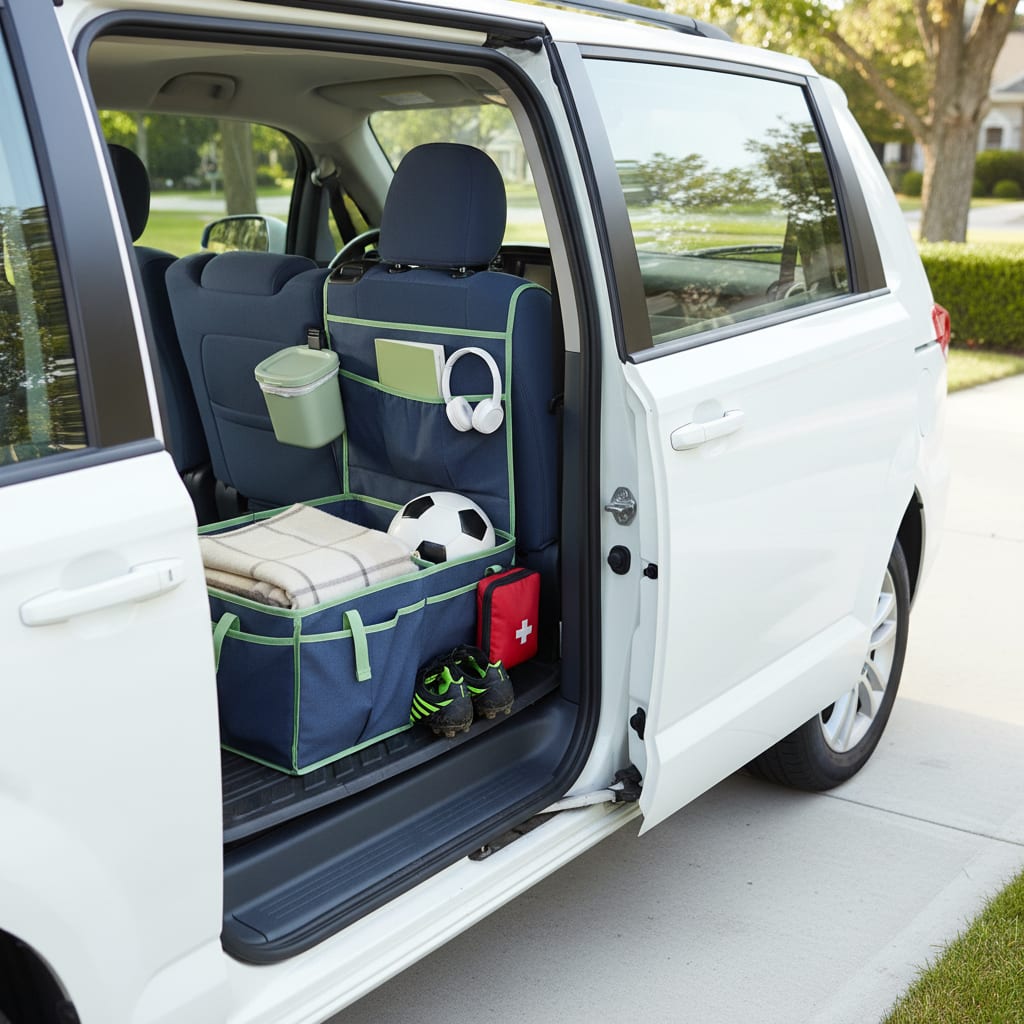
Minivan organization works when you stop treating the van as storage and start treating it as a locker room with five fixed zones: a trunk block for gear, a seat-back zone each kid owns, a driver console for the adult essentials, a trash point, and a wet/dirty zone that keeps cleats off the upholstery. Assign each zone one job, put a two-minute cleanout at the end of every practice run, and the daily driver stops being an archaeological site. Car organization for kids isn’t about buying containers — it’s about every object in the van having exactly one address, and everyone in the family knowing all five of them.
Why the van fails (it’s a boundary problem)
A family minivan collects stuff for a boring reason: it’s the only room in the house nobody is responsible for. Bedrooms have owners; the van has passengers. So water bottles, jackets, half-read library books, one shin guard, and roughly four hundred wrappers accumulate in a space with no cleanup ritual attached — and by October you’re driving a garage.
The fix is ownership by zone. Every zone gets a named purpose and, where possible, a named kid. The moment a seat-back pocket belongs to the seven-year-old, it becomes something she maintains rather than something she contributes to. That’s the entire theory. The rest is placement.
The five zones
Zone 1 — the trunk block (gear). The single highest-value piece of van organization is a structured trunk organizer with rigid walls, because the actual failure mode of a trunk is not clutter, it’s sliding: a soft duffel migrates on every turn and by the time you park at the field, everything is under everything. A collapsible multi-compartment organizer with tie-downs like the Drive Auto trunk organizer strapped to an anchor point holds its shape, and its compartments give you three fixed addresses: gear, spares, and cargo.
Critically, the trunk block is not where sports gear lives full time. Gear lives in the house, in bins, per the gear staging system — it rides in the trunk block on the way to practice and comes back out on arrival. A van that permanently stores cleats is a van that has quietly become the gear station, and gear stations that move at 45 mph don’t get restocked.
Zone 2 — the seat-back zone (one per kid). Each kid gets one hanging seat-back organizer with a fixed inventory they choose within limits: a book or two, headphones, a small activity, a tissue pack. Not snacks — snacks are a whole other genre of decay. A multi-pocket hanging organizer like the Drive backseat organizer works in most third-row vans; a $0 alternative that works nearly as well is one zip pouch per kid that lives in their seat pocket and leaves the van weekly.
The rule that makes seat-back zones survive: whatever doesn’t fit doesn’t ride. No overflow onto the floor, no “just for today.” A kid with a fixed-capacity zone learns the trade-off themselves, which is a better outcome than me refereeing it every Tuesday.
Zone 3 — the driver console (the adult five). Phone mount, sunglasses, a pen that works, a small first-aid pouch, and cash or a card for concession stands and the fundraiser table that ambushes you at every tournament. That’s the list. The console is where discipline is hardest and matters most, because the console is the zone you reach into while moving.
Zone 4 — the trash point. Undignified, load-bearing. One lidded, leak-proof can that hangs off the back of the passenger seat — the HOTOR car trash can is the workhorse version and the lid is the whole point, since an open bag in a hot van is a smell you will remember. Empty it on the same trigger every time: whenever you fill the gas tank. Tie the chore to an event, not a day, and it actually happens.
Zone 5 — the wet/dirty zone. A rubber-backed mat or a plastic boot tray in the cargo area for cleats, wet swim bags, and muddy anything. Everything that’s been on a field goes there and only there. This single boundary is the reason our carpet has survived three soccer seasons, and it costs about as much as one detailing appointment you no longer need.
Zone map at a glance
| Zone | Location | Holds | Owned by |
|---|---|---|---|
| Trunk block | Cargo floor, strapped | Today’s gear, spares, cargo | Adult |
| Seat-back ×3 | Behind each front seat | One kid’s ride-along kit | Each kid |
| Console | Driver reach | Phone, sunglasses, pen, first aid, cash | Adult |
| Trash point | Passenger seat back | Trash, lidded | Whoever’s closest |
| Wet/dirty | Cargo, on a tray | Cleats, wet bags, mud | Last one in |
The two-minute cleanout
A weekly deep clean is a fantasy in a sports season. What actually holds is a two-minute cleanout at the end of every practice run, done in the garage while everyone is still in car-mode: everyone takes their own things, one person does a trash sweep, the wet zone gets emptied onto the garage floor to dry. Two minutes, three people, and the van resets to zero daily instead of drifting for a month.
The trigger matters more than the duration. Ours is the same moment as the gear unload — nobody goes inside until their arms are full. That handoff is the last block on every practice-night time map we run, which is why it happens: it’s on the map, not on a chore chart, and a thing on the map is a thing with a time.
Once a month, add the deeper pass — floor mats out, seat-back zones dumped and re-inventoried, first-aid pouch restocked, and a check that the spare gear in the trunk block still fits the kid it’s for. Shin guards outgrow children faster than anyone expects.
When you’re carpooling other people’s kids
A van that carries neighbors is a semi-public space and the standard rises a little. The three things to keep permanently stocked once you’re on a carpool rotation: a spare booster if your driving group includes a kid under the height line, a printed card in the glovebox with each carpool kid’s parent contacts and any allergy note, and enough clear floor that a fourth kid can actually sit down. I keep our carpool card with the registration — the glovebox is the one place in the van nobody redecorates.
One boundary worth stating plainly, because it saves arguments: this is a daily-driver system, not a road-trip system. Packing a van for a week away — cooler placement, the tetris of luggage, entertainment for hour six — is a different problem with a different answer, and the folks who cover road trips with kids have that covered. What I run is the Tuesday version: soccer at 5:15, two kids, one dog-eared library book, home by 7.
FAQ: minivan and car organization
How do you keep a minivan clean with kids?
Attach a two-minute cleanout to a daily trigger — for most sports families, the moment you pull into the garage after practice. Everyone takes their own things, one person does a trash sweep, wet gear leaves the van. Daily resets beat weekly deep cleans because nothing accumulates long enough to feel like a project.
What should you keep in the car for kids?
One fixed kit per kid in their own seat-back zone: a book, headphones, one small quiet activity, tissues. Adults keep a console five — phone mount, sunglasses, a working pen, small first aid, and cash for concession stands. Everything else is cargo and leaves the van when the trip ends.
Where do you store sports gear in a minivan?
In a strapped-down structured trunk organizer for the trip only, with a rubber tray or mat for cleats and wet bags. Gear should live in bins at home and ride in the van, not live there — permanent van storage means it never gets restocked or washed on a schedule.
Is a trunk organizer worth it?
Yes, for one specific reason: rigid walls stop bags from sliding on turns, which is what actually creates trunk chaos. A strapped organizer with two or three compartments gives everything a fixed address. Soft totes and open crates work fine at home and poorly in a moving vehicle.