The Carpool System: Schedules, Backups, No-Show Rules
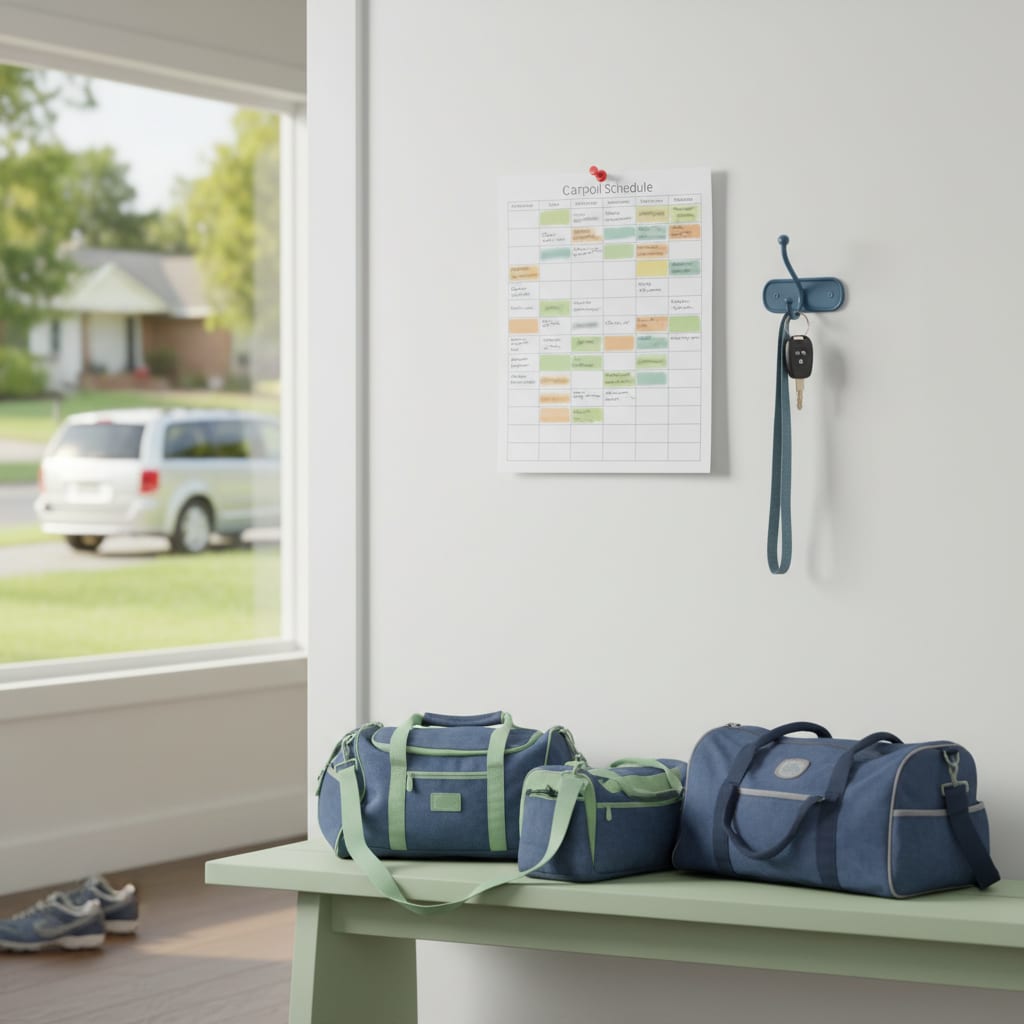
A carpool schedule survives the season when it has three parts most carpools skip: a written grid (who drives which leg, which week — posted, not “in the thread”), a named backup for every leg (decided in September, not discovered at 5:05pm), and agreed no-show rules — what happens when a driver goes dark, how late is late, and who calls it. The driving is the easy part. A carpool is really a small logistics co-op with no manager, and the ones that collapse by October don’t collapse over gas money or directions; they collapse over ambiguity. Write the ambiguity out of it in week one and the thing runs itself until the sports banquet.
Build the grid before the season builds it for you
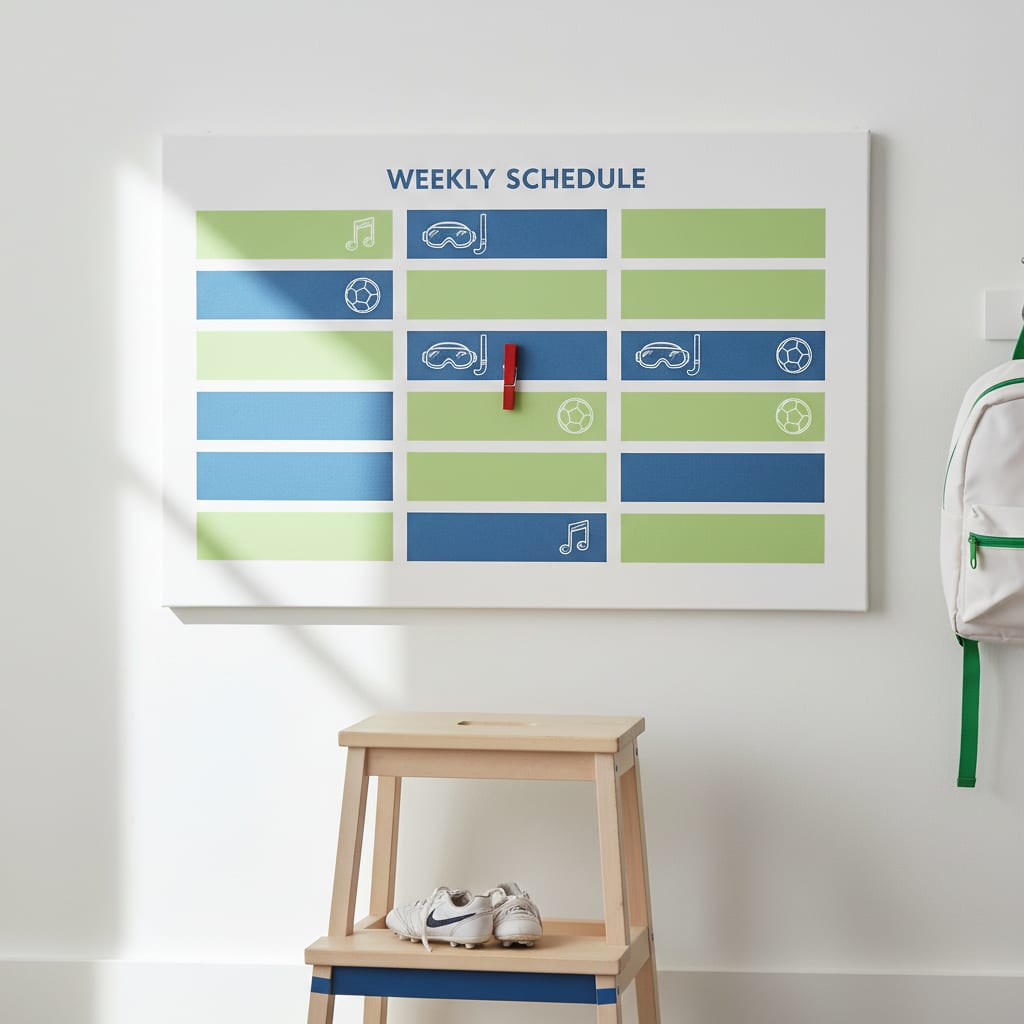
The grid is one page: legs down the side (Tuesday practice drop, Tuesday pickup, Thursday drop, Saturday games), families across the top, initials in the boxes, repeating on a one- or two-week cycle. Ours hangs at the command center next to the weekly run-sheet, and every family gets a photo of it — the whole point is that the answer to “who has Thursday?” is look at the grid, never scroll the thread. Three design rules from grids that died young: assign legs, not days (Tuesday-drop and Tuesday-pickup are different jobs — splitting them is exactly what makes carpool worth it for a parent who can do 3:45 but not 6:15); balance by burden, not by count (one 7am Saturday leg is worth two Tuesday drops, and everyone silently knows it — price it accordingly and say it out loud once); and put the cycle on a calendar date, because “we alternate” degrades into “wait, whose week is it?” by mid-season. Fairness, for the record, does not require equality — a family that can’t drive can own the schedule itself, the snack grid, or the team-mom binder. It requires stated contributions, because resentment grows only in the unstated gaps.
Backups: the clause that saves the carpool
Every leg on the grid gets a second set of initials: the named backup, agreed at the season’s start. This is the whole difference between a carpool and a group of people who sometimes drive each other’s kids. When the primary’s meeting runs long, she texts one person — her named backup — instead of lobbing “can anyone grab the girls??” into a thread of five families all waiting to see who cracks. The named backup either confirms or says no, and only then does it go to the full thread as an open call. Diffuse responsibility is how kids end up standing outside a gym at 6:40 while four adults each assume a fifth. Named responsibility is how they don’t. (Our house also keeps its own family info sheet current so any carpool parent suddenly holding my kid knows the release rules and both our cells.)
The no-show rules, agreed in September
Nobody wants to negotiate consequences at 6:45pm in a parking lot, so the rules get set at the season’s first meeting, when everyone still likes each other:
| Situation | The agreed rule |
|---|---|
| Running late | Text the thread the moment you know — lateness is logistics; silence is the offense |
| Can’t make your leg | Your job to arrange the swap: named backup first, then open call. The leg stays yours until someone says “I’ve got it” |
| Kid not at the pickup point | Driver waits five minutes, texts the parent, then leaves — a carpool waits for kids who are coming, not kids who forgot |
| Repeated no-shows | One direct conversation, then the family moves to rider-only status with a different contribution |
That third row sounds cold and is actually the kindest rule on the list: it protects the driver from choosing between four punctual kids and one absent one, and it teaches the fastest lesson in youth sports — the carpool is a train, not a taxi. My 10-year-old missed it exactly once.
Run the thread like a dispatcher
The group text is the carpool’s nervous system, and it stays healthy on three habits: confirmations are mandatory — every handoff gets a “got both girls” text the moment doors close, because that message is the difference between a quiet kitchen and a parent staring at a clock doing math; the thread carries operations only — schedule changes, confirmations, “leaving now,” while the memes and the fundraiser links get a separate social thread so nobody mutes the channel that matters; and changes go on the grid, not just the thread — a swap agreed at 2pm is re-stated as “so Thursday: Dana drops, I pick up,” because a decision buried forty messages up is a decision nobody made. This is the same discipline that keeps our practice nights from dissolving: the plan lives in exactly one place, and everything else just points to it.
FAQ: carpool systems
How do you set up a carpool schedule that actually works?
Put it in writing as a grid — legs down the side, families across the top, repeating on a set cycle — and give every leg a named backup. Post it and photo it to all drivers. Most carpool failures are ambiguity failures, and a written grid removes the ambiguity before it costs anyone an evening.
How do you keep a carpool fair when families can’t drive equally?
Balance by burden, not by trip count — early-morning and far-field legs are worth more, and everyone knows it — and let non-driving families contribute in other stated ways: owning the schedule, the snack sign-ups, the team binder. Fairness is stated contributions, not identical ones.
What should the rules be when a carpool driver doesn’t show?
Agree in advance: immediate text on any delay, the absent driver owns finding their swap (named backup first), a five-minute wait rule at pickups, and a direct conversation after repeated misses. Setting the rules in September keeps enforcement from ever feeling personal in November.
How many families should be in a carpool?
Three to five works for most teams — enough to genuinely lighten the load, few enough that the grid and thread stay manageable. Two families is a swap, not a system; past six, coordination costs eat the savings and the thread becomes its own part-time job.