Trick-or-Treat: The Street Plan and the Meet Point
Decide four things before a single costume goes on: the route, the meet point, the turnaround time, and which adult has which children. Everything that goes wrong on Halloween night goes wrong because one of those four was never actually agreed — a family splits at a corner, a four-year-old is still out at eight, or three adults each assume someone else has the small one. Thirty minutes of planning in the week before, ideally on the street group chat, and the night runs itself.
The four decisions, in order
The route. Not “the neighborhood” — an actual line, drawn on the streets you have. Make it a loop rather than an out-and-back so nobody has to negotiate a return trip with tired kids, and pick the direction that keeps you on sidewalks. The AAP’s guidance is worth building the route around rather than remembering halfway through: stay on well-lit streets and use the sidewalk, and where there isn’t one, walk at the far edge of the roadway facing traffic.
The meet point. One house, named, with the porch light on — not a corner. A corner has no bathroom, no chairs and nowhere to leave a bag of coats. Whoever hosts it is not thereby hosting a party; they are providing a known address that everyone can say out loud to a child.
The turnaround time. A clock time, agreed in advance, that the group actually turns around at rather than “when they get tired.” More on this below, because it is the decision the little ones live or die by.
Who has whom. Named adult, named children, said out loud at the start. Not implied by proximity.
The meet point does the most work
Pick the house at the start or the middle of the loop, whichever has the better porch. What it gives you:
- A place to drop the four-year-old’s coat at 6:30 and find it again at 7:15.
- A bathroom, which is the single most common reason a family peels off and doesn’t come back.
- A rotating adult. Two grown-ups stay put with chairs and hand out candy; everyone else walks. Swap at the halfway point. Nobody does the whole night in either job.
- A named place for a lost kid to go. “If you can’t find me, go back to the Merricks’ porch” is an instruction a six-year-old can actually follow, which “stay with the group” is not.
If the street already runs a block party, you have done this before — the meet point is the same logistics object as the food table, minus the permits.
Headcount conventions that survive a dark street
Groups of nine children and four adults lose people constantly, and they lose them at crossings. Two conventions are enough:
- Count at every crossing, not at every house. Crossings are where a group stretches out. The AAP is direct about this: cross as a group at a crosswalk where one is available, and avoid mid-block crossings, where child pedestrian injuries are much more common — and the same page notes that child pedestrian injuries are more likely on Halloween than on any other night of the year. That is the reason the crossing is where you count.
- Pairs, with a named adult each. Not “the big kids look after the little kids.” Adult A has these two, adult B has those three. Say it at the meet point before you leave and again when an adult swaps out.
Everybody carries a light. The AAP asks for a flashlight after dark; glow sticks (a bulk pack like PartySticks) work on the small ones who won’t hold anything. It is not about seeing the sidewalk — it is about a driver seeing a child in a dark costume at dusk.
The turnaround time, and the little one’s exit
This is the piece nobody writes down, and it is why the youngest child’s Halloween usually ends in tears on somebody’s driveway.
Set two times, not one. The little-kid exit is the earlier one — in our house it is 7:15, three or four streets in — and it happens at the meet point, by handover, not by a whole group stopping. One adult walks the small one home from a known address while the rest continue; that only works because the meet point exists and because everyone agreed the time before anyone was tired. The group turnaround is the later one, and it is a time, not a feeling.
If your town runs an earlier daylight event, take it for the youngest and treat the evening as the big kids’ night. The AAP makes the same point plainly: earlier festivities help you stick to your child’s regular bedtime. A four-year-old who did the 4pm event and is in the bath at 7:00 has had a completely good Halloween, and the house is still standing on November 1st.
If you are the house
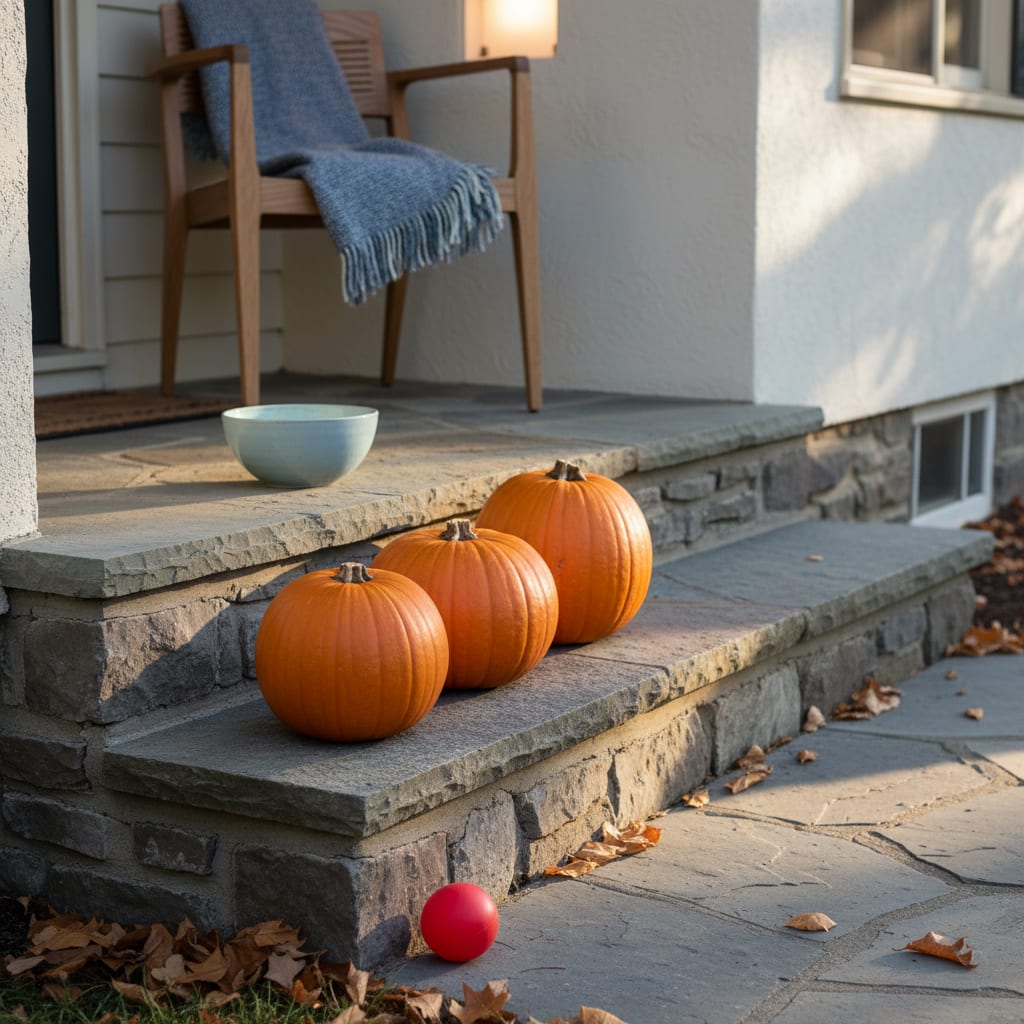
Your job is the twenty feet between the sidewalk and your door, and it takes ten minutes in daylight the day before. The AAP’s list for hosts is short and specific: remove tripping hazards such as garden hoses, toys and bikes, sweep wet leaves from sidewalks and steps, check outdoor lights and replace burned-out bulbs, and restrain pets so they do not jump on or bite a trick-or-treater. For the pumpkin, the same page recommends a battery-operated flameless candle, a flashlight or a glow stick rather than a flame.
The porch-light convention runs both directions, and it is the most useful piece of street etiquette of the year: that same page tells families to only go to homes with a porch light on and ideally a well-lit pathway — so if you are out, or out of candy, turn the light off. Nobody is offended, nobody knocks, and the families walking past can read your house from thirty feet away.
The group chat, and where to stop
One message, a week out, with the four decisions in it. One on the night with the meet point address. Then mute it — a chat that runs live all evening means four adults reading phones instead of counting children at crossings.
New to the street and not sure who to send it to? The roster is the whole job, and collecting it once is a thing you only do the first year. If this is your first fall here, ask at the bus stop — the first thirty days is when people expect the question, and Halloween is the easiest night of the year to meet a street.
Costumes, the party half and the candy itself are all somebody else’s specialty, and deliberately so — this is the route, the count and the clock. What I’d add from the bus-stop end of the street: the same crossing you worry about at 7:40 in the morning is the one to worry about at 6:40 at night, and it is worse in the dark.
FAQ
What time should trick-or-treating start and end? Whatever your town does — check the municipal page or the street chat, because many towns publish hours. What matters more is that your household sets its own earlier exit time for the youngest child and says it out loud before anyone leaves.
How many adults do you need for a group of kids? Enough that every child is named to a specific adult. Practically that is one adult per two or three children on a dark street, more if the group includes anyone under five, and it works far better than a large group of adults with collective responsibility for everybody.
What if a child gets separated from the group? This is what the named meet point is for. Tell every child the address before you leave, not a description of it, and have them repeat it back. Older kids walking separately should have an agreed return time — the AAP suggests reviewing their plan and route and agreeing a specific time they will be home.
Is it worth planning a route for a street you know well? Yes, because you are not planning it for you. You are planning it so four adults and nine children have the same picture of the night, and so nobody stands in the dark deciding which way to go with a tired four-year-old attached to them.