Before the First Phone: House Rules for Staying Reachable
Before you decide when a kid gets a phone, name the specific gap you’re trying to close: the twenty minutes between the bus and your car, the walk home from practice, the Saturday your ten-year-old is three streets away and dinner is at six. Write the gap down as a sentence with a time in it, and then work the cheapest fix that closes it. Most gaps close without a phone at all — with a memorized number, a named backup adult, a landline, a school office, or a watch. When a device really is the answer, the rules get written before it comes out of the box, not after the first argument.
Step one: write the gap as a sentence
“She’s the only one without one” is not a gap. “He’s alone at the house from 3:35 to 4:50 on Tuesdays and Thursdays” is. So is “she walks home from the pool and I want to know she left.” The sentence forces two useful things out of hiding: when, and who needs to reach whom.
Almost every family sentence I’ve heard falls into one of four shapes:
| The gap | What it actually needs |
|---|---|
| A short predictable window (bus, walk home, practice pickup) | A protocol and a backup adult — usually no device |
| A recurring solo stretch at home | A house line or a shared device that stays home |
| Unpredictable roaming (bike, friends’ houses, the park) | A locatable device with a small contact list |
| Coordination with the kid’s own social world | That’s a phone question, and it’s a different question |
Only the last row is really about a phone. The first three have cheaper, sturdier answers, and buying a phone to solve row one is how a family ends up managing a device for six years to fix a fifteen-minute problem.
The ladder, cheapest rung first
Rung 1 — memorized numbers. Two parent cell numbers, memorized, tested cold at dinner. This is the single highest-value thing on the list and it costs nothing. A kid who knows the numbers can reach you from any adult’s phone, any front office, any friend’s kitchen, forever. Back it up with an index card in the backpack, because memory fails on the day it matters.
Rung 2 — the named adult. For every routine gap, a specific person: the neighbor whose house is the fallback, the parent who covers the bus stop when you’re stuck, the friend’s mom on the walk-home route. Named out loud, agreed with that adult, and known to your kid as a person rather than a concept. This is also why the street roster earns its keep — it turns “somebody on the block” into a number you can dial.
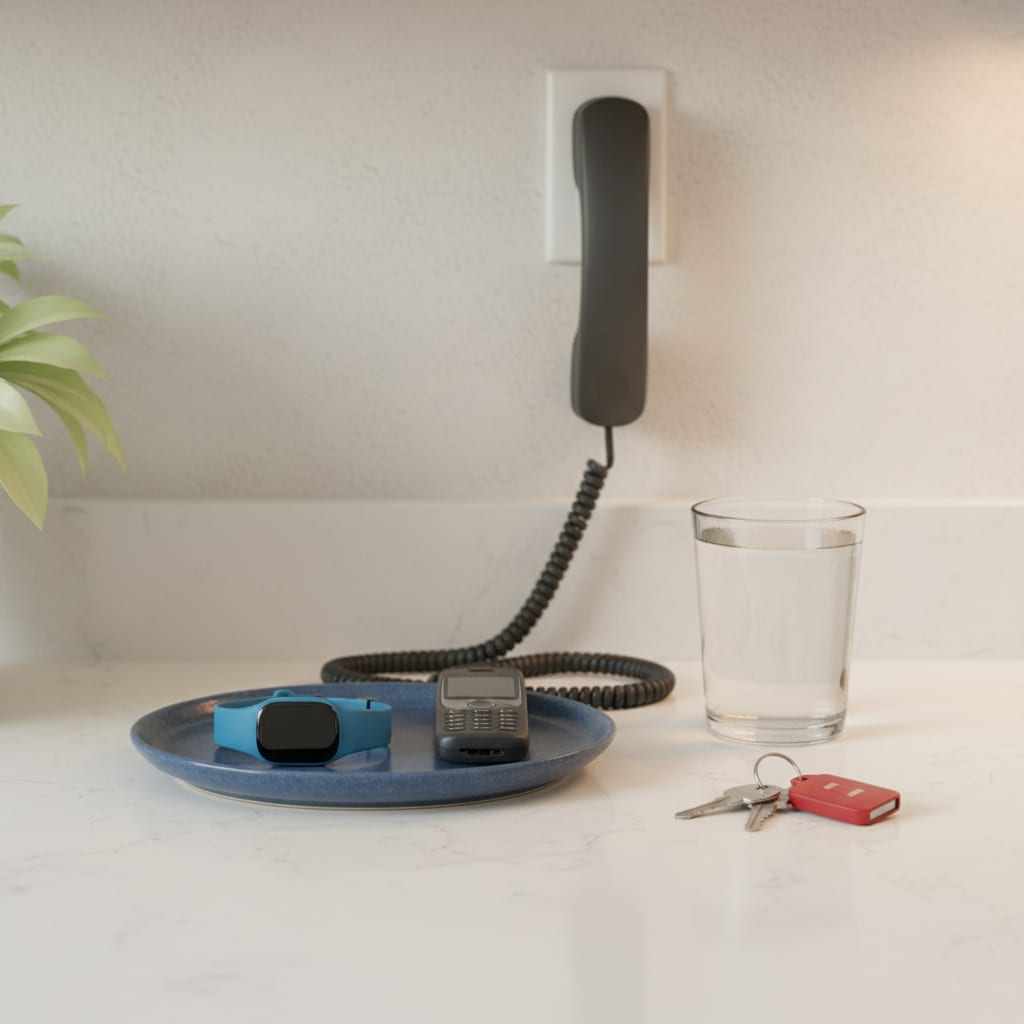
Rung 3 — the house line. A landline or a cheap VoIP line on the kitchen wall closes the home-alone gap entirely, costs less per year than one month of a phone plan, and has the underrated property of not going anywhere. Kids call out, you call in, nothing needs charging.
Rung 4 — the shared family device. An old tablet or a hand-me-down phone with no SIM, on wifi, that lives in the kitchen. Good for calls home and video chats with grandparents; useless outside the house, which is exactly the constraint you want at this stage.
Rung 5 — a locatable, call-only device. For roaming gaps, a wearable or a locked-down handset that does calls, texts, and location with a parent-managed contact list and no browser or app store. Gabb is the best-known family in this category; carriers sell their own equivalents. Compare on the boring stuff — coverage where you actually live, battery life, whether you can add and remove contacts, and what happens when it’s lost. I’m not reviewing devices here; my sister site handles verdicts. My concern is that this rung exists and that most families skip past it straight to a smartphone.
Rung 6 — an actual phone. Fine. Just don’t arrive here by drift.
Write the house rules before the device arrives
The mistake isn’t the device. It’s activating it on a Tuesday and inventing the rules on Friday, in an argument, at 9pm. Write six lines first, on paper, and have both kid and adult sign them the same way we sign our family screen-time contract:
- Where it sleeps. A named spot outside the bedroom — the kitchen counter, the charging drawer — and a time it goes there. This is the clause that prevents the most future trouble and the one families most often add late, after it’s a renegotiation instead of a rule.
- Who’s in the contacts. A short list you both build. Parents can add and remove; the kid can request. On a locked-down device this is enforced by the device, which is the point of a locked-down device.
- The answer rule. A parent call or text gets answered inside a stated number of minutes when the kid’s awake and not in class. A device that isn’t answered isn’t reachability, it’s an object.
- Where it goes during the day. School policy governs school hours — read it, because many districts require phones off and away, and a kid who doesn’t know that gets it confiscated in week two. Practice, dinner and homework hour get your house’s own answer.
- What happens when it’s forgotten, lost or dead. Not a punishment clause — a procedure. Dead battery means find an adult and use their phone. Lost means tell a parent that day, no penalty for telling. You want the truth fast, and a kid who fears the consequence hides the loss.
- What gets reviewed, and when. Say plainly what you’ll see (location, contacts, messages, or none of the above at their age) and put a calendar date on revisiting all six rules — one a term is plenty. Rules that get reviewed on schedule don’t have to be renegotiated by ambush.
Two more practical items belong with the rules and not in them: the device passcode goes on the household’s family info sheet with the rest of the account information, and every adult who supervises your kid should know what the reachability plan is. A rule that only one parent knows is a rule that fails on the first away week.
The talk that makes the rules stick
Say the reason out loud, once, in one sentence: “This exists so you can reach me and I can reach you between 3:30 and 5:30 — that’s the job it has.” A device with a stated job is easy to govern. A device given as a milestone gift has no boundaries built into it, and every limit you add afterward reads as a punishment for having grown up.
Then hold the line on the two clauses that decay fastest: the sleeping spot and the answer rule. Everything else can flex with age.
FAQ: kids, phones and staying reachable
At what age should a kid get a phone?
There’s no universal age, and the more useful question is what specific gap you’re closing. Write the gap down with a time in it, then take the cheapest rung that closes it — memorized numbers, a named backup adult, a house line, a locked-down call-and-locate device — and only buy a smartphone when the gap genuinely requires one.
What are the alternatives to giving a kid a smartphone?
Memorized parent numbers plus an index card in the backpack; a named neighbor as the standing fallback; a landline or cheap home line; a shared wifi-only tablet that never leaves the kitchen; and locked-down wearables or call-only handsets with parent-managed contacts. Most family reachability problems are solved by the first two.
What rules should we set before the first phone?
Six: where it charges overnight (outside the bedroom), who’s allowed in the contacts, how fast a parent message gets answered, where it lives during school and practice, the procedure for lost or dead, and a scheduled date to review all of it. Write them down and sign them before the device is activated.
Should a phone be allowed at school?
Follow your district’s policy, and read it before you buy — many require devices off and stored during the day, and a phone that violates the policy gets confiscated fast. If the gap you’re solving is after dismissal, a device that stays in the backpack all day still does its job.