Hosting a Playdate Without Rearranging Your Life
Hosting a playdate takes about fifteen minutes of preparation, and none of it is cleaning. The whole job is four decisions made before the kid arrives: a stated window of roughly two hours, one bin of open-ended toys instead of a house-wide open house, a thirty-second rules speech at the door, and a snack chosen in advance so you’re not negotiating at 4:15. Everything else — the baseboards, the guest bathroom, the craft you saw somewhere — is optional, and mostly it’s a tax you’re charging yourself. Kids come over to play with your kid. The house is scenery.
The window: two hours, said out loud
Every hosting problem I’ve had traces back to an invitation with no end time. “Come over after school!” is not a plan; it’s an open tab. State the window in the invitation — “3:45 to 5:45, I’ll have him back to you by six” — and you have converted an ambiguous social obligation into an appointment, which is a format both families already know how to run.
Two hours is the sweet spot for elementary kids, ninety minutes if they don’t know each other well. Anything past two and a half hours and you’re not hosting a playdate, you’re providing childcare — a fine thing to do on purpose and a terrible thing to discover by accident at 6:40 with dinner unstarted.
Pick a window that doesn’t collide with the parts of your evening that can’t move. If practice is at 5:15, the playdate ends at 4:45, full stop. I keep the whole thing inside the after-school landing — snack, play, out — so the guest leaves before homework hour starts rather than during it. The related etiquette (who stays, who drops off, how the ask should be phrased) lives in playdate etiquette; this post is purely the host’s operations manual.
One bin beats a whole house
The instinct is to open everything: the playroom, the basement, the closet with the good art supplies. What actually happens is that two kids tour eleven activities for ninety seconds each and leave every one of them on the floor, and then you spend Friday night restoring a house you cleaned Friday morning.
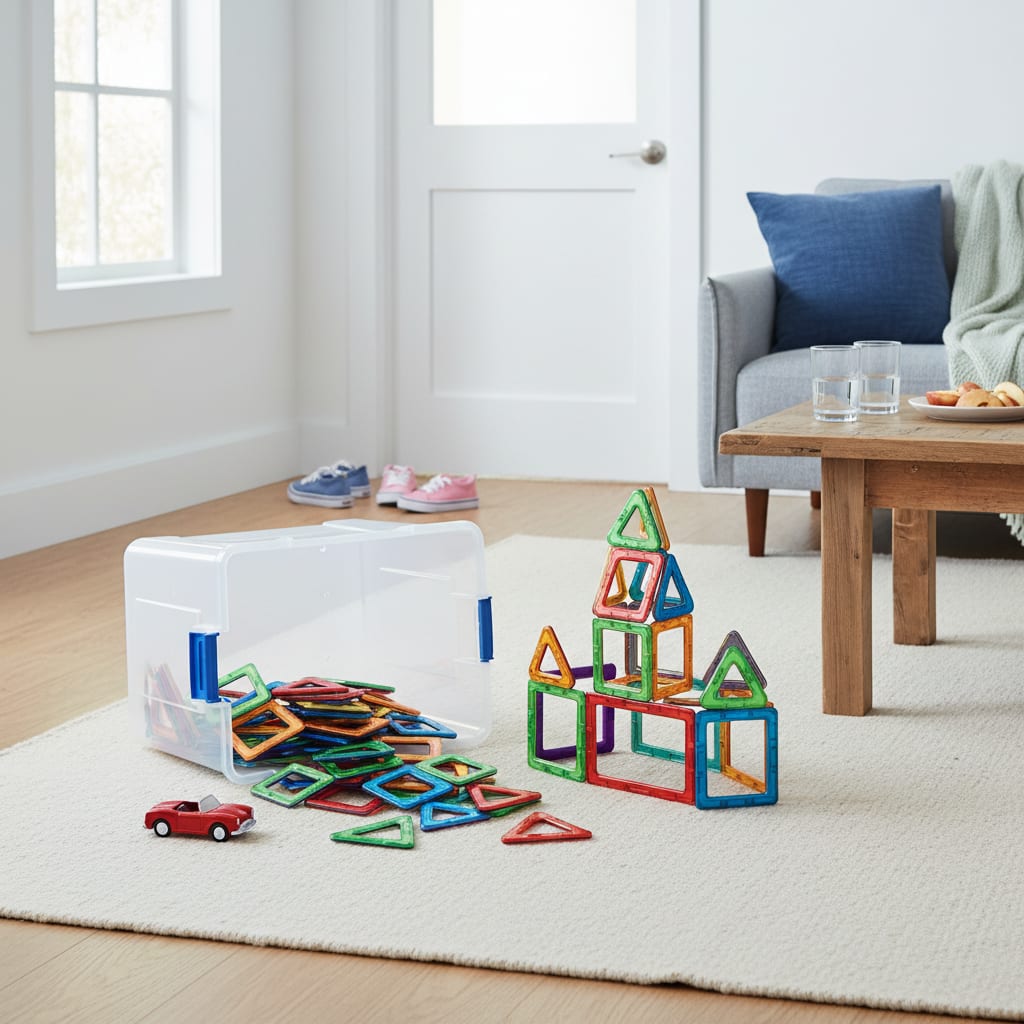
Do the opposite. Put out one bin of open-ended stuff in one room, and let the kids expand from there if they want to. Open-ended means it doesn’t have a right answer or a finish line — building sets, blocks, figures, cars, a deck of cards. A set of Magna-Tiles is the canonical version in our house because it works for a four-year-old and a ten-year-old at the same time and cleans up into one container. Anything with instructions, a winner, or 400 pieces smaller than a pea can stay in the closet.
Two more house-side calls worth making before the doorbell:
- Decide which rooms are open. Bedrooms open or closed, basement yes or no, backyard yes but not the trampoline. Deciding this at 3:40 is easy; deciding it at 4:20 while two kids stare at you is a negotiation.
- Close the doors on anything you don’t want to supervise. A closed door is a rule that enforces itself, and it beats saying “not in there” four times.
I do not do a craft. I have never once had a kid ask for one. The families who love crafting will host the craft playdate, and their kids will come to my house and build a ramp out of couch cushions, and everybody wins.
The thirty-second door script
When the guest arrives, say the rules once, in front of both kids, in about the time it takes to take off shoes:
“Hi! Okay — shoes here, backyard and the family room are open, upstairs is closed today, snack around four, and mom’s picking you up at 5:45. If you need anything I’m in the kitchen.”
That’s the entire performance. It sets the map, the food, the time, and where the adult is, and it lands with both kids at once so nobody has to relay it later. Doing it in front of your own kid matters more than you’d think — it’s the difference between rules and a private deal.
For a drop-off, get the guest parent’s cell into your phone before they pull away and text them the address thread so it exists. If your street already has a working parent roster, most of this is already in your pocket, which is exactly why the roster is worth the hour it takes to build.
Snacks: decide once, then stop deciding
Ask the allergy question at confirmation — “anything he can’t or won’t eat?” — and then pick the snack before the kids arrive so 4:15 doesn’t turn into a menu consultation with two customers. Serve it at the table, at a set time, with water. Standing-buffet snacking makes the crumb radius the size of the house.
What you actually serve is not my department — the food bloggers own it, and my sister site heymomblog has a whole shelf of after-school snack ideas if you want the list. My only rule is logistical: pick something that doesn’t need you at the stove for ten minutes, because ten minutes at the stove is exactly when the trampoline conversation happens.
The exit, on time and undramatic
The last fifteen minutes are where a good playdate goes sideways, so run them on a script too:
- T-minus 15: announce it. “Fifteen minutes, then we’re cleaning up.” Kids can’t read your clock.
- T-minus 10: cleanup starts. One bin means cleanup is genuinely two minutes, which is the whole argument for the bin.
- T-minus 5: shoes and bag by the door. Water bottles, jackets, the one sock. Do a floor sweep of the room they were in — this is where lost objects become someone’s evening.
- T-zero: hand off at the door. Two sentences to the parent, thank-you from the kids, done.
Do not add a bonus fifteen minutes. It reads as generous and it isn’t: the other family’s dinner clock is running, and the playdate that ends cleanly is the one that gets reciprocated. If the pickup parent is chronically late, build the buffer into the window you state next time — offer 3:45 to 5:15 and let the drift land where it doesn’t hurt.
Hosting when your house is not company-ready
Nobody is inspecting your house. Kids notice the dog and the snack; parents notice whether their kid came home happy and on time.
If you genuinely can’t host this season — a renovation, a shift schedule, an elderly parent in the guest room — host somewhere else. A park meetup, a library hour, or a walk-home from the bus counts as your turn. When we first moved in with half our boxes still stacked in the dining room, I ran three “playdates” at the playground down the street, and two of those families are still on our short list years later. The location was never the point; the thirty-day habit of going first was.
FAQ: hosting a playdate
How long should a playdate be when you’re hosting?
Two hours is the practical default for elementary-age kids, and ninety minutes for a first visit or a younger pair. State the start and end time in the invitation, and end on time — the playdate that ends well is the one that repeats.
Do I have to clean my house before a playdate?
No. Clear the floor of the one room the kids will use, make sure the bathroom has soap and a hand towel, and close the doors on anything you’d rather not supervise. That’s a fifteen-minute job, not a Saturday.
What do I do if the guest kid won’t follow our house rules?
State the rule once more, calmly and in front of both kids, and redirect the activity rather than the child (“we’re keeping the ball outside — let’s get the blocks out”). If something’s genuinely unsafe, the playdate ends early and politely, and you tell the parent at pickup in one plain sentence. It rarely gets that far.
Should I plan an activity, or let them figure it out?
Let them figure it out. Put out one bin of open-ended toys and stay out of the way. Structured activities are for hosts who enjoy running them; kids who chose each other’s company usually need a floor and no interruptions.