Child Scared of Thunder at Night: The Storm-Night Plan
A child scared of thunder at night is a scheduling problem wearing a weather costume. Decide the plan on a clear evening, not at 1am: one named place everyone goes, one adult who handles it, steady sound already running in the bedrooms, and a wake time that does not move the next morning. Storms are forecast hours ahead, which makes this the rare 2am event you can prepare for. The fear itself usually fades over a season or two. The lost school morning is what actually costs you.
The storm doesn’t wake one kid, it wakes the street
Here is what a 12:40am line of storms does to a house on our block. The wind arrives before the rain and rattles the gutters. The four-year-old is up first and comes down the hall. The dog is up second, standing at the top of the stairs doing his job, which is barking. That wakes the ten-year-old, who was fine and now isn’t, because the house is awake and the dog is losing his mind. By 1:15 there are four people in one room, and at 6:40 there are still four people who have to be somewhere.
So the thing you’re managing is not thunder. It’s a chain of wakings, and every link in it can be shortened in advance.
Decide it before the sky does
Storms come with warning. Tuesday afternoon’s forecast is enough to run a four-minute conversation at dinner, and that conversation is the whole intervention.
| Decision | Made in advance | Made at 12:40am |
|---|---|---|
| Where a scared kid goes | Named room, agreed, boring | Negotiated in a hallway, sets a precedent |
| Which adult gets up | On the rota, other one sleeps | Both up, both wrecked |
| The dog | Already downstairs, door shut | Barking at the top of the stairs |
| Bedroom sound | Running since lights-out | Nobody is plugging anything in now |
| Tomorrow’s wake time | Unchanged | ”Let’s just let them sleep in” |
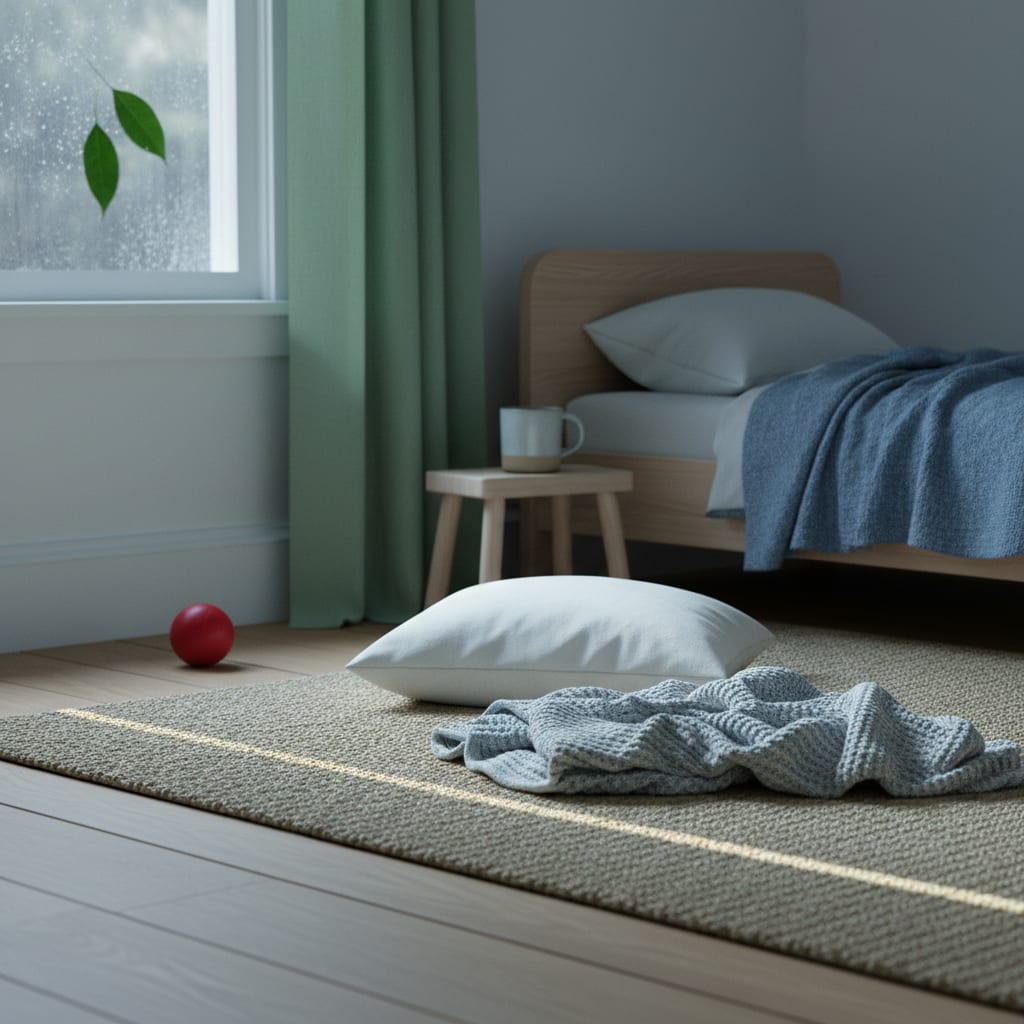
Pick the destination room deliberately. Ours is the middle bedroom — no exterior wall to the west, so it takes the least weather noise. A sleeping bag on a sibling’s floor beats your bed, for a reason that has nothing to do with tenderness: your bed is the most comfortable place in the house and children are excellent economists. Give the storm plan a floor and a blanket and it stays a storm plan.
And put one adult on the storm shift the way you would a night feed. Two woken adults isn’t twice the coverage — it’s two people running the school run on four hours.
Give them the actual rules, because rules beat reassurance
“It can’t hurt you” isn’t true and kids know it, which is why it doesn’t land. What lands is a job with real content. The National Weather Service’s lightning safety guidance is short enough for a seven-year-old to own: if you can hear thunder, lightning is close enough to strike you, so you stay inside; and you stay in safe shelter for at least 30 minutes after the last rumble.
Its indoor list is the part that turns fear into procedure: stay off corded phones and anything plugged into the wall; stay away from plumbing, so no bath and no washing up mid-storm; stay back from windows and doors, and off the porch.
That last one is genuinely useful at 1am, because it answers the question the kid is actually asking. Are we doing the right thing? Yes — we are inside, away from the window, waiting out the thirty minutes. Being correct is more soothing than being cheerful, and a child who can recite the rule has something to do with their hands. It also answers the two questions that always follow: the wiring is built for this, and the flashlight is in the kitchen drawer, where we already knew it was.
Mask the wind, not the thunder
You cannot cover a thunderclap, and a machine loud enough to try is loud enough to be its own problem. What you can cover is everything else the storm does: the gutter drip that runs for two hours, the wind against the siding, the rain on the skylight, the neighbour’s gate.
That’s the case for steady sound in the kids’ rooms as a standing default rather than a storm-night scramble. A mechanical fan-style machine like the Yogasleep Dohm makes a genuinely constant sound instead of a short loop, and it’s already running when the first gust hits — nobody is setting up equipment at 12:40. Betteroo’s rundown of how steady sound actually works in a bedroom covers placement and volume; the short version is across the room from the pillow, not beside it, and quiet enough that you’d still hear a child call from the doorway.
The dog is the other amplifier, and the fix is spatial. Ours goes downstairs with the door shut before a forecast storm rather than after the first bark, which is the same principle as the rest of his bedtime routine — decide his position while everyone is calm.
Hold the morning
This is the part that decides whether one storm costs you one night or two weeks.
The temptation at 6:40, with everyone flattened, is to let them sleep in. Don’t. Move the wake time and you’ve moved bedtime the next night, which lands the sequence a school night depends on forty minutes late on a Wednesday. Hold the alarm and lower the standard for everything else: cereal, clothes that need no decision, five minutes earlier out the door because everyone is slow.
Then move the next bedtime earlier by twenty minutes and say nothing about it. That’s the recovery — not a lie-in, an early night. Same repair as any one-off late night, and it works because the wake time is the anchor holding the whole morning run in place.
If the youngest ends up in your room every storm and then most other nights too, the pattern has stopped being about weather. Rebuilding the habit of staying in their own bed is a separate project from storm nights, and worth running on a clear week.
The neighbourly bit nobody warns you about
A storm is the one night event happening to everyone on the street at once, which produces its own logistics.
The group chat goes off at 1am with outage reports and a photo of somebody’s trampoline in somebody else’s yard. Mute it overnight and read it at six — the district’s closure decision comes through its own channels, so check the source at 6am rather than the chat’s speculation at 2am.
Two things worth twenty minutes before the season: know which neighbours have a generator and which have a basement, and put the gutters and the overhanging limbs on your fall list. The branch that comes down at 1am is nearly always the one you noticed in August.
FAQ
Is being scared of thunder normal at seven? Yes, and it’s common well past it. Storm fear tends to arrive in the preschool years and fade over a season or two as kids build a working model of what’s happening. Worth a word with your pediatrician: fear that’s spreading — refusing to sleep alone on clear nights, checking forecasts anxiously, or panic that doesn’t settle once the storm passes.
Should I wake my child before a forecast storm to warn them? No. A child who sleeps through it has had a good night; a child woken to be told a scary thing is coming has been given the fear for free. Mention it at dinner, then let bedtime be bedtime.
Do they have to go back to their own bed the same night? Not on the night itself — that’s a fight at 1am you don’t need. But the destination should be the agreed room and the agreed floor, not your mattress, and the next night runs normally. The plan holds because it’s the same every storm, not because it’s strict.
The power went out and the alarms are flashing. Does the morning still hold? Yes — set a phone alarm as backup and reset the clocks over breakfast, not at 2am. The one thing that has to survive a storm night intact is the wake time.
Storm nights are easier when the ordinary bedtime is already solid. If yours is being rebuilt for the third time this month, Betteroo’s free sleep quiz is a fast way to see what’s actually driving the wake-ups underneath the weather.