After-School Routine Chart (Free Printable)
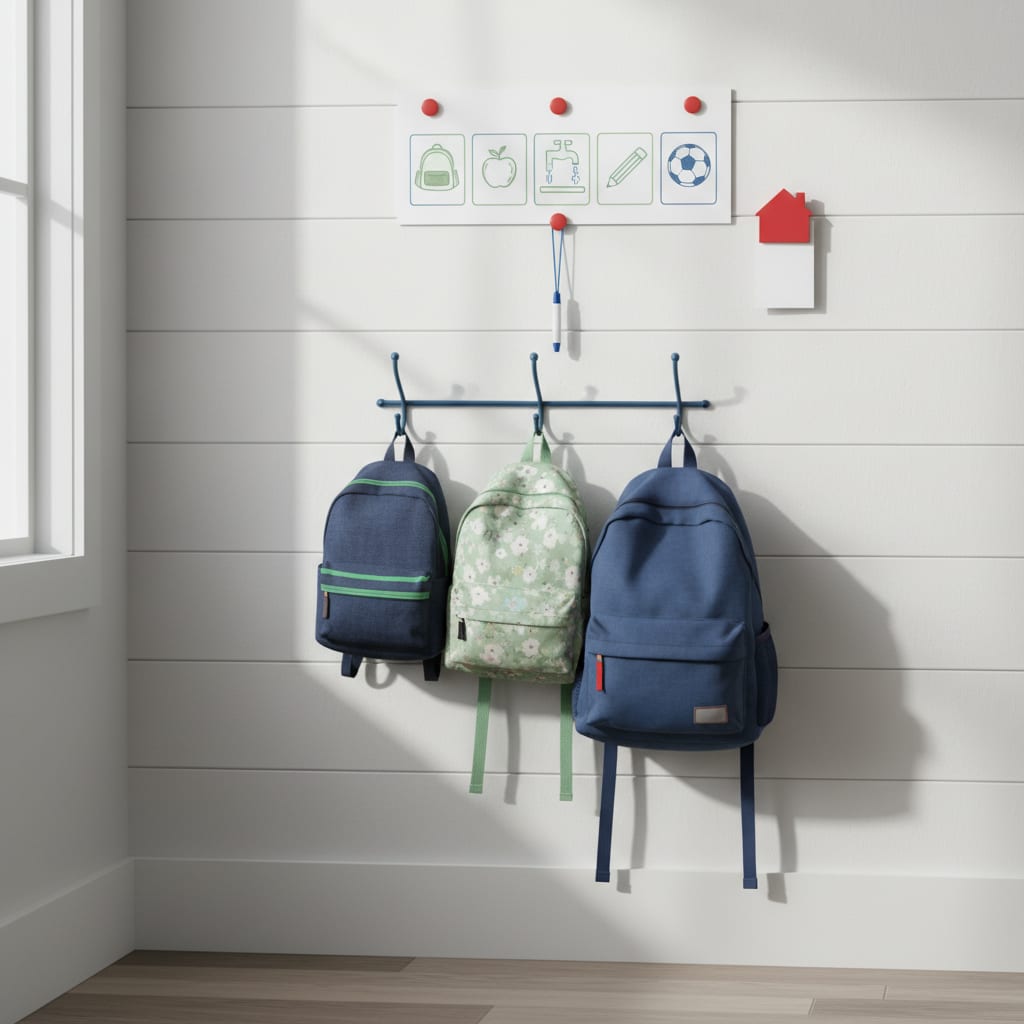
An after-school routine chart is a five-step sequence — unpack, refuel, reset, work, free — posted where your kid actually lands, at your kid’s eye level, in a format your kid can actually read: pictures for the pre-reader, a checklist for the big kids. Print it, hang it by the backpack hooks, and point at it instead of narrating. That last part is the entire product. The chart doesn’t add a single new rule to your afternoon; it just moves the rules off your voice and onto the wall, which is where rules go to stop being arguments.
Why the chart works when the reminders don’t
Eight years in a school front office taught me one durable truth about children between 3:00 and 4:00pm: they have heard enough adult sentences for one day. A kid who has been receiving instructions since the first bell does not have receptors left for “hang up your backpack, where’s your folder, wash your hands” delivered verbally at the door — that’s just weather to them. A chart works because it’s not you. It hangs there, silent and consistent, saying the same five things in the same order every single day, and when someone stalls out mid-landing, “check your chart” is one sentence instead of five. The full theory of the landing lives in the after-school routine pillar; the chart is that routine, laminated.
The five steps (in this order, on purpose)
| Step | What it says | What it means |
|---|---|---|
| 1. Unpack | Backpack on hook, folder in tray, lunchbox to counter | The backpack station gets fed now, not at 7:38am |
| 2. Refuel | Snack at the table | Fixed time, fixed place; the food itself is not the chart’s business |
| 3. Reset | Shoes away, hands washed, outside clothes if it’s a sports night | The two-minute pivot from school-kid to home-kid |
| 4. Work | Homework or reading block | Starts at a clock time, not “later” — later is a myth |
| 5. Free | Genuinely free | The payoff step; it’s on the chart so kids trust it’s coming |
Order matters more than timing. Unpack comes first because a backpack that makes it past the door unopened will next be seen at bedtime, containing a permission slip due yesterday. Free comes last and on the chart because kids follow a sequence far better when the sequence visibly ends somewhere good.
Picture chart vs. checklist: match the reader
Ages 4–6 — the picture strip. Five icons in a row, left to right: backpack on hook, apple, faucet, pencil, ball. No words worth reading, nothing to check off — littles do better with “point at where you are” than with pencil-work. My 4-year-old can’t read “refuel,” but he can read a picture of an apple like it’s breaking news.
Ages 7–9 — the picture checklist. Same five steps, small icons plus words, with a checkbox column. This is the sweet-spot age: they can read it, and checking boxes is still fun instead of insulting. Laminate it and hand over a dry-erase marker like an Expo low-odor; wiping yesterday’s checks is somehow the best part.
Ages 10+ — the plain checklist. Words only, smaller, mounted without ceremony. My 10-year-old would rather be seen with a diaper bag than a cartoon apple chart, but a discreet list by the hooks still catches her — the trick at this age is that the chart reads as a system, like the one on the morning routine chart she’s already ignoring successfully at 6:55am and following anyway.
Where to hang it (this decides everything)
The chart lives where the landing happens — for us, on the wall directly above the backpack hooks, at kid eye level, which is a foot lower than where you want to hang it. A chart in the kitchen is decor. A chart at the point of entry is signage. If your kids come in through two different doors, print two; paper is cheap and consistency isn’t.
Making it stick: the two-week protocol
Week one, you walk it with them: land together, point at step one, do step one. You’re not enforcing, you’re training — same energy as a new fire-drill route. Week two, you retreat to pointing from a distance. By week three the chart is either furniture or it’s working, and the difference is almost always whether the adults kept freelancing. If you verbally re-issue the steps every day, the chart never gets hired; the kids will always take instructions from the louder source. Let the wall be the boss. Evenings have their own version of this handoff — the school-night routine runs on the same principle of sequence-over-nagging, all the way to lights-out.
FAQ: after-school routine charts
What should be on an after-school routine chart?
Five steps, in order: unpack (backpack, folder, lunchbox), snack, reset (shoes, hands), homework or reading, then free time. Keep it to one row of steps — a chart with ten items is a poster, and nobody follows a poster.
What age do routine charts work for?
Roughly 4 through 12, if the format matches the kid: picture-only strips for pre-readers, icon-plus-word checklists for early readers, plain lists for big kids. The failure mode isn’t age — it’s handing a 10-year-old a chart with a cartoon apple on it.
Should free time come before or after homework?
After, with rare scheduled exceptions for late-practice nights. “Snack, then work, then free” survives contact with real children because the good part is visibly at the end of the sequence; “free first, work later” quietly deletes the work step by 5:30pm.
How do I get my kids to actually use the chart?
Walk the steps with them for the first week or two, then switch to pointing at the chart instead of repeating the steps out loud. The chart only takes over if you stop competing with it — a rule that lives on the wall and in your mouth simultaneously is just nagging with a prop.