Kids' Bedtime in Summer: When the Sun's Up at 8pm
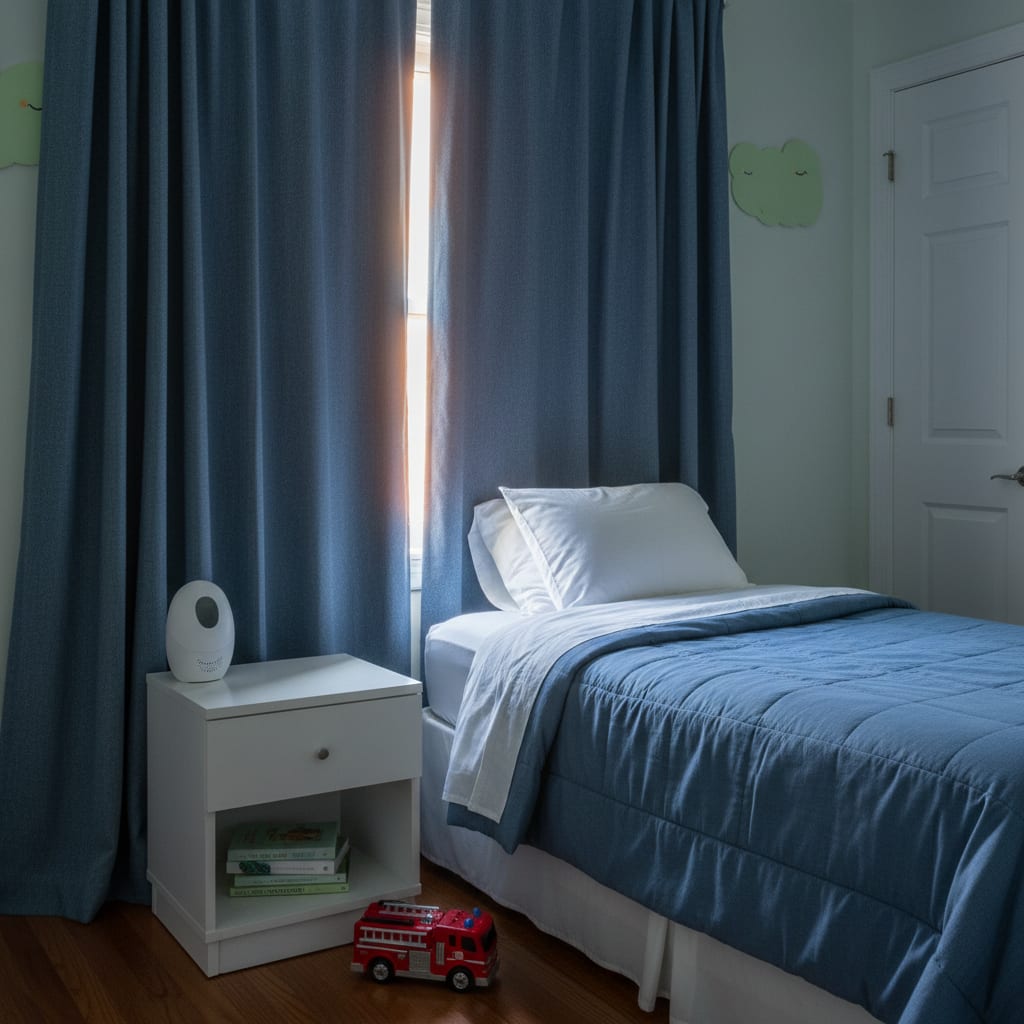
Holding a kids’ bedtime in summer comes down to three moves: make the bedroom dark enough to be believable (real blackout coverage, not the decorative kind), quiet enough to beat the cul-de-sac (a fan or white noise, windows shut for the first hour), and keep the sequence of bedtime identical to the school year even if the clock shifts 30–45 minutes later. Kids don’t take bedtime’s word for it in July — the sun says one thing, you say another, and the sun has seniority. So you stop arguing and change the evidence.
The July problem, stated honestly
At 8:00pm in July, my kids’ bedroom windows report the following: full golden daylight, the thwock of a driveway basketball game two houses down, at least one scooter, and the unmistakable sound of other children — awake, outside, audibly thriving. Against that, I am offering a toothbrush. This is not a fair fight, and treating it as a discipline problem misreads it. A 7-year-old who says “but it’s not even dark” is not defying you; she’s citing evidence. The school-year bedtime works because the whole environment co-signs it — dark sky, quiet street, tired kid. Summer bedtime fails because the environment flipped sides. The fix is environmental, not rhetorical.
Blackout logistics: the load-bearing purchase
Curtains labeled “room-darkening” dim a room the way a screen door slows a toddler. What works is true blackout material plus attention to the perimeter — the glow leaks around the edges, and kids’ eyes go straight to the leak. The workable options, in escalating order of commitment: blackout curtains like NICETOWN’s hung wide and high so they overlap the frame on all sides; a cheap blackout liner clipped behind the curtains you already like; or the renter-grade move, a portable blackout shade like the Amazon Basics suction-cup shade or even blackout film for the summer months only. Do the bedtime test: lie on the kid’s bed at 8pm and look where they look. If you can find the sunset, so can they. We run full blackout in the 4-year-old’s room and a lighter version for the big kids, who mostly need the room dim enough that reading-in-bed feels like evening instead of recess.
The sound problem nobody warns you about
Darkness gets all the press, but on our street the real bedtime saboteur is audio. You can blackout a window; you cannot blackout the sound of the neighbor kids playing manhunt. The layered fix: windows closed for the first hour of sleep (the AC argument settles this one anyway), plus a fan or a white noise machine like the Yogasleep Dohm running from the start of the wind-down, not switched on after the fact — the noise floor has to be established before the interesting sounds start, or it reads as a cover-up. And a scheduling note that took me two summers to learn: if your own big kids are the ones out front at 7:45, the little one’s bedtime is unwinnable. Our house rule is that driveway play moves to the backyard once the youngest starts his wind-down. The big kids grumbled for a week; the alternative was a 4-year-old at the window like a tiny disappointed lighthouse keeper.
Shift the clock once, then hold the sequence
We move summer bedtimes 30–45 minutes later than the school year — deliberately, in one decision, the way the summer schedule sets all five anchors — and then the line holds all season. What must not shift is the sequence: same order of bath, teeth, books, lights as the school-night routine, because the sequence is the actual sleep cue. By July, “bath started” tells my kids’ bodies it’s night far more convincingly than the sky does. Exceptions exist — the block party, fireworks, the cousins visiting — and they work because they’re exceptions with a next-morning cost everyone has met before. Exception-creep, not the sun, is what actually breaks summer bedtime: every “it’s summer, who cares” is a small loan against August, and the back-to-school reset collects with interest.
The younger-sibling angle: the 8pm pile-up
Here’s the summer-specific collision: daylight pushes the big kids’ bedtime later while the youngest — especially a 3-to-5-year-old still napping — needs his earlier slot defended, and suddenly 8pm is rush hour: one kid winding down, two kids negotiating, one adult. Worse, summer scrambles the nap math itself; a quiet hour that runs long at 1:30 becomes a bedtime standoff at 8:00, and I do not have the training to price that trade-off daily. That’s the one piece of this we outsource: the 4-year-old runs on his Betteroo plan — the personalized sleep program that’s followed him since babyhood — which sets his day-by-day quiet-hour and bedtime call and adjusts as summer shifts his rhythm. Fair warning that it’s built for the baby-and-toddler years, so a school-age kid is past its range and our guy is at the far edge of it; but for exactly this problem — a youngest kid whose nap and bedtime are a moving equation the whole evening depends on — it’s the difference between guessing and having a plan. The big kids just get the later slot, staggered lights, and reading-in-bed as the closing act.
 Summer scrambles the youngest kid's sleep math
If your littlest is still napping, Betteroo builds a day-by-day plan — today's nap call, tonight's bedtime — that adjusts as the season shifts, so 8pm stops being a standoff.
Take the 2-minute sleep quiz →
Summer scrambles the youngest kid's sleep math
If your littlest is still napping, Betteroo builds a day-by-day plan — today's nap call, tonight's bedtime — that adjusts as the season shifts, so 8pm stops being a standoff.
Take the 2-minute sleep quiz →
FAQ: summer bedtime
How do I get my kids to sleep when it’s still light outside?
Change the evidence instead of arguing: true blackout coverage with the edge-gaps handled, white noise established before the wind-down starts, and the identical bedtime sequence you run all school year. Kids sleep on cues, and in summer the environment has to supply the cues the sky won’t.
Should kids’ bedtime be later in summer?
A deliberate 30–45 minutes later is reasonable for school-age kids and makes the daylight fight winnable. The key is shifting once and holding the new line all season — drift by nightly exceptions is what turns August’s reset into a demolition project.
Do blackout curtains actually help kids sleep in summer?
Genuine blackout material helps a lot; “room-darkening” mostly doesn’t. Coverage matters as much as fabric — hang wide and high so nothing glows around the edges, and check the room from the kid’s pillow at 8pm. Perimeter leaks are what kids fixate on.
What about noise from other kids playing outside?
Close the windows for the first hour, run a fan or white noise from the start of wind-down so the baseline is set before the interesting sounds start, and move your own kids’ evening play away from the youngest’s window. Audio, not light, is often the real saboteur on a loud street.