Road-Trip Nights: Motel Bedtimes and Time-Zone Math
The part of a road trip that wrecks families isn’t the driving — it’s the nights. Three decisions settle almost all of it: pick a departure strategy and hold it (pre-dawn, normal day drive, or overnight haul — not equally good), set a hard arrival time at least ninety minutes before the youngest kid’s bedtime, and decide whether you’re keeping home-clock times or walking the clock before you cross the first time-zone line. Packing is a solved problem. The schedule is what gets improvised in a parking lot at 10:40pm with a four-year-old crying in the third row.
Three departure strategies, and what each one actually costs
| Strategy | Leave | What it buys | What it costs |
|---|---|---|---|
| Pre-dawn start | 4:30–5:30am | Kids sleep the first two hours; you arrive mid-afternoon | One short night for the adults |
| Normal day drive | 8:00–9:00am | Rested driver, predictable stops | Arrival lands 5–8pm, on top of dinner and bedtime |
| Overnight haul | 8:00–10:00pm | Empty roads, kids “sleep the miles” | An exhausted driver and a bedtime you can’t rebuild for three nights |
The pre-dawn start wins more often than anything else. You carry sleeping kids to the car in pajamas, they’re out until sunrise, and by the time anyone asks how much longer you’ve banked two hours of silence and an afternoon at the far end. The adults lose an hour of sleep; one normal night fixes that.
The case against driving through the night
The appeal is obvious: empty roads, no “are we there yet,” kids asleep in their seats. The problem is trading a known cost (a long day of driving) for an unknown one — how alert you’ll be at 3am on hour seven — and drowsy driving is a hazard highway-safety agencies treat as seriously as impairment. Nobody self-assesses alertness reliably at 3am, which is exactly the failure mode.
If you drive overnight anyway — beating desert heat, one long empty stretch — set the rules first: two licensed drivers swapping on a timer, every two hours at a lit exit, tired or not; a hard abort rule that stops at the next motel if the second driver fades; real stops, out of the car and walking; and no stacking it on a work day. Then plan the recovery day, because the day after is a nap day whether you scheduled one or not.
And kids who “sleep the miles” mostly sleep them badly — light, interrupted at every gas stop, finished at 5:40am in a parking lot.
The motel night, run like a school night
The most useful rule I’ve found: be parked at least ninety minutes before the youngest kid’s bedtime, and treat that as the real constraint on the day’s driving. Not distance. Not “we can make one more hour.”
Then run the room in a fixed order, because the order is what keeps it short:
- One adult takes the room, one takes the kids. Room adult carries in the overnight bag only; kid adult walks laps of the parking lot with everyone for ten minutes. That walk discharges six hours of sitting still, and skipping it costs forty minutes at lights-out.
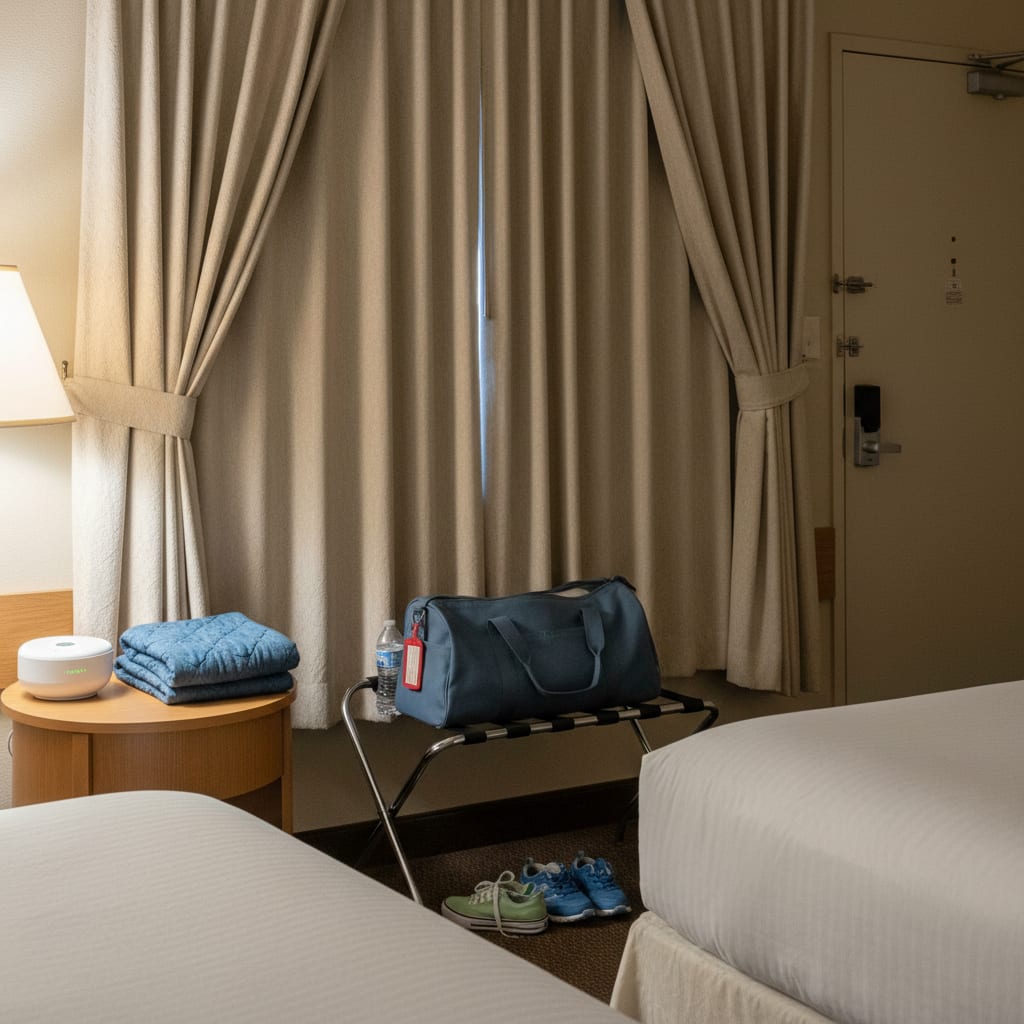
- Set up before anyone gets excited. Curtains closed and clipped, AC cool, extra bedding off the floor, sleep spots assigned out loud so there’s no bed negotiation at 9:15.
- Deal with light. Motel curtains leak, and there’s usually a parking-lot lamp aimed at the window plus a row of glowing electronics. Clip the curtain gap shut with pants hangers, towel over the TV standby light, and if you travel with a small kid more than once a year a portable blackout shade with suction cups earns its space in the trunk.
- Deal with sound. A motel is a corridor of doors, ice machines and strangers with a 5am flight. A travel sound machine like the Yogasleep Rohm runs a full night on a charge and raises the floor so the hallway stops registering as events.
- Run your home routine, compressed. Same order, same words, half the length: teeth, pajamas, two books, lights.
If your kids are old enough, give each one a job at the door — the room gets set up while nobody has time to start bouncing on a bed.
Time-zone math, in plain numbers
The decision is binary — hold home-clock times, or walk the clock — and you pick by how long you’re staying.
Two or three nights. Don’t shift anything. Keep meals and bedtimes on home-clock time and do the arithmetic: a 7:30pm bedtime at home is 5:30pm local if you drove two zones west. Yes, that’s bedtime in daylight, and yes, it beats dragging a four-year-old back onto home time on the way home. Black out the room and let it be weird for two nights.
Four nights or more. Walk the clock, roughly thirty to sixty minutes a day, in the direction you travelled, starting on arrival. Westbound is the kind one — everything shifts later and kids happily stay up. Eastbound means an earlier bedtime than a body wants, so start two or three days before you leave rather than on the road, and let morning light do the pulling.
Same mechanism as the twice-yearly clock change, in fact: Betteroo’s guide to handling the clock change with a small child has the increment math and light timing worked out for the age where it matters most.
For big kids it’s simpler: bedtime can flex a full hour on vacation, the way it flexes when it’s still bright at 8pm in July. The youngest one sets the constraint.
The youngest kid sets the driving day
The nap and the bedtime are the two fixed points; the driving happens between them, not through them. Leave early enough that the nap happens in the car on purpose rather than at 4:50pm by accident, stop for real movement before the second half, and don’t let “we’re so close” push past the point where a tired preschooler tips over. An overtired kid at a check-in desk does not fall asleep faster — the wired-and-wrecked pattern runs the other way, and you’ll pay for forty extra miles with ninety minutes of lights-out.

The drive home, and the night after it
Coming home needs a buffer day. Arriving Sunday at 9pm and starting school Monday at 7:13 is how a good trip becomes a bad week. Be home by mid-afternoon on the last travel day, put everyone to bed on home-clock time even if it’s early, and let the first morning back be slow. If the clock drifted, don’t fix it in one night — run a short version of the two-week walk-back, fifteen minutes a night, and it settles by the weekend; the summer schedule can absorb the rest.
Two things that aren’t my lane: what to pack belongs to thetravelmommy’s road-trip-with-kids guide, and what the car holds the rest of the year is the minivan setup.
FAQ: road trips, motel nights and time zones
Is it better to drive at night with kids or leave early in the morning?
Pre-dawn is usually the better trade: the same two hours of sleeping kids, without a driver who’s been awake twenty hours. Reserve overnight driving for genuine reasons, with two drivers swapping on a timer and a hard rule about stopping.
What time should we stop driving each day?
At least ninety minutes before the youngest child’s normal bedtime. That buffer covers check-in, a parking-lot walk, room setup and a compressed bedtime routine — the difference between a normal night and a two-hour one.
Should kids stay on home time in a different time zone?
For two or three nights, keep home-clock times and black out the room; it’s less work than shifting twice. For longer stays, move bedtime roughly thirty to sixty minutes a day in the direction you travelled, and for eastbound trips start a couple of days before you leave.
How do you get a toddler to sleep in a motel room?
Control light and sound first — curtains clipped shut, electronics covered, a steady sound source running — then run your exact home routine in half the time, same order, same words. Assign sleep spots out loud before anyone’s in pajamas, and arrive early enough that none of it happens past their normal bedtime.